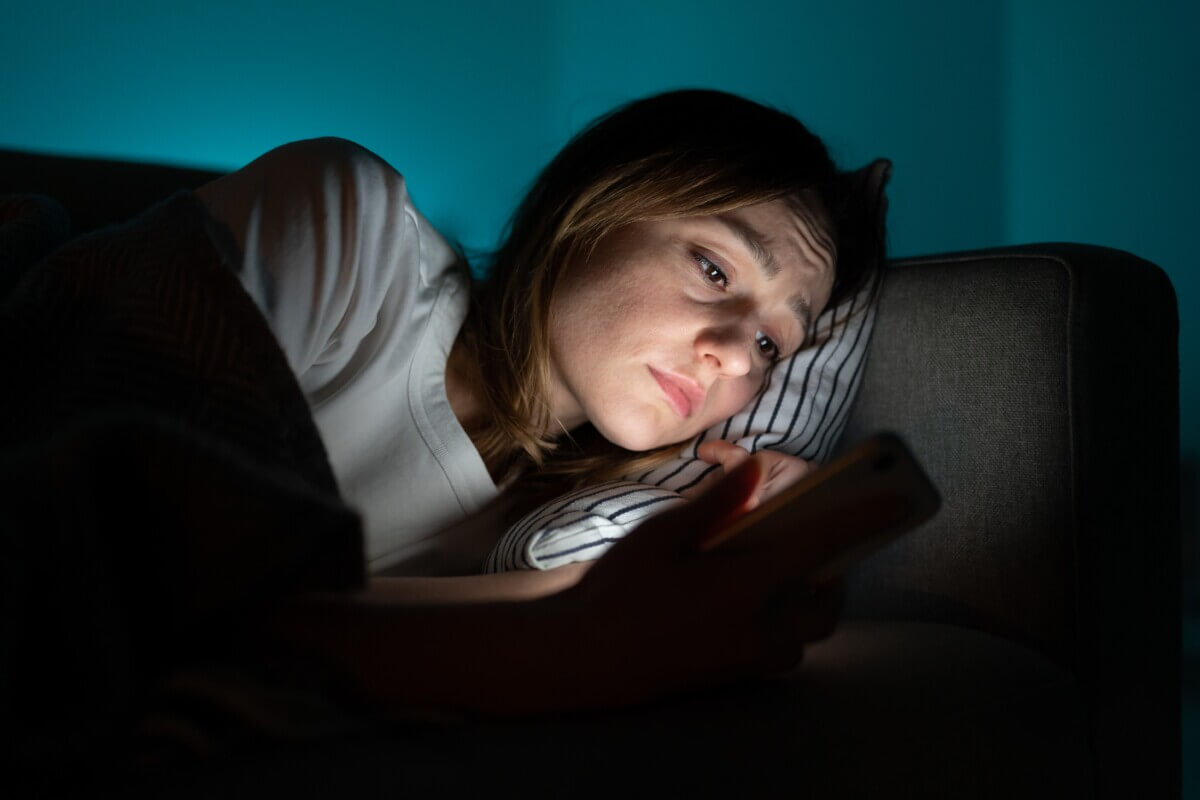
(Photo by DimaBerlin on Shutterstock)
In A Nutshell
- People who post on X between 11 p.m. and 5 a.m. report lower well-being than daytime users.
- Nighttime posting explained about 1.9% of wellbeing differences—similar to lifestyle effects like sleep or exercise.
- Links to depression and anxiety were small, explaining less than 1% of variation.
- Older adults showed a stronger connection between late-night tweeting and anxiety scores.
BRISTOL, England — People who post on X (formerly Twitter) late at night tend to feel worse about their lives overall, but a new study suggests the link to clinical depression might not be as strong as researchers expected.
A study of 310 adults in the UK found something interesting: X users who regularly posted between 11 p.m. and 5 a.m. reported notably lower well-being compared to people who posted during the day. When researchers analyzed more than 18,000 tweets alongside mental health questionnaires, they found the well-being difference was about as big as the impact from binge drinking or skipping regular exercise.
Surprisingly, nighttime posting didn’t show much connection to depression or anxiety symptoms. The timing of when people tweeted explained less than 1% of their scores on standard depression and anxiety assessments.
“The average hour participants posted tweets explained almost 2% of the variation in mental wellbeing, comparable to reports of the impact of binge drinking and exercise,” the researchers wrote in their paper published in Scientific Reports.
Tracking X Habits Around the Clock
Researchers from the Avon Longitudinal Study of Parents and Children tracked when participants posted on then-Twitter during two-week periods between April 2020 and May 2022. Instead of just labeling people as “daytime” or “nighttime” users, they calculated a precise average posting time for each person using a mathematical approach that treats the 24-hour day like a clock face.
This matters because someone who tweets mostly around 9:30 p.m. is different from someone posting at 2 a.m., even though both might get lumped into “nighttime” in simpler studies.
During those same two weeks, participants filled out questionnaires about their mental health, answering questions about depressive symptoms, anxiety, and overall well-being. The study included adults from their late 20s to late 50s.

How Much Does Late-Night Tweeting Matter?
People who tended to tweet overnight scored about four to eight points lower on a standard well-being scale compared to daytime tweeters. That might not sound like much, but researchers say differences of three points or more actually matter in terms of how people feel day to day.
Peak well-being showed up around 6:50 p.m., while the lowest scores belonged to people tweeting around 2:20 a.m.
Why might this happen? Daniel Joinson, the lead researcher at the University of Bristol, points to sleep disruption. Using X actively at night could keep people awake longer or make their sleep less restful. Since good sleep helps mental health, this could explain why night owls felt worse overall.
To understand how meaningful this is, consider other lifestyle factors researchers have studied. One large American study found that binge drinking explained about 2% of how well teenagers and young adults felt about their lives. Smoking marijuana explained about 1.8%. Other studies have found similar numbers for things like how much people exercise, how many hours they sleep, or whether they smoke cigarettes.
The 2% from nighttime posting sits right in that range alongside these other recognized health factors.
The Depression and Anxiety Puzzle
When researchers looked specifically at depression and anxiety symptoms, the picture changed completely. The timing of tweets explained only 0.2% of depression scores and 0.7% of anxiety scores. Those numbers are so small they barely register.
People who tweeted overnight did score slightly higher on anxiety assessments, about one or two points more than daytime users. But research shows you need at least a four-point difference for it to really matter clinically. For depression, posting time barely budged the scores at all.
This contradicts several earlier studies that found stronger links between late-night social media use and depression. But those studies had a key weakness: they asked people to estimate their own social media use. Research shows people are pretty bad at this. Many overestimate by nearly an hour to more than four hours per day.
The Bristol team used actual Twitter data instead of relying on memory, which gives a much more accurate picture.
They also measured depression and anxiety on a sliding scale rather than just asking “depressed or not depressed?” Mental health doesn’t work in simple yes-or-no categories. It exists on a spectrum, and measuring it that way captures details that get lost when you force people into boxes.
Age Makes a Difference
When researchers split people up by age, something interesting emerged. Among older adults (average age 56), posting time explained 1.3% of anxiety scores. That’s more than double the 0.6% seen in younger adults (average age 27). That’s also higher than the 0.7% researchers found when they looked at everyone together.
For depression, women showed slightly stronger patterns, though the difference was modest.
These findings matter for figuring out who might benefit most from changing their nighttime social media habits. If you’re designing an intervention to help people tweet less at night, it might help older adults more with anxiety.
The study included 189 younger participants and 113 older ones. Most were white, and women outnumbered men, especially in the younger group.
What This Means for Social Media Rules
This research lands in the middle of heated debates about regulating social media, especially late at night. TikTok recently rolled out “Wind Down,” which switches users under 18 from their regular feed to calming content after 10 p.m. China wants to ban social media between 10 p.m. and 6 a.m. for minors entirely. UK officials are watching these moves closely.
The Bristol findings suggest these kinds of restrictions might help with general well-being more than with clinical depression or anxiety specifically. But there’s a catch: the study can’t prove late-night tweeting causes lower well-being. It could work the other way around. Maybe people who already feel bad about life tend to use social media late at night because they can’t sleep or feel restless.
Besides outright curfews, platforms could offer tools that let people block themselves during certain hours or give alerts about the risks of late-night scrolling. These gentler nudges might work better than blanket bans while still giving people control.
One important caveat: all this data came from the COVID-19 pandemic, when everything about mental health and social media use looked different than normal. People reported using phones before bed more often during lockdowns. Whether these patterns stuck around after the pandemic ended remains unknown.
Also, this study only tracked active posting, not passive scrolling. Reading tweets probably affects mental health differently than writing them, and it happens way more often. The researchers also measured posting times in one-hour chunks for privacy reasons, so someone tweeting at 9:08 p.m. got recorded as 9:00 p.m.
Even though the depression and anxiety connections were weak, the researchers say the wellbeing findings alone deserve attention. Wellbeing captures the positive side of mental health that often gets ignored when studies focus only on what’s wrong. Someone can have low depression and anxiety but still lack energy, optimism, or satisfaction with life.
This study shows that lumping all mental health together misses important details. Late-night X use connects to overall life satisfaction, even if it doesn’t tie strongly to clinical symptoms of depression or anxiety disorders.
Paper Summary
Methodology
Researchers analyzed data from 310 adult participants in the Avon Longitudinal Study of Parents and Children who provided access to their Twitter accounts and completed mental health questionnaires between April 2020 and May 2022. The team collected 18,288 tweets posted during two-week periods before participants completed questionnaires. Using circular statistics, researchers calculated the average hour each participant posted tweets, treating time as a circular variable, like positions on a clock, rather than grouping hours into broad “daytime” and “nighttime” categories. Participants self-reported their mental health using three validated scales: the Short Mood and Feelings Questionnaire for depressive symptoms, the Generalized Anxiety Disorder 7 scale for anxiety symptoms, and the Warwick Edinburgh Mental Wellbeing Scale for overall wellbeing. Mixed-effect statistical models accounted for the fact that some participants provided data from multiple questionnaires and controlled for participant age and sex.
Results
Average posting time showed a statistically significant association with all three mental health measures. For mental wellbeing, average posting time explained 1.9% of the variation in scores after accounting for age and sex. Participants who typically tweeted between 11 p.m. and 5 a.m. scored approximately four to eight points lower on wellbeing compared to those who posted during daytime hours, a difference researchers deemed clinically meaningful. For depressive symptoms, average posting time explained just 0.2% of variation, while for anxiety symptoms it explained 0.7%. Predicted depression scores showed minimal variation across different posting times. Anxiety scores were predicted to be one to two points higher for overnight tweeters compared to daytime users, below the threshold considered clinically meaningful. When researchers split participants by age group, older adults showed stronger relationships between posting time and anxiety symptoms. When split by sex, female participants showed slightly stronger relationships with depressive symptoms.
Limitations
The study’s sample was not representative of the broader population or even all ALSPAC participants with Twitter accounts. Nearly all participants were white, the sample skewed female, and consisted entirely of adults despite adolescents being a key demographic for social media research. All data were collected during the COVID-19 pandemic, when mental health and social media patterns likely differed from typical times. The research measured only active posting behavior through tweets, not passive scrolling, reading, or other Twitter activities. Time measurements were grouped into one-hour windows for privacy protection, slightly reducing precision. The study design cannot determine whether nighttime tweeting causes lower wellbeing or whether people with lower wellbeing are more likely to tweet at night. Researchers did not incorporate sleep quality or quantity measures, which could be an important mechanism linking nighttime social media use to mental health. Some participants in the sample belonged to the same families, potentially introducing non-independence in the data.
Funding and Disclosures
Daniel Joinson was funded by the EPSRC, grant number EP/S023704/1. Oliver Davis and Claire Haworth were funded by the Alan Turing Institute under the EPSRC grant EP/N510129/1. Claire Haworth and Nina Di Cara were supported by a Phillip Leverhulme Prize. Claire Haworth and Oliver Davis were funded by CLOSER, which was supported by the Economic and Social Research Council and the Medical Research Council. The UK Medical Research Council and Wellcome, Grant 217065/Z/19/Z, and the University of Bristol provide core support for ALSPAC. The authors declared no competing interests.
Publication Details
Joinson, D., Haworth, C.M.A., Simpson, E., Cristianini, N., Di Cara, N.H., & Davis, O.S.P. (2025). “Active night-time tweeting is associated with meaningfully lower mental wellbeing in a UK birth cohort study,” Scientific Reports, 15, 34301. DOI: 10.1038/s41598-025-14745-y


