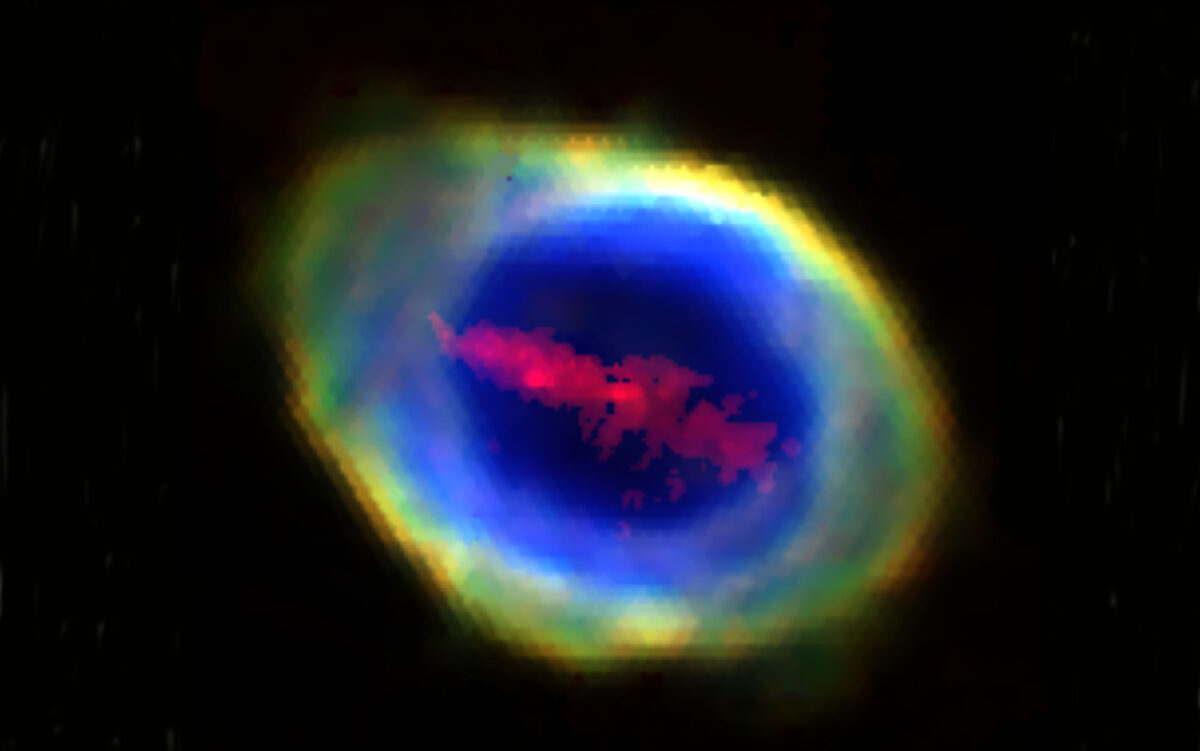
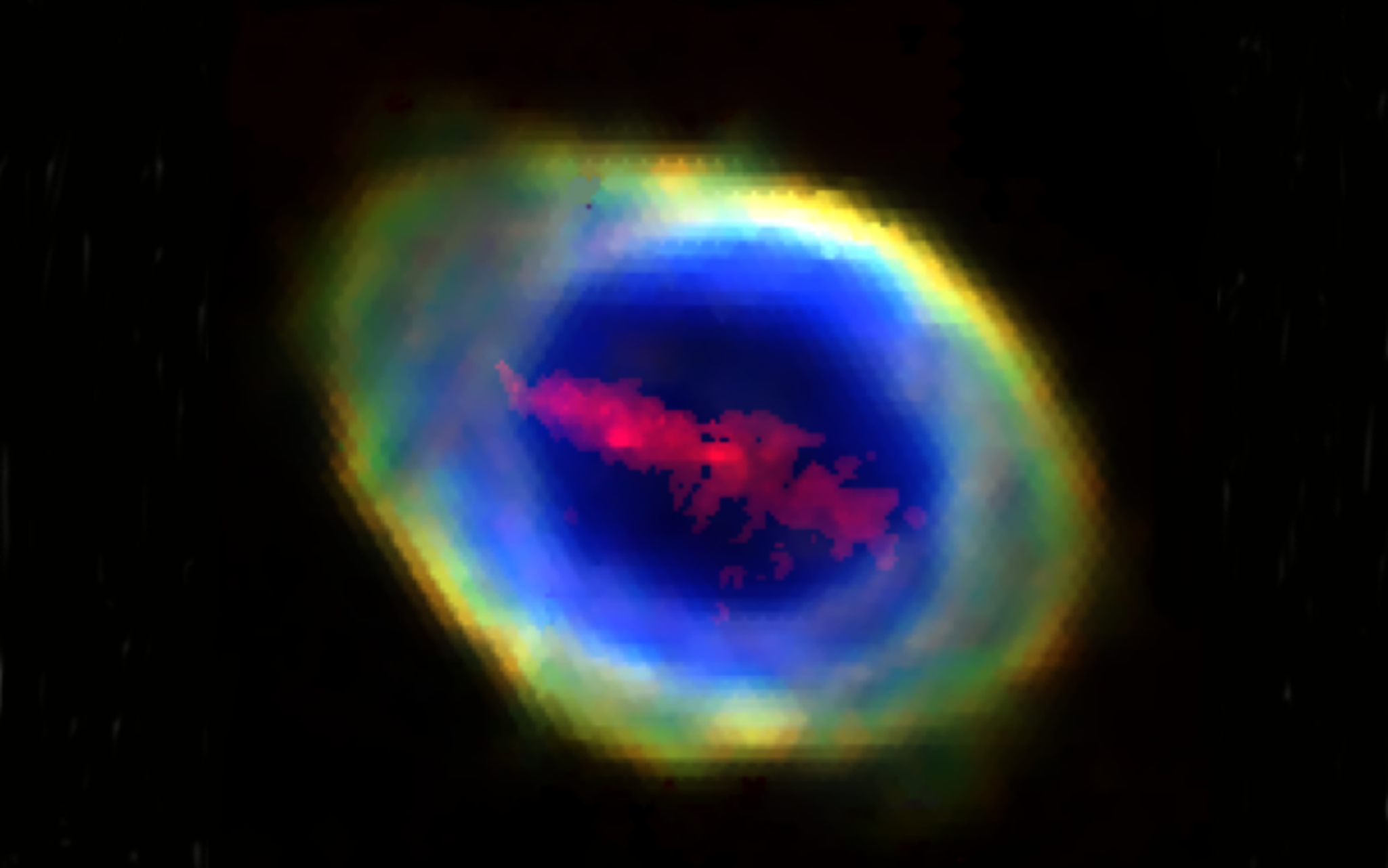
A composite RGB image of the Ring Nebula (also known as Messier 57 and NGC 6720) constructed from four WEAVE/LIFU emission-line images. The bright outer ring is made up of light emitted by three different ions of oxygen, while the ‘bar’ across the middle is due to light emitted by a plasma of four-times-ionised iron atoms. North is up and East is to the left in the image. (Credit: R. Wesson, Cardiff University/UCL)
The discovery reminds us just how little we really know about our galaxy
In A Nutshell
The Mystery: Evidence suggests dust is being destroyed to release iron, but the extreme conditions needed to break up dust (shock waves over 50 km/s or million-degree gas) aren’t present; scientists can measure the feature but can’t explain how it formed
The Discovery: Astronomers found a mysterious bar of highly charged iron atoms cutting through the famous Ring Nebula, a structure that doesn’t match any known phenomenon in dying stars
Why It’s Strange: Only iron shows this linear pattern. Every other element (oxygen, nitrogen, argon, helium) looks completely different, and the motion doesn’t fit what scientists expect from jets or outflows
Hidden in Plain Sight: Despite decades of intense study making the Ring Nebula one of astronomy’s most photographed objects, this feature went undetected until 2023 when a new telescope technology revealed it
Astronomers have discovered something strange cutting through the center of the Ring Nebula, one of the most photographed objects in the night sky. A narrow bar of highly charged iron atoms appeared in observations from a powerful telescope in Spain. The discovery, detailed in Monthly Notices of the Royal Astronomical Society, has left researchers scratching their heads because this iron bar doesn’t match anything they’ve seen before in dying stars.
Even stranger, the Ring Nebula has been studied for decades. It’s the famous smoke ring in space that sits about 2,600 light-years away in the constellation Lyra. Professional astronomers have mapped it with everything from radio telescopes to X-ray detectors. Amateur stargazers love pointing their backyard scopes at it on summer nights. Yet somehow, this linear iron structure went completely undetected until spring 2023.
At first glance, the iron bar looks like it could be a jet shooting out from the central star, and many dying stars do produce those. However, when researchers measured the light signals from the iron, the numbers didn’t add up. The iron emission shows extra redshift compared to the rest of the nebula, with velocity offsets between 20 and 50 kilometers per second. Moreover, both sides of the bar show similar offsets rather than opposite motion patterns. A real jet would show one side approaching and one side receding, like water spraying from a garden hose that’s pointed at an angle.
Why Only Iron Shows This Pattern
Lead researcher Roger Wesson from Cardiff University and his team found emission from iron atoms that have been blasted so hard they’ve lost four or five electrons each. This process can be likened to stripping the paint off a car down to bare metal, except instead of paint, electrons are stripped away that normally orbit iron atoms. Creating these stripped-down iron atoms takes incredibly energetic radiation.
Even more confounding, among these observations no other element in the Ring Nebula shares this same pattern. Not oxygen, not nitrogen, not argon, not helium. Everything else looks completely different. Even argon, which needs similar energy levels to get stripped down like the iron does, doesn’t form this bar shape. The iron emission stands alone, like a line was drawn across the nebula with an iron-filled marker.
The Ring Nebula formed when a sun-like star ran out of fuel and blew off its outer layers into space, leaving behind a super-hot white dwarf at the center. Scientists have models for how these nebulae can form different shapes (footballs, hourglasses, pinwheels). But a narrow bar of one specific element that doesn’t line up with anything else? That’s not in in any model.
Hidden in Plain Sight for Decades
Why did this go unnoticed for so long? Previous studies used what’s called long-slit spectroscopy. This approach only allows the viewer to see whatever is directly in line with that slot. Unless astronomers happened to line up their slot at exactly the right angle (about 70 degrees from north), they’d miss the iron bar completely. They might catch tiny pieces of it and assume those were just measurement uncertainties.
The new WEAVE instrument corrected this oversight. Instead of one narrow slot, it uses 547 small fiber-optic cables arranged in a hexagonal pattern, each grabbing light from its own patch of sky. By taking three overlapping observations of the Ring Nebula, the team stitched together a complete map of how different elements are distributed across its entirety.
When they processed the data, the iron bar appeared bright, obvious, and unmistakable in the images. The feature stretches about 50 arcseconds across the nebula’s center, which is roughly the width of a human hair held at arm’s length. The total amount of detected iron ions in the bar adds up to about 14 percent of Earth’s mass, all concentrated in this one linear structure.
The Dust Mystery
Sometimes what you don’t detect tells you as much as what you do. Astronomers don’t see evidence for the kind of super-hot, X-ray-bright gas that would make dust destruction an easy explanation. X-rays would have to indicate gas heated to over a million degrees, which is hot enough to vaporize dust grains and release their iron atoms into space.
Shock waves can also destroy dust grains, but they need to be moving well above about 50 kilometers per second to do it efficiently. The iron signals show velocity offsets of 20-50 km/s. That’s right at the edge, likely not quite fast enough. For comparison, Earth orbits the Sun at 30 km/s, so fairly similar speeds.
Yet when researchers compared these new observations with infrared images from the James Webb Space Telescope, they saw less dust precisely where WEAVE sees more iron. It’s like the dust is getting destroyed in the bar region, releasing its iron atoms. But without the tell-tale signs of extreme heat or fast-enough shock waves, scientists can’t figure out what’s actually breaking up the dust.
In the nebula’s bright outer ring, where dust is still intact, iron is about 1,000 times less abundant than what we see in the Sun. In the bar region, the team estimates iron is at most about 250 times depleted, possibly even less depleted than that, though the measurements are complicated by gas from different layers mixing together. Less depleted could mean more iron has been released from dust, but how exactly that’s happening remains a mystery.

Where Is This Thing?
The central white dwarf star also isn’t at the bar’s center. It’s offset to the southeast by a few arcseconds. In other words, the star is slightly off to one side of the iron bar. Recent observations showed the star does sit at the center of the nebula’s outer halo, so this offset only applies to the bright inner region. The bar seems to follow the visual cavity’s central axis more than it follows the star itself.
It in unknown where the bar sits along our line of sight through the nebula. It could be in front of the bright ring, behind it, or cutting through the middle. Future observations with higher-resolution instruments might answer that question by separating out different velocity components that are currently blurred together.
All in all, this discovery proves that even the most intensively studied objects in space can still surprise us. The Ring Nebula isn’t some distant, barely visible smudge requiring the world’s largest telescopes. It’s featured in astronomy textbooks and planetarium shows. Finding a major structural feature that scientists never knew was there raises new questions about how dying stars work.
The observations caught this iron bar during the telescope’s testing phase, when the team was still figuring out how everything worked. Some of the instrument’s fibers weren’t even functioning yet. Despite those limitations, the data was good enough to reveal this feature and start measuring its properties. A more complete analysis of the entire Ring Nebula is coming soon, which might provide more clues about what created this mysterious iron bar.
Paper Notes
Limitations
The observations were obtained during WEAVE’s science verification phase in May and June 2023, when the instrument was still being commissioned. No systematic flux calibration observations were collected, requiring the team to use the central star itself as a calibrator. Some LIFU fibers were not operational, creating gaps in the reconstructed images.
The spectral resolution of approximately R ~ 2,500 limits the ability to separate different velocity components that might be present. Weak emission components from other elements with similar velocities to the iron lines would be lost against brighter emission from the main nebula. Higher resolution observations (R ~ 20,000) would be needed to detect such components.
The true iron depletion factor in the bar cannot be determined precisely because hydrogen and other element emission in the bar region may arise mainly from different gas parcels along the line of sight. The quoted depletion factor of 250 relative to solar abundances represents an upper limit—actual depletion could be significantly lower.
Funding and Disclosures
Funding for the WEAVE facility was provided by UKRI STFC, the University of Oxford, NOVA, NWO, Instituto de Astrofísica de Canarias, Isaac Newton Group partners (STFC, NWO, and Spain, led by the IAC), CNRS-INSU, the Observatoire de Paris, Région Île-de-France, CONACYT through INAOE, the Ministry of Education, Science and Sports of Lithuania, Konkoly Observatory (CSFK), Max-Planck-Institut für Astronomie (MPIA Heidelberg), Lund University, the Leibniz Institute for Astrophysics Potsdam (AIP), the Swedish Research Council, the European Commission, and the University of Pennsylvania.
Publication Details
Authors: R. Wesson, J. E. Drew, M. J. Barlow, J. García-Rojas, R. Greimel, D. Jones, A. Manchado, R. A. H. Morris, A. Zijlstra, P. J. Storey, J. A. L. Aguerri, S. R. Berlanas, E. Carrasco, G. B. Dalton, E. Gafton, R. García-Benito, A. L. González-Morán, B. T. Gänsicke, S. Hughes, S. Jin, R. Raddi, R. Sánchez-Janssen, E. Schallig, D. J. B. Smith, S. C. Trager, and N. A. Walton.
Journal: Monthly Notices of the Royal Astronomical Society (MNRAS) | Volume/Pages: Volume 546, pages 1-8 (2026) | DOI: 10.1093/mnras/staf2139 | Publication Date: Accepted November 26, 2025; published January 16, 2026 | Affiliations: Authors affiliated with Cardiff University, University College London, Instituto de Astrofísica de Canarias, University of La Laguna, and numerous other institutions across Europe and Mexico.
Observations: Obtained with the William Herschel Telescope on La Palma, operated by the Isaac Newton Group of Telescopes. Data taken May 19-20 and June 24, 2023, during WEAVE science verification.


