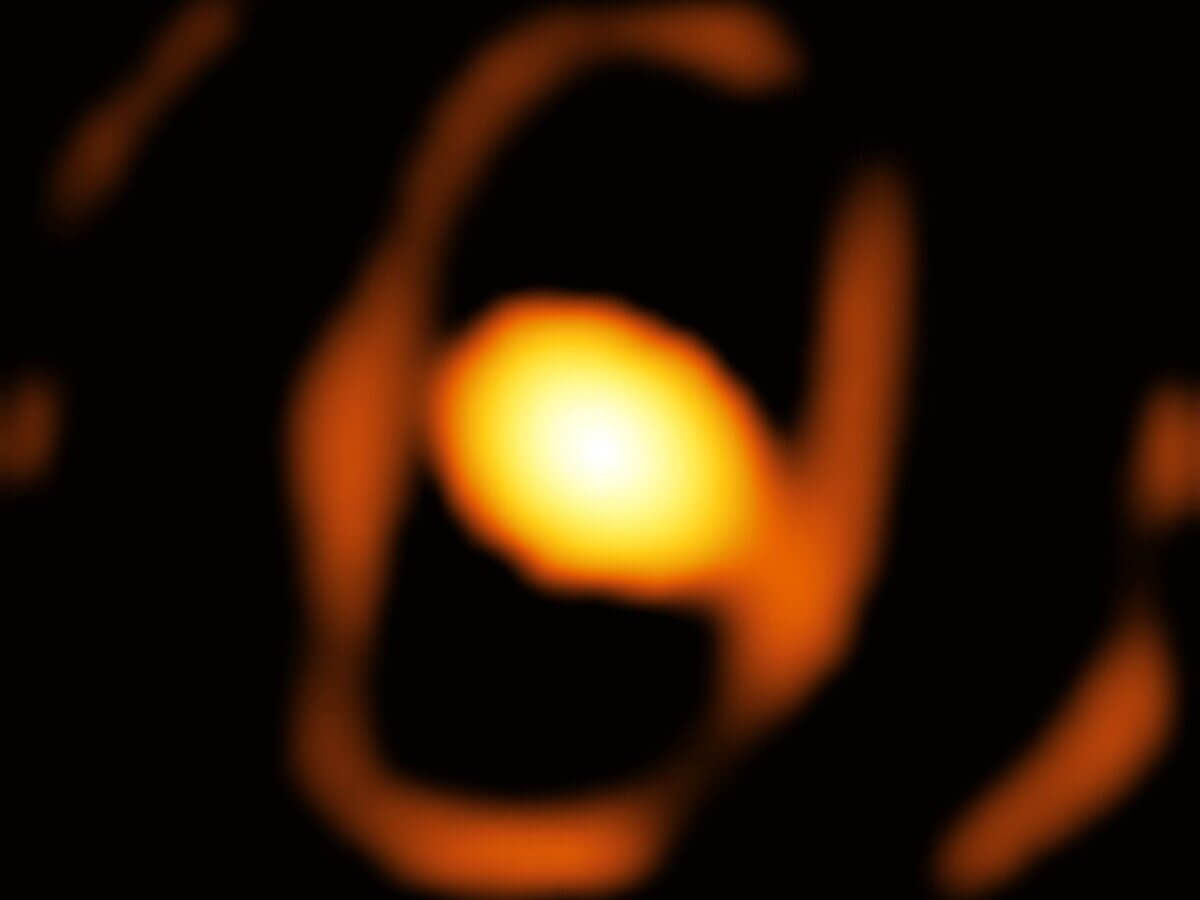
This is an image of the star WOH G64, taken by the GRAVITY instrument on the European Southern Observatory’s Very Large Telescope Interferometer (ESO’s VLTI). (Credit: ESO/K. Ohnaka et al.)
SANTIAGO, Chile — Imagine capturing a portrait of a cosmic giant so massive it could swallow our entire solar system thousands of times over — and doing so from 160,000 light-years away. That’s exactly what an international team of astronomers has accomplished, snapping the first detailed close-up image of a star outside the Milky Way.
The star in question, WOHG64, is a red supergiant located in the Large Magellanic Cloud, a satellite galaxy of the Milky Way. Using advanced telescope technology, scientists captured unprecedented details about how this massive star is changing, revealing a fascinating process of stellar evolution that could help us understand how stars live and die. The full findings are published in the journal Astronomy & Astrophysics.
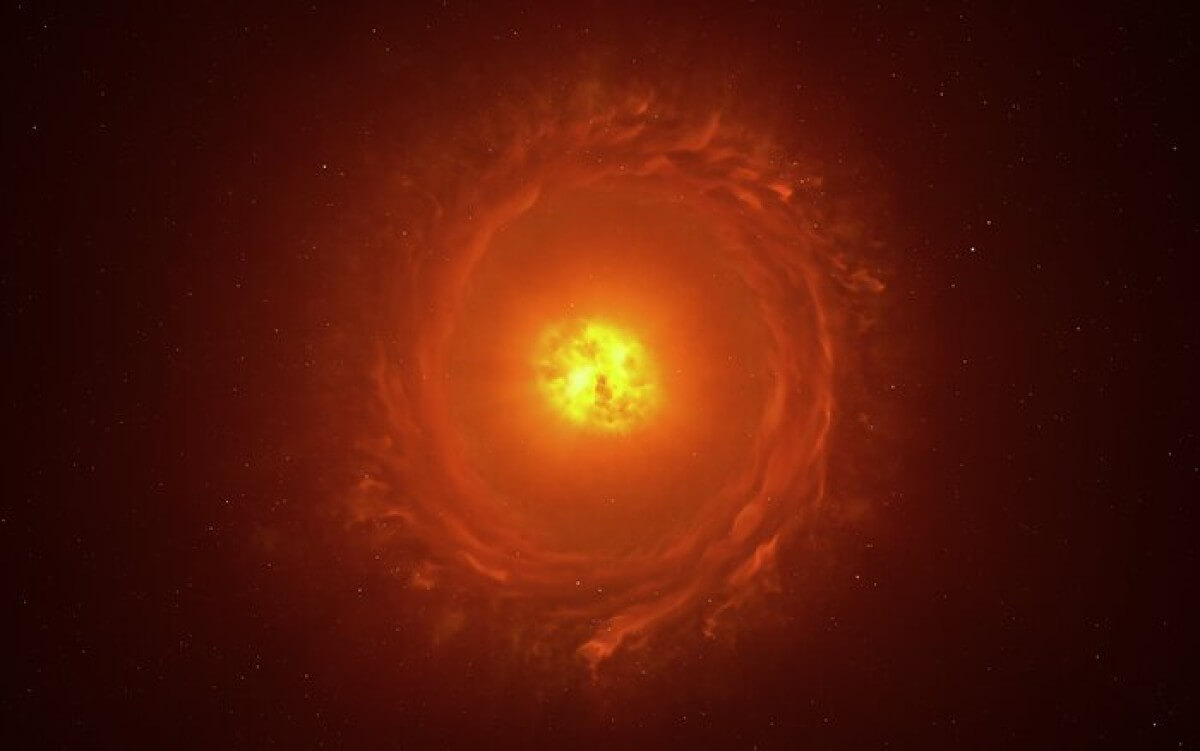
Red supergiants are cosmic behemoths – stars hundreds of times larger than our sun that are nearing the end of their life cycle. They’re known for dramatic mass loss, shedding enormous amounts of material into space before ultimately exploding as spectacular supernovae.
“We discovered an egg-shaped cocoon closely surrounding the star,” says lead researcher Keiichi Ohnaka from Universidad Andrés Bello in a media release. “We are excited because this may be related to the drastic ejection of material from the dying star before a supernova explosion.”
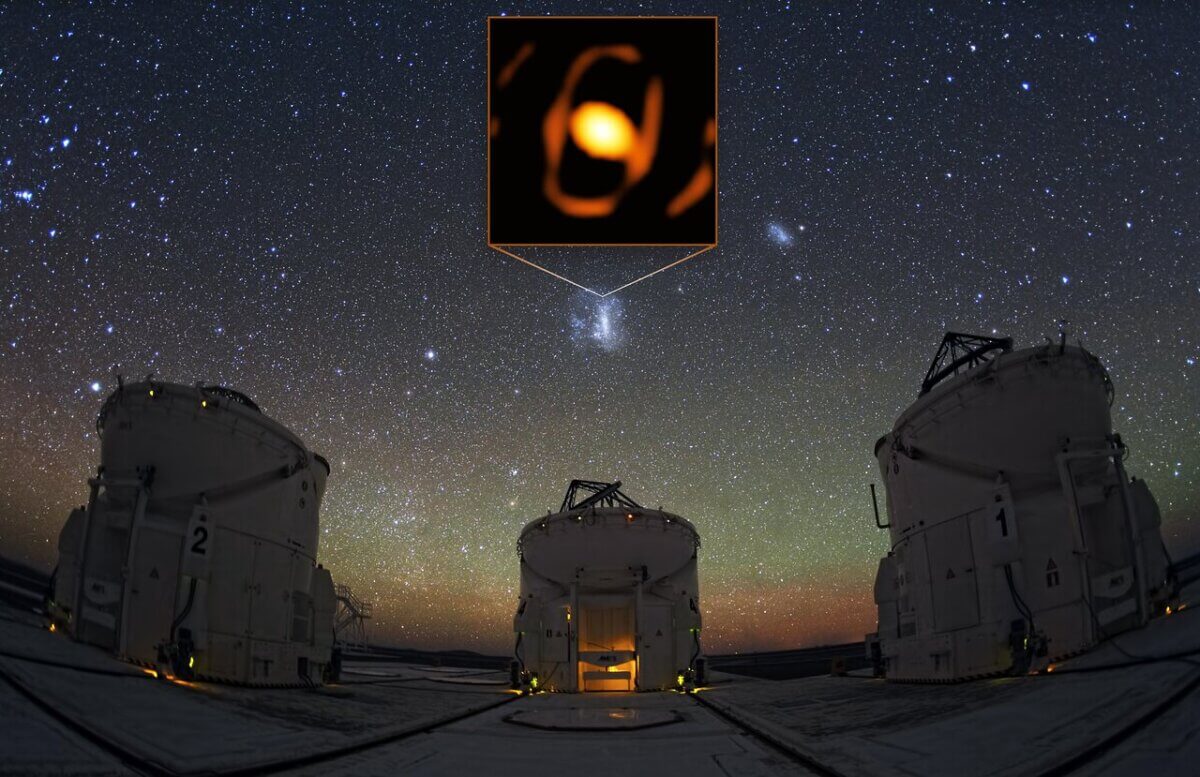
What makes WOHG64 special is the dramatic transformation researchers observed in its surrounding environment. By using cutting-edge infrared interferometry – a technique that combines light from multiple telescopes to create ultra-high-resolution images – scientists detected something unexpected: the star is creating brand new dust incredibly close to its surface.
This dust formation is happening at an astonishingly small scale, just about 13 times the star’s radius. The newly formed dust appears to be creating a unique, elongated structure around the star, potentially indicating the beginning of a significant change in the star’s lifecycle.
“We have found that the star has been experiencing a significant change in the last 10 years, providing us with a rare opportunity to witness a star’s life in real time,” explains Gerd Weigelt, an astronomy professor at the Max Planck Institute for Radio Astronomy.
“This star is one of the most extreme of its kind, and any drastic change may bring it closer to an explosive end,” adds co-author Jacco van Loon, director of the Keele Observatory at Keele University, who has been observing WOH G64 since the 1990s.
While astronomers have previously captured about two dozen close-up images of stars within our galaxy, WOHG64 represents an entirely new frontier. It’s a testament to human technological innovation that we can now peer so precisely into the cosmic unknown.
Paper Summary
Methodology
The research team used multiple advanced instruments, including the GRAVITY instrument at the Very Large Telescope Interferometer in Chile. They collected data across different wavelengths of light, from near-infrared to mid-infrared, allowing them to build a comprehensive picture of the star’s environment.
Key Results
The most striking finding was a fundamental change in the star’s spectrum – how its light is distributed across different wavelengths. Before 2010, the star’s spectrum showed clear water absorption features. After 2016, the spectrum transformed into a continuously rising pattern with minimal water signatures.
The scientists believe this change is caused by the formation of new, hot dust grains close to the star’s surface. These grains are likely composed of transparent materials like aluminum oxide or magnesium silicates, which condense at extremely high temperatures around 1,500 Kelvin.
Study Limitations
The study has several constraints. The sparse historical data makes it challenging to pinpoint exactly when the dust formation began. Additionally, the observations are limited to a single star, so researchers cannot yet generalize these findings to all red supergiants.
Discussion & Takeaways
This research provides a rare glimpse into the dynamic processes occurring in massive, dying stars. The dust formation could have significant implications for understanding stellar evolution, mass loss, and the eventual supernova explosion.
Interestingly, the team also noticed the star appears brighter in certain light bands, potentially due to light scattering from these new dust grains – a subtle but intriguing phenomenon.
Funding & Disclosures
The research was supported by multiple institutions, including the European Southern Observatory, NASA, and various national research councils. The team utilized data from multiple sky survey projects and space telescopes, demonstrating the collaborative nature of modern astronomical research.


