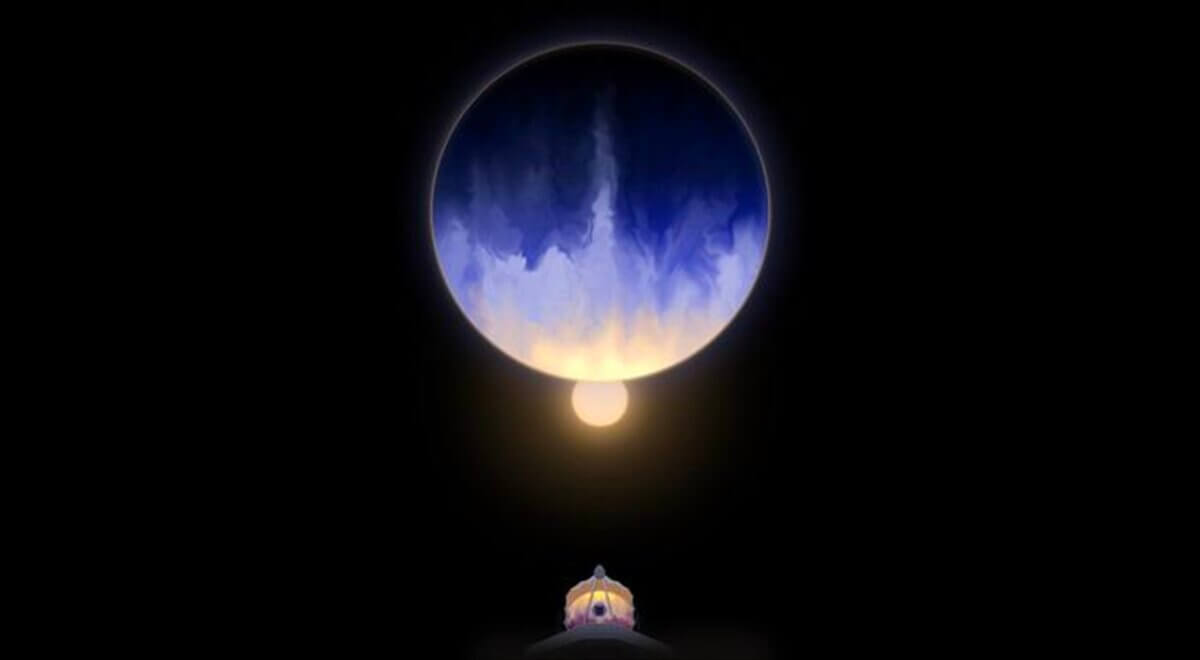
Artist's illustration of the exoplanet WASP-107b based on transit observations from NASA's James Webb Space Telescope as well as other space- and ground-based telescopes, led by Matthew Murphy of the University of Arizona and a team of researchers around the world. (Credit: Rachel Amaro/University of Arizona)
TUCSON, Ariz. — All planets are round, but they are not all perfectly symmetrical. Thanks to the James Webb Space Telescope, scientists have captured the first images of a planet in outer space with asymmetric edges in its atmosphere. Moreover, this stunning contrast takes place on an exoplanet where one side permanently faces its sun.
Published in the journal Nature Astronomy, scientists from the University of Arizona say this east-west asymmetry means there are differences in atmospheric conditions between the two hemispheres of this strange new world. According to the authors, the asymmetry results from the position of the exoplanet in relation to the star it orbits.
Study authors explain that the planet is “tidally locked” — meaning the same side always faces the star and other side stays in darkness. The differences in gases, temperature, and cloud patterns for each side give scientists a unique opportunity to study how planets change when they get different amounts of sunlight.
“This is the first time the east-west asymmetry of any exoplanet has ever been observed as it transits its star, from space,” says lead study author Matthew Murphy, a graduate student at the University of Arizona’s Steward Observatory, in a media release.
Transit refers to a planet moving in front of its sun, allowing astronomers here on Earth to see these disruptions and learn more about the planets orbiting distant stars.
“We don’t have anything like it in our own solar system. It is unique, even among the exoplanet population,” Murphy adds.
Exoplanet WASP-107b is roughly the same size as Jupiter, but it only carries about a tenth of the mass. This low level of density and low amount of gravity makes the atmosphere more inflated than other exoplanets, contributing to its massive size. WASP-107b is estimated to be around 890 degrees Fahrenheit — a temperature that falls in between planets of our solar system and the hottest known exoplanets.
“Traditionally, our observing techniques don’t work as well for these intermediate planets, so there’s been a lot of exciting open questions that we can finally start to answer,” explains Murphy. “For example, some of our models told us that a planet like WASP-107b shouldn’t have this asymmetry at all — so we’re already learning something new.”
Planets outside our solar system have been a topic of interest to the researchers for almost two decades. Images and observations from ground and space have helped in predicting the atmosphere of exoplanets.
“But this is really the first time that we’ve seen these types of asymmetries directly in the form of transmission spectroscopy from space, which is the primary way in which we understand what exoplanet atmospheres are made of — it’s actually amazing,” says study co-author Thomas Beatty, an assistant professor of astronomy at the University of Wisconsin-Madison.
The next step is to use the observational data to get a more detailed view of the exoplanet and what drives this unique asymmetry.
“For almost all exoplanets, we can’t even look at them directly, let alone be able to know what’s going on one side versus the other,” Murphy concludes. “For the first time, we’re able to take a much more localized view of what’s going on in an exoplanet’s atmosphere.”
Paper Summary
Methodology
The researchers used a space telescope called the James Webb Space Telescope (JWST) to observe the exoplanet WASP-107 b as it passed in front of its star. During the transit, the light from the star passes through the planet’s atmosphere, allowing scientists to study the atmosphere’s characteristics.
Specifically, they looked at the “morning” and “evening” sides of the planet, which correspond to the parts of the planet that face the star at different times. By measuring how light changes at different wavelengths as it passes through the atmosphere, they could detect differences in temperature and cloudiness on these two sides of the planet.
Key Results
The scientists found that the evening side of WASP-107 b was hotter than the morning side by about 180 degrees Celsius. They were surprised to see such a large temperature difference because WASP-107 b is a relatively cool exoplanet compared to others with such strong differences. The evening side showed more signs of clouds and water vapor, while the morning side was much cooler and had fewer noticeable features. This discovery challenges some existing models of how temperatures are distributed on such planets.
Study Limitations
One of the limitations of this study is that it is based on observations of only one transit of the planet, meaning the researchers could not see how the atmosphere might change over time. Additionally, the study relies on certain assumptions about the planet’s atmosphere and orbit, which might affect the accuracy of the findings. The equipment also has limitations, and some of the data could be influenced by noise or other factors that weren’t completely accounted for, although the researchers did run tests to minimize these issues.
Discussion & Takeaways
This study showed that WASP-107 b, despite being a cooler exoplanet, still experiences significant temperature differences between its morning and evening sides. This challenges the expectation that only much hotter planets would show such differences. The findings suggest that the atmospheric models used to understand these planets need to be updated to account for these surprising results. Further observations of other cool exoplanets will be necessary to determine whether WASP-107 b is an unusual case or if many other planets also exhibit these differences.
Funding & Disclosures
This research was supported by several institutions and organizations, including the NASA Goddard Space Flight Center. The researchers disclosed that they used data from various sources, including the James Webb Space Telescope and other observatories. No conflicts of interest were reported, and the researchers followed standard protocols for the study.


