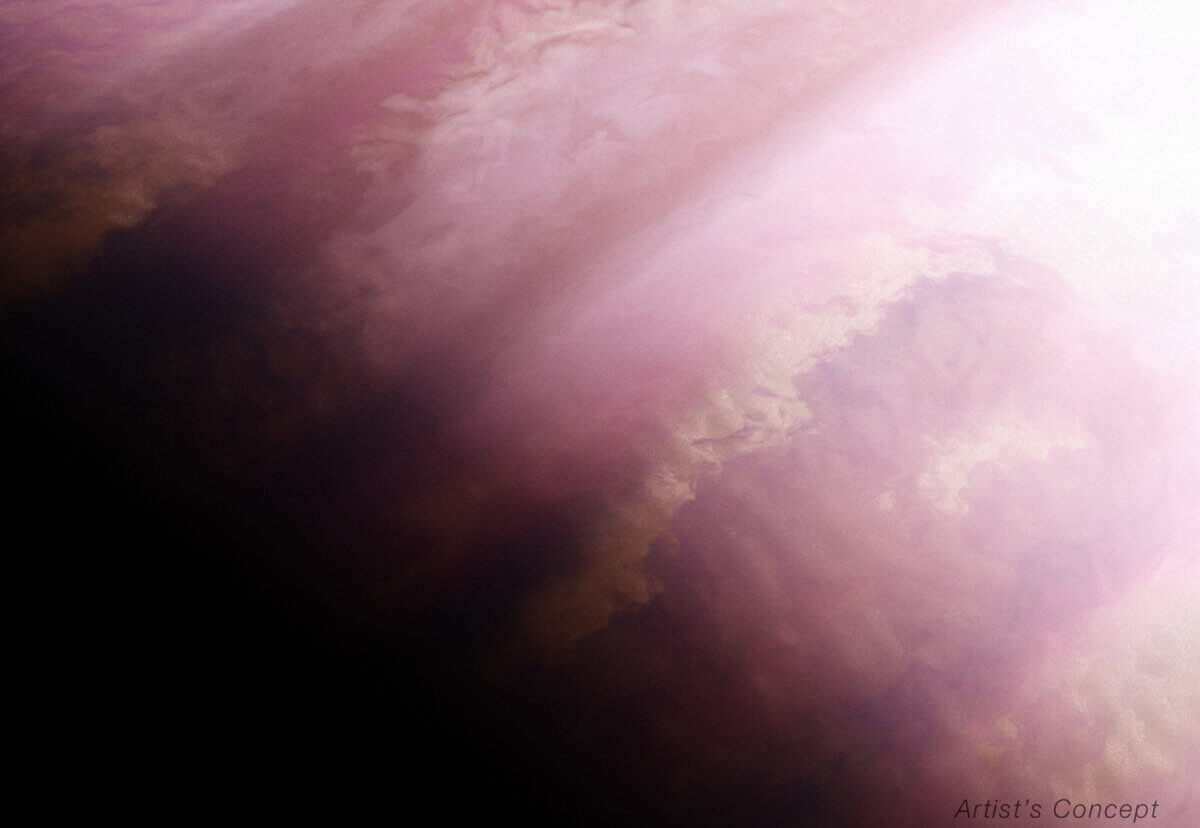
Artist's concept of WASP-39b (Credit: Imperial College London)
LONDON — Set your phasers to stunned for this next discovery. A team of international researchers have located a distant planet where one side is perpetually bathed in scorching sunlight, while the other remains in eternal darkness. Now, picture the boundary between these two extremes — a cosmic twilight zone where “morning” and “evening” exist in a never-ending cycle. In a case of cosmic coincidence, one of the scientists making this discovery shares his name with one of the most famous sci-fi explorers, Star Trek’s James Kirk!
Thanks to the James Webb Space Telescope (JWST), Dr. Kirk of Imperial College London and scientists from the United States and United Kingdom have observed this phenomenon on a distant planet roughly 700 light-years away from Earth. Unlike many of the worlds Captain James Kirk of “Star Trek” discovered, this planet has the rather unpoetic name of WASP-39b.

What makes WASP-39b so unique?
The planet is what astronomers call a “hot Jupiter” — a gas giant planet that orbits extremely close to its star. However, WASP-39b is no ordinary hot Jupiter. It’s a world of extremes that defies our earthly expectations, according to the findings published in Nature.
For starters, WASP-39b is bigger than Jupiter but weighs about as much as Saturn. It’s so close to its home star that it completes an entire “year” (one orbit around the Sun) in the same amount of time it takes the planet to rotate once on its axis. This means that, in the same way our Moon always shows the same face to Earth, WASP-39b always presents the same side to its star.
The result? A planet with permanent day and night sides, where temperatures soar above a blistering 1,000°C (1,832°F) on the sun-facing side. However, it’s the boundary between these two sides — the “terminator” in astronomy-speak — that’s got scientists buzzing with excitement.
“There is no planet like this in our Solar System, but most of the planets we observe orbiting distant stars are closer, with short orbits, like WASP-39b. Now, we have been able to test our theories about these planets and, for the first time, directly measure an exoplanet’s morning and evening side over a wide wavelength range,” says Dr. James Kirk, from the Department of Physics at Imperial College London, in a media release.
So, what exactly did scientists find?
Picture this: on the “morning” side of WASP-39b, where the cooler night air meets the blazing day, temperatures hover around a toasty 600°C (1,112°F). Meanwhile, on the “evening” side, where the scorching daytime heat begins to fade into night, it’s even hotter at about 800°C (1,472°F). That’s hot enough to melt lead!
The Webb telescope’s ultra-sensitive instruments also detected something else: clouds behaving very differently on each side of the planet. The morning side appears to be significantly cloudier than the evening side.
Why does this matter? Well, it’s all about understanding how atmospheres work on these alien worlds.
“This analysis is also particularly interesting because you’re getting 3D information on the planet that you weren’t getting before. Because we can tell that the evening edge is hotter, that means it’s a little puffier. So, theoretically, there is a small swell at the terminator approaching the nightside of the planet,” says Néstor Espinoza, the lead author of the study.
Simply put, we’re starting to see these distant planets as real, dynamic worlds with complex weather patterns, not just featureless balls of gas.
The way scientists figured this out is pretty clever. They used a technique that measures how the star’s light changes as the planet passes in front of it. The planet’s atmosphere acts like a filter, and different molecules in the atmosphere leave different “signatures” in the light. By analyzing these signatures, scientists can deduce what’s in the atmosphere and how it’s behaving.
What makes this discovery so groundbreaking is that, until now, scientists had to assume that a planet’s atmosphere was pretty much the same all over. This new study shows that’s not necessarily the case, opening up a whole new dimension in our understanding of exoplanets.
Dr. Kirk and his colleagues are already planning their next moves. They want to use even more of Webb’s instruments to study WASP-39b and other similar planets. These instruments can analyze different types of light, potentially revealing even more details about these alien atmospheres.
“Now we’ve demonstrated the feasibility of this method with JWST, and the precision of JWST is so immense, it really opens up a new avenue into understanding and measuring atmospheric circulation for exoplanets that we were previously largely insensitive to,” Dr. Kirk continues.
As we continue to push the boundaries of what we can observe in the cosmos, each discovery brings us closer to answering some of humanity’s biggest questions: Are we alone in the universe? How common are planets like Earth? And what incredible, alien worlds are out there waiting to be discovered?


