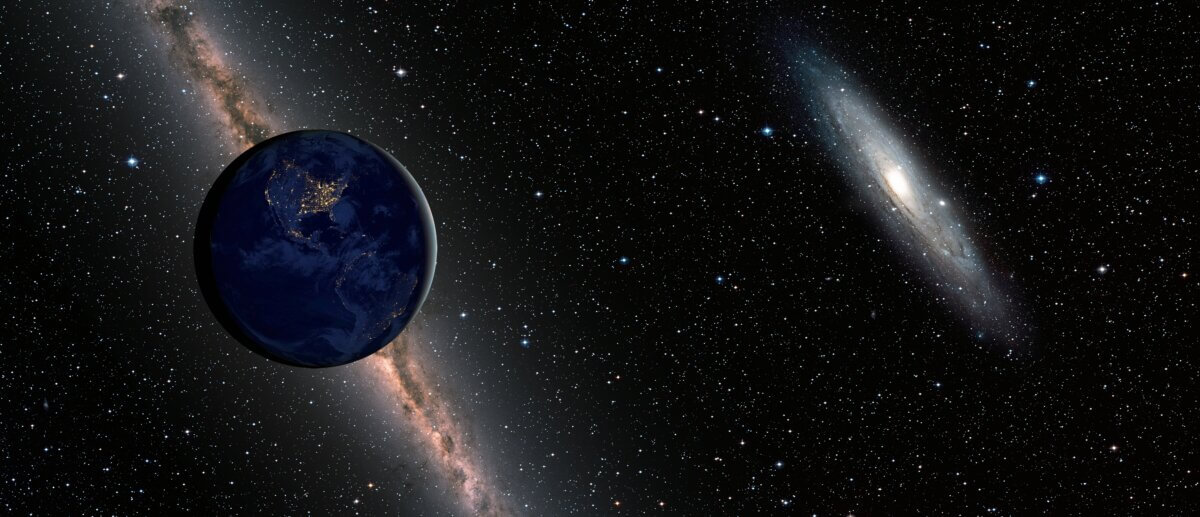
(Credit: muratart/Shutterstock)
HELSINKI, Finland — For decades, astronomers have confidently predicted that our Milky Way galaxy is on a collision course with its nearest large neighbor, the Andromeda galaxy. This cosmic crash, expected to occur in about five billion years, has been widely accepted as an inevitable event in our galaxy’s future. However, a new study is challenging this long-held belief, suggesting that the Milky Way’s fate is far less certain than previously thought.
Led by Till Sawala from the University of Helsinki, an international team of researchers has found that there’s only about a 50% chance that the Milky Way and Andromeda will actually collide within the next 10 billion years. This startling conclusion comes from a thorough analysis of the latest observational data and sophisticated computer simulations of galactic dynamics. Simply put, everything humans know about space and the way galaxies move shows that the chances of our galaxy crashing into our nearest neighbor are no better than a coin flip.
The team’s work focused on four key players in our local cosmic neighborhood: the Milky Way, Andromeda (also known as M31), the Triangulum galaxy (M33), and the Large Magellanic Cloud (LMC). By incorporating the most up-to-date measurements of these galaxies’ positions, velocities, and masses, the researchers created a more accurate model of how these celestial bodies might interact over billions of years.
One of the most significant findings is the crucial role played by the LMC, a satellite galaxy of the Milky Way. Despite being much smaller than the Milky Way or Andromeda, the LMC’s gravitational influence is substantial enough to potentially alter the course of our galactic dance with Andromeda. The researchers found that including the LMC in their calculations actually decreased the likelihood of a Milky Way-Andromeda merger.
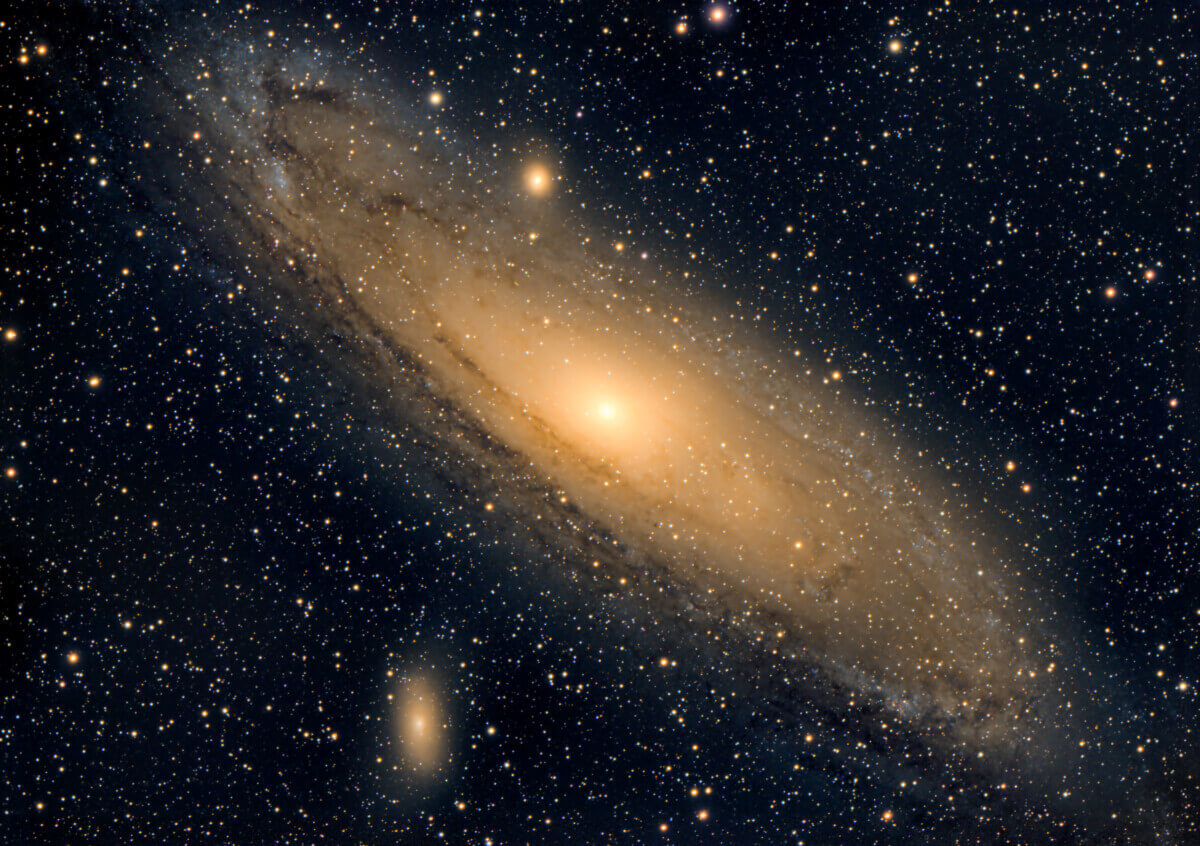
To understand why this is so important, imagine a cosmic game of billiards. Previously, scientists were mainly focused on the two largest balls – the Milky Way and Andromeda. However, this new research shows that smaller balls like the LMC can have a significant impact on the trajectory of the larger ones, potentially preventing them from colliding.
The study, published online as a pre-print on arXiv, also highlights the importance of precise measurements in astronomy. Thanks to advanced space telescopes like Gaia and Hubble, we now have much more accurate data on the motions of galaxies in our cosmic neighborhood. However, even small uncertainties in these measurements can lead to vastly different outcomes when projected over billions of years.
For instance, the team found that slight variations in Andromeda’s proper motion – its movement across the sky as seen from Earth – could result in scenarios ranging from a near-certain collision to almost no chance of merger at all. This underscores the challenge of making long-term predictions in a complex system like our Local Group of galaxies.
The findings extend far beyond the fate of our galaxy. It challenges our understanding of galactic evolution and the processes that shape the universe on the largest scales. If the Milky Way and Andromeda don’t merge as expected, it could mean that large elliptical galaxies – often thought to be the result of such head-on collisions – might form through other mechanisms more frequently than astronomers have thought.
The research also highlights the incremental nature of scientific progress. As our tools and methods improve, we can refine our understanding of the universe, sometimes overturning long-held beliefs in the process. This study doesn’t definitively rule out a future collision between the Milky Way and Andromeda, but it does show that such an event is far from certain.
In the end, whether our galaxy merges with Andromeda or continues its solitary journey through space, one thing is clear: the night sky billions of years from now will look very different from what we see today. And while we won’t be around to witness it, studies like this one allow us to peer into the possible futures of our cosmic home, reminding us of our place in the vast, ever-changing universe.
Paper Summary
Methodology
The researchers used a technique called Monte Carlo simulation to account for uncertainties in their data. They started with the best available measurements of the positions, velocities, and masses of the Milky Way, Andromeda, M33, and the LMC. For each of these parameters, they created a range of possible values based on the measurement uncertainties.
They then ran thousands of simulations, each time randomly selecting values from these ranges. This allowed them to see how often different outcomes (like a galaxy merger) occurred across many possible scenarios. The team also used a mathematical model to simulate how the galaxies’ gravitational forces affect each other over time, including the effects of dynamical friction, which causes orbiting bodies to lose energy and potentially merge.
Key Results
The key finding is that in their simulations, the Milky Way and Andromeda merged within 10 billion years in only about 54% of cases. This is significantly lower than previous estimates, which suggested a near-certain collision. The researchers found that including the LMC in their calculations reduced the merger probability while including M33 increased it slightly. They also discovered that small changes in the initial conditions, particularly in Andromeda’s proper motion, could lead to vastly different outcomes.
Study Limitations
First, the study relies on current measurements, which, despite being the most accurate available, still have uncertainties. These uncertainties compound over the billions of years being simulated.
Second, the model simplifies galaxies as simple spherical objects, ignoring complex internal structures that could affect their interactions. Finally, the study doesn’t account for the potential influence of other, more distant galaxies or the overall expansion of the universe, which could affect the long-term evolution of the Local Group.
Discussion & Takeaways
This research challenges the long-held belief in an inevitable Milky Way-Andromeda collision. It demonstrates the importance of considering all major bodies in a galactic system, not just the largest ones. The study also highlights how improvements in observational data can lead to significant changes in our understanding of cosmic processes. For the broader field of astronomy, it suggests that we may need to reconsider models of galaxy evolution, particularly those that rely heavily on major mergers to explain the formation of large elliptical galaxies.
Funding & Disclosures
The research was supported by grants from the Research Council of Finland, the European Research Council, and the Science and Technology Facilities Council. The authors declared no competing interests. The study used facilities provided by the CSC – IT Centre for Science in Finland and the DiRAC facility at Durham University in the UK.


