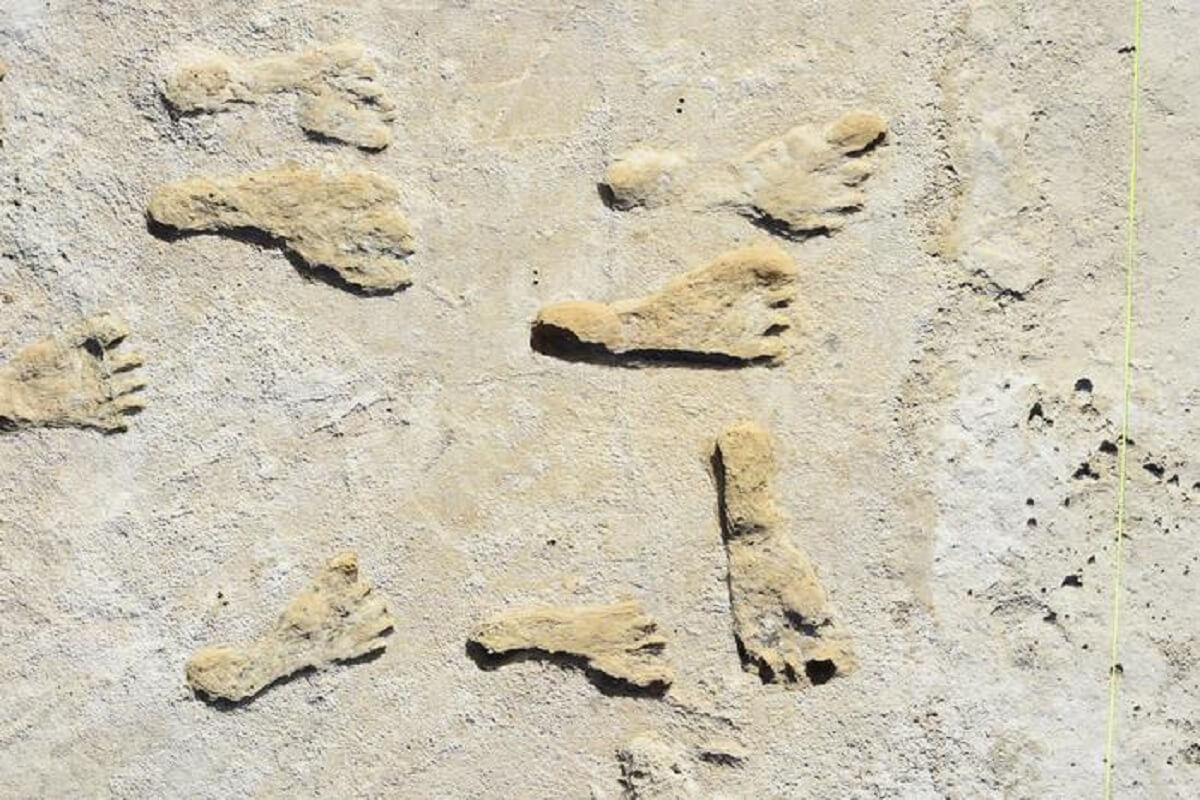
Fossilized footprints in White Sands National Park. (credit: USGS, NPS, Bournemouth University)
In a nutshell
- New independent research confirms that 23,000-year-old human footprints at White Sands National Park are authentic, proving people lived in North America during the peak ice age.
- The discovery pushes back human arrival in the Americas by thousands of years, challenging traditional theories about when and how people first migrated from Asia.
- Early Americans thrived in an ice age wetland oasis filled with mammoths and other megafauna, demonstrating remarkable adaptability to extreme climate conditions.
TUCSON, Ariz. — Scientists have confirmed that controversial human footprints discovered in New Mexico are indeed 23,000 years old. The findings support the view that people walked across North America during the peak of the last ice age, at a time when massive glaciers blocked the typical migration routes from Asia.
The discovery at White Sands National Park has ignited one of archaeology’s most intense debates in recent decades. Since the footprints were first announced in 2021, critics have questioned whether the dating methods were reliable, suggesting the tracks could be significantly younger than claimed. But new independent research published in Science Advances has provided compelling new evidence that strongly supports the original timeline.
The findings suggest that humans were living in the Americas thousands of years earlier than previously believed, during the Last Glacial Maximum, when ice sheets stretched from coast to coast. These early Americans thrived in what was then a dynamic landscape of shallow lakes and wetlands filled with Ice Age megafauna.

Independent Scientists Confirm the Timeline
Rather than re-examining the footprints themselves, University of Arizona archaeologist and geologist Vance Holiday, along with graduate student Jason Windingstad, focused on reconstructing the broader geological story of ancient Lake Otero. They mapped previously undocumented lake and wetland deposits that connect directly to the rock layers where the human tracks are preserved.
The pair collected 26 new radiocarbon dates from organic-rich mud samples, known as palustrine mud, analyzed by two independent laboratories with no connection to the original 2021 or 2023 research. These new dates outline a detailed sedimentary timeline from more than 23,600 to about 17,000 years ago, closely matching the original estimates for the human footprints.
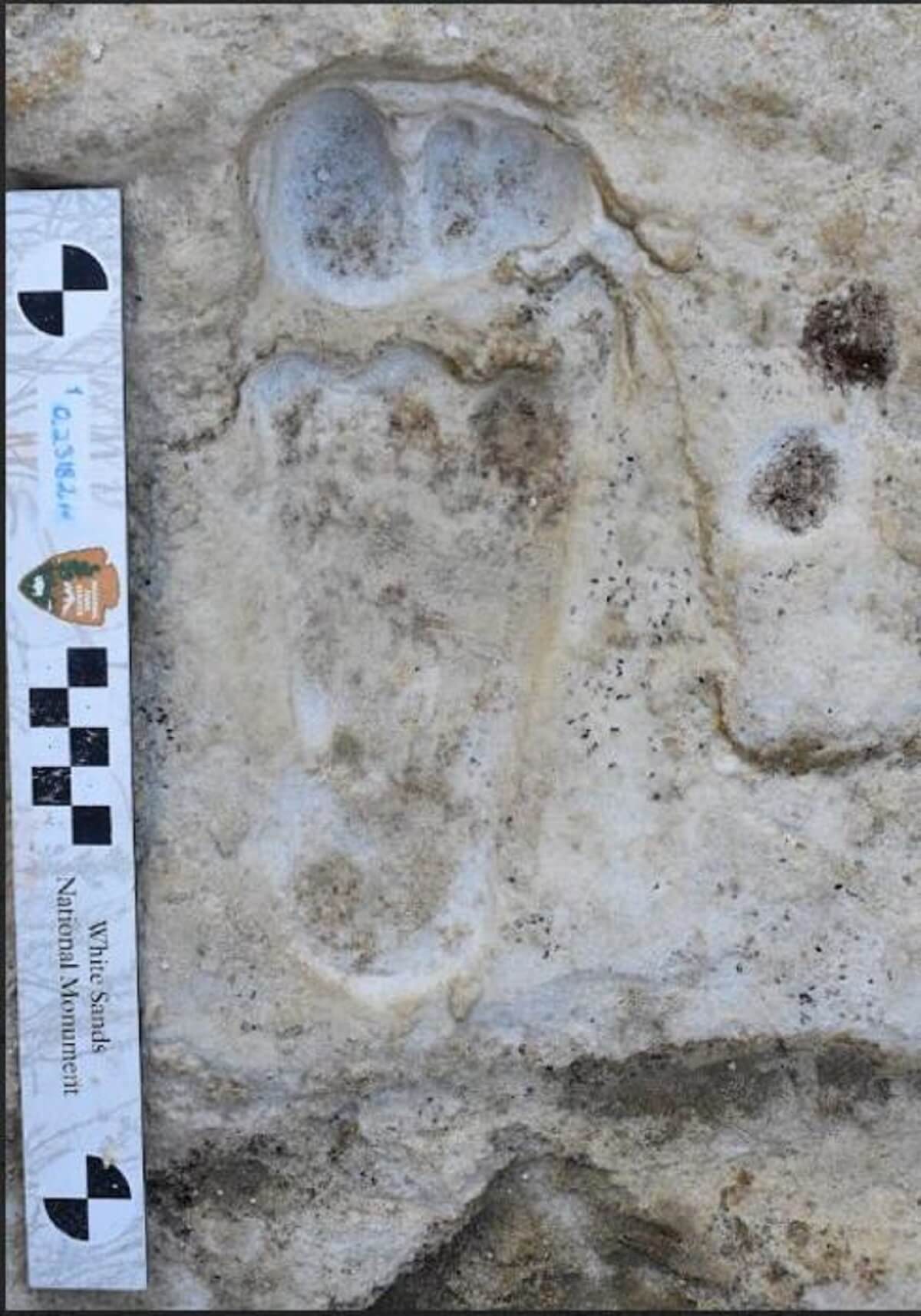
(credit: USGS)
The study area covered three locations along a 2-mile segment of an ancient escarpment: WHSA Locality 2 (the original track site), a central trenching area, and a site called Gypsum Overlook. Researchers used trenching, sediment coring, and stratigraphic mapping to track the prehistoric environmental changes across these zones.
“It’s a strange feeling when you go out there and look at the footprints and see them in person,” said Windingstad, a doctoral candidate in environmental science. “You realize that it basically contradicts everything that you’ve been taught about the peopling of North America.”
The Ice Age Oasis Where Humans Thrived
Twenty-three thousand years ago, White Sands wasn’t a desert. It was a sprawling wetland basin with a salty lake at its center. The region was fed by mountain runoff and supported aquatic plants such as Ruppia (widgeon grass), whose preserved seeds were discovered in the same sediment layers as the human tracks.
The footprints were made on a gently sloping alluvial plain where mountain water periodically spread across the basin floor. During dry phases, the mud would dry and crack, creating perfect conditions for preserving footprints, before being buried by the next pulse of sediment or water.
Evidence shows that people returned to the area repeatedly over time, leaving tracks in at least eight different layers. They shared this Ice Age ecosystem with mammoths, ground sloths, and camels, whose tracks were also preserved in the same beds.
The wetlands provided abundant resource, including fresh water, edible plants, and game, offering a habitable oasis in the midst of a glacial landscape.

Responding to the Critics
Skeptics of the original dating raised concerns about possible contamination of the plant materials used for radiocarbon testing. They argued that seeds and pollen might have absorbed ancient carbon from groundwater, making them appear older than they really were.
The new study directly addresses these doubts. Researchers dated bulk wetland mud rather than relying solely on seeds or pollen, and found carbon isotope signatures that differed significantly from those of the seeds, making contamination from decomposed plant matter unlikely.
They also found no evidence for the so-called “seed ball” hypothesis, which proposed that old seeds were pushed ashore by storm waves. Instead, the seed layers were located in calm wetland settings, with no signs of turbulent water or storm-related deposition.
Most importantly, the water that formed the sediments was fresh runoff from nearby mountains, not ancient, alkaline groundwater. While that runoff could increase in salinity by dissolving gypsum and carbonates from the landscape, it wouldn’t skew radiocarbon dates.

Rewriting the Story of Human Migration to America
The confirmation that these footprints are at least 23,000 years old challenges long-held theories about when people first arrived in the Americas. For decades, scientists believed humans migrated from Asia around 15,000 to 16,000 years ago, after the melting of massive ice sheets opened corridors into North America.
But the White Sands tracks date to a time when ice still spanned the continent, implying that humans must have arrived even earlier, before those ice barriers had formed.
The fact that people were navigating and surviving in glacial North America shows extraordinary adaptability in the face of environmental extremes, an insight that may hold lessons for our own uncertain future.
Future investigations will likely search for other archaeological sites from this period and further explore how Ice Age peoples managed to thrive in such a harsh climate. But for now, scientists can say with confidence that people were walking across the American landscape 23,000 years ago, long before most textbooks say they should have been there.
Paper Summary
Methodology
Researchers conducted an independent stratigraphic study along a 3-kilometer segment of the eastern escarpment of Alkali Flat near White Sands National Park. They used trenching, coring, and sediment sampling to map previously unrecognized lake and wetland deposits that directly connect to the human track-bearing layers. The team collected samples from three study areas: WHSA Locality 2 (where the original tracks were found), a Central area, and Gypsum Overlook. Twenty-six radiocarbon dates were obtained from bulk sediment samples (palustrine mud) and analyzed by two independent laboratories not involved in the original track dating research.
Results
The study documented a continuous stratigraphic record spanning more than 23,600 to approximately 17,000 calibrated years before present. Four distinct rock layers (Strata 1, 2A, 2P, and 2L) were identified, representing different depositional environments including wetlands, shallow lakes, and alluvial plains. The radiocarbon dates from the new study are consistent with and support the original dating of the human footprints. New dates of approximately 22,400 to 20,700 calibrated years before present from Gypsum Overlook correlate stratigraphically with the track-bearing alluvial layers dated to approximately 23,000 to 21,000 years ago. The research revealed that the human tracks were made on an alluvial plain at the margin of ancient Lake Otero, with nearby wetlands and shallow lake systems that offered rich resources.
Limitations
The study acknowledges that dating bulk organic-rich sediment samples is not ideal for radiocarbon chronology and can potentially be problematic due to contamination from various sources. However, the researchers argue that the consistent dating across multiple stratigraphic sections and the agreement between different types of samples (seeds, pollen, and bulk sediment) makes contamination unlikely. The study also notes that Pleistocene deposits younger than approximately 17,000 years may be buried under modern dune systems and were not accessible for investigation. Some radiocarbon samples were identified as redeposited material and were excluded from the final chronology.
Funding and Disclosures
This research was supported by the Argonaut Archaeological Research Fund through the University of Arizona Foundation. The authors declare no competing interests. The study was conducted independently of the original White Sands research team that first reported the human footprints.
Publication Information
The paper “Paleolake geochronology supports Last Glacial Maximum (LGM) age for human tracks at White Sands, New Mexico” was published in Science Advances, Volume 11, on June 18, 2025 (DOI: 10.1126/sciadv.adv4951). The lead author is Vance T. Holliday from the University of Arizona, with co-authors from Northern Arizona University, Southern Methodist University, White Sands Missile Range, and other institutions.


