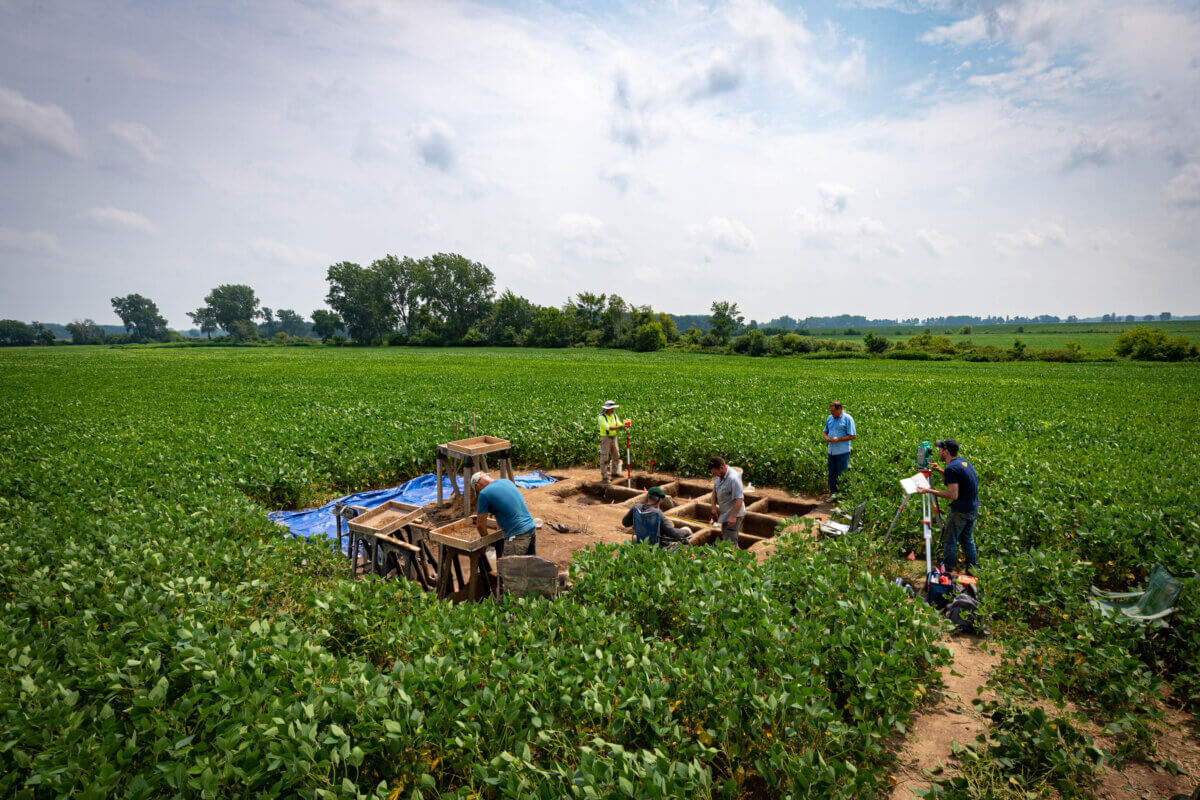
Credit: Daryl Marshke/Michigan Photography University of Michigan researchers and volunteers excavate the Belson Clovis Site in St. Joseph County.
ANN ARBOR, Mich. — Even our early human ancestors couldn’t resist the crystal-blue waters of the Great Lakes. A new study found that the Great Lakes were a repeat destination for the Clovis People, who appeared in North America 13,000 years ago. In what is now southwest Michigan, the Clovis people were found to have traveled back to the site for approximately three to five consecutive years.
The Clovis people appeared during the Pleistocene epoch, a time when sheets of glaciers blanketed most of the world, making areas like modern-day Michigan virtually unlivable. However, that assumption was broken in 2021 when a study found the Clovis people set up camp in southwest Michigan. These same researchers have found this wasn’t a one-off sightseeing trip, as recent evidence shows the Clovis people settled in this area for several years, most likely during the summer. The study is published in the journal PLOS ONE.
The southwest Michigan area where the Clovis people resided for some time is known as the Belson site. Researchers found several tools made of chert stone from an area in modern-day western Kentucky, about 400 miles from the Belson site. Fragments of the tool showed these pieces came from northeastern Kentucky and were from Paoli chert.
“It took me a year to identify it, and when I did, it was very surprising,” says Thomas Talbot, an independent researcher who first uncovered the first signs of Clovis settlement at the Belson site in Michigan in 2008 and who analyzed the chert tools, in a media release. “Then we found a broken base, which we call a diagnostic. The broken base was made from that Paoli material. Once you read the paper and look at the data and maps, there are some patterns that are starting to emerge that are pretty cool.”
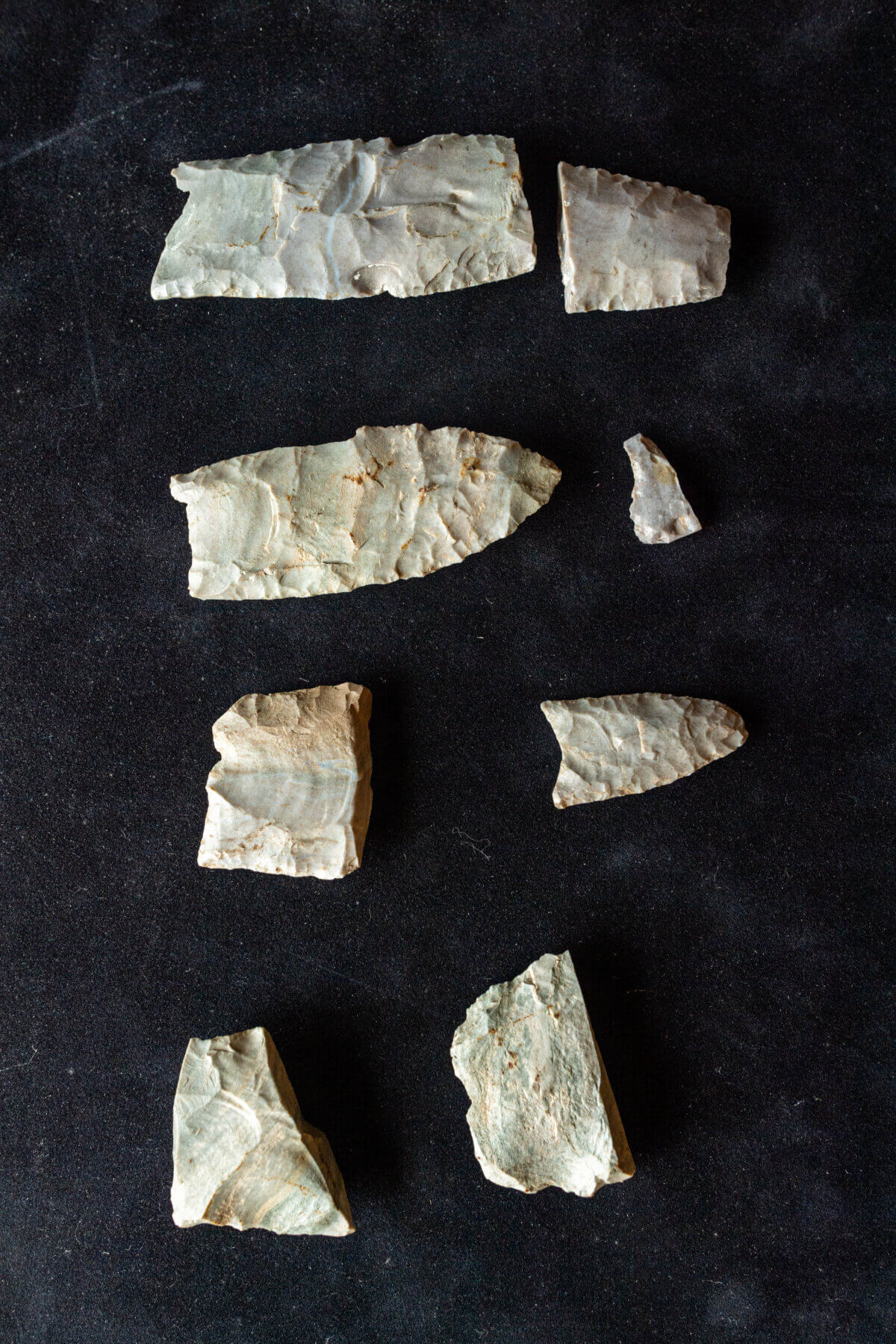
The tools helped create a timeline of the actions occurring among the Clovis people at the time. They were made in present-day Kentucky and then traded to other people living in central Indiana, who brought them to the Belson site. According to the researchers, people living at the Belson site lived there in the summer and went back to what is now central Indiana during the winter. The tool trade had to have happened during those yearly routes across North America.
“In this way, people formed ‘links in a chain’ with yearly routes that likely connected the whole continent, from Michigan to Mexico,” says Brendan Nash, a doctoral student of archaeology at the University of Michigan and lead author of the study. “This is likely why technology from the Clovis period is so similar throughout most of North America.”
A trademark of the Clovis people was using tools with spear points. These points often had a distinctive central channel through the length of the tool called a flute. The channel was used to attach a shaft into a spearhead to create hunting weapons for stalking prey of all sizes. Clovis people also used large flakes of materials off stones to develop points with razor-sharp edges, which created makeshift knives.
Archaeologists have yet to learn when the Clovis people began making weapons, but they know it was a popular tool-making method across America. Before 2021, Clovis tools had not been found in the Great Lakes region.
When visiting an area near the Belson site in 2017, the researchers hypothesized the area in Michigan was more significant to the Clovis people, who did not just randomly drop tools when traveling. The number of tool fragments suggested this group of people lived there.
The current study looked at buried flakes of Attica Chert — small chips from the stone the Clovis people used to make or resharpen their points. Other tools were buried in less disturbed sediment beneath other surface layers.
Of the dozens of tools found, researchers focused their attention on three. As they traced for protein remnants, they found signs of musk ox, caribou or deer, hare, and Peccary (an ancient ancestor to modern-day pigs). The hare and peccary protein came from the same Michigan area where the Clovis people were suspected of residing. The findings also showed the Clovis people had a more unique diet than previously suspected.
“Taken together, the ancient protein data suggests that these people had a broad spectrum diet, eating a wide variety of animals,” Nash explains. “Our findings are contrary to the popular notion that Clovis people were strictly big game hunters, most often subsisting on mammoths and mastodons.”
It’s also likely the Clovis people ate plants, but it’s harder to prove since plant material does not appear in protein tests. Additionally, plant remains are not as robust as animal bones, and traces do not last for 13,000 years.
“This site teaches us about a way of life lost to time,” Nash adds. “Through the sourcing of stone and the styles of tools, we are tracking a group of people as they live and travel across the Pleistocene landscape of the American Midwest.”
Paper Summary
Methodology
The researchers investigated a campsite used by Clovis people in the Great Lakes region around 14,000 years ago. To understand how the people lived and used the land, they excavated an area where ancient stone tools and flakes (small pieces of rock from tool-making) were found. They divided the site into small squares and carefully dug down layer by layer, making sure to record the exact location of every artifact they found.
The team then used a special instrument to measure the position of each item in 3D space. They sifted the soil to catch even the tiniest flakes and analyzed the types of stone to figure out where the Clovis people might have traveled to get their materials.
Key Results
The study uncovered many stone flakes and tools that were made from a type of stone called Attica chert, which was brought from a place over 200 kilometers away. The team found evidence that the site had been used multiple times, with people coming back to the same spot. They identified two areas where the tools were concentrated, suggesting different activities took place at each one.
Some tools had traces of animal proteins on them, meaning they were used for hunting or processing animals. The researchers concluded that the people who used the site had a broad diet and were skilled at finding and using the best materials available.
Study Limitations
One of the main limitations of the study is that the exact dates of the occupations at the site are difficult to pin down. While the tools and artifacts show clear signs of Clovis technology, it’s not certain how much time passed between each visit to the site.
Additionally, because of modern farming activities, the top layers of the soil have been disturbed, meaning some artifacts might have been moved from their original positions. The study also focused mainly on the stone tools, leaving other aspects of the site, like possible food remains or plant usage, less explored due to the difficulty of preserving such materials over thousands of years.
Discussion & Takeaways
The study of the Belson site gives us a clearer picture of how the Clovis people used the landscape during the late Ice Age. By analyzing the tools and their arrangement, the researchers believe the site was likely a hub for hunting and processing animals, with people returning multiple times to carry out specific tasks.
This pattern of site reuse suggests that the Clovis people were not just wandering aimlessly but had a plan for how they moved across the land. Their reliance on high-quality stone from far away also indicates they had networks for resource gathering. Overall, the site offers valuable insights into how early humans organized their lives and interacted with their environment.
Funding & Disclosures
The research was partly funded by the Rackham Student Research Improvement Grant from the Horace H. Rackham School of Graduate Studies at the University of Michigan. The authors have stated that they have no competing interests, meaning they did not receive any financial or personal benefits that could have influenced the study’s results.


