(Credit: muratart/Shutterstock)
In A Nutshell
- About 11 billion years ago, a dwarf galaxy called the Gaia-Sausage-Enceladus slammed into the young Milky Way, severely rattling its spinning disk but failing to destroy it.
- New computer simulations show the collision scrambled the orbital motion of ancient stars, making our galaxy’s disk appear younger than it actually is when measured by today’s telescopes.
- The crash likely triggered a massive burst of new star formation, a conclusion supported by the fact that ancient star clusters across a wide range of iron content all appear to have formed at roughly the same time.
- Because our oldest stars still show organized rotation today, researchers conclude the intruding galaxy was probably less than one-quarter the Milky Way’s mass, large enough to leave a lasting mark but not large enough to destroy what the young galaxy had already built.
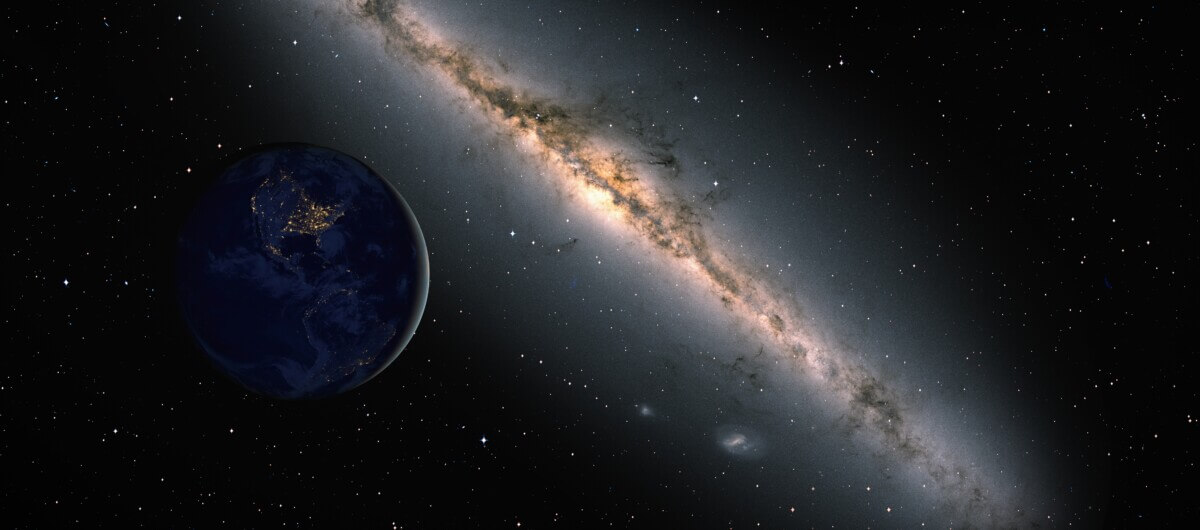
A colossal collision with another galaxy severely disrupted the Milky Way’s spinning disk about 11 billion years ago. New research using computer simulations offers clues to how our galaxy’s disk survived, and why present-day stellar motions may make it look younger than it really is.
For decades, astronomers have tried to piece together the Milky Way’s earliest chapters by studying the motion and chemistry of ancient stars. That same crash, it turns out, scrambled many of those very clues. A new study published in Monthly Notices of the Royal Astronomical Society finds that what looks like the disk’s “birth moment” in today’s stellar movements is often a distorted echo of a much earlier event, pushed forward in time by the shockwaves of that impact.
Known as the Gaia-Sausage-Enceladus, or GSE, the culprit was a now-absorbed dwarf galaxy that slammed into the young Milky Way. The new study argues this merger was most likely a “minor” event in galactic terms, meaning the intruder was probably less than one-quarter the mass of the early Milky Way. That constraint, the researchers say, explains why our galaxy’s rotating disk survived at all.
The Milky Way’s Disk Is Older Than It Looks
To reach these conclusions, researchers Matthew Orkney and Chervin Laporte drew from the AURIGA simulation suite, starting with 30 Milky Way-mass virtual galaxies and focusing on 16 that had ancient, direct mergers resembling the one thought to have shaped our galaxy. Each simulation tracks gas cooling, star formation, stellar explosions, black holes, and magnetic fields across billions of years. By comparing how these virtual galaxies evolved after their collisions with what the Gaia satellite observes in our own galaxy today, the team could test which scenarios best match reality.
One of the study’s most eye-opening findings involves when the Milky Way’s disk first started spinning in an organized way. Stars in a disk orbit the galactic center in roughly circular paths, much like planets around the sun. Astronomers measure how orderly this motion is on a scale where a score near +1 means a smooth, forward-moving orbit and a score near 0 means the star is plunging chaotically inward and outward.
When the researchers looked at these orbital scores as they appear today, the data suggested the disk started spinning relatively late. When they rewound the clock and examined those same stars’ orbits at birth, the disk had actually been spinning much earlier, in some simulations more than 12 billion years ago. In other words, the crash had scrambled the motion of those ancient stars, making the disk look far younger than it was.

A Crash That Likely Sparked a Firestorm of New Stars
Rather than simply scattering existing stars, the GSE collision also appears to have triggered a massive wave of new star formation. When the intruder made its first close pass toward the galactic center, the gravitational disruption likely compressed gas clouds and ignited a burst of stellar births. In most of the simulations, that burst of newly formed stars outweighed the population of older disk stars knocked onto halo-like orbits, meaning paths that fling stars far out of the disk plane rather than keeping them on smooth, circular tracks.
Stars born during that compressed, chaotic period tended to form quickly, before the surrounding gas could become heavily enriched with iron, leaving them iron-poor but rich in elements like magnesium. Researchers estimate the GSE’s first close passage happened around 11 billion years ago, with the interaction winding down roughly a billion years later. That timing becomes especially telling when looking at globular clusters, dense, ancient balls of stars that orbit the Milky Way. Clusters within a particular range of iron content appear to share a common formation time, which the researchers interpret as a possible signature of that same starburst. To the researchers, the fact that both timelines land at the same moment is “remarkable corroboration.” After about 10 billion years ago, the simulated record shows a sharp drop in halo and kicked-up disk stars, consistent with the merger’s disruptive phase coming to an end.
How Big Was the Galaxy That Hit Ours?
Perhaps the most consequential constraint the study places on the GSE is its mass. Gaia and other sky surveys show that very old stars in our galaxy, some as ancient as 13.5 billion years, still display clear, organized rotation. In the simulations, only minor mergers, where the intruder was less than one-quarter the mass of its host, preserved that level of organized rotation. Major mergers were far more destructive, dropping the orbital circularity scores of ancient stars to near zero and erasing nearly all trace of any disk that existed before the crash. Because our oldest stars still show strong, orderly rotation today, the researchers conclude the GSE almost certainly fell into the minor-merger category.
Our galaxy took a cosmic punch around 11 billion years ago, likely sparked a wave of new stars in the process, and kept spinning. Billions of years later, every chapter of that ordeal survives in the chemistry and motion of stars astronomers are only now learning to decode.
Paper Notes
Limitations
This study relies primarily on the AURIGA simulation suite, which uses subgrid models, simplified stand-ins for physical processes too small-scale to simulate directly, such as individual star formation events and supernova explosions. The simulations were selected to bracket the most likely mass range of the Milky Way but were not specifically designed to reproduce the Local Group or Local Volume environment. Merger mass ratio determinations can vary substantially depending on when along the merger’s path the measurement is taken and should be viewed as approximate. Additionally, the investigation of the Eos stellar population was limited to a single re-run simulation because the tracer particles needed to track gas flow were not available for most simulations in the suite. Age uncertainties in real observational data also make it harder to distinguish populations like the Splash and the starburst in practice, as the authors acknowledge.
Funding and Disclosures
Researchers Matthew Orkney and Chervin Laporte acknowledge funding from the European Research Council under the European Union’s Horizon 2020 research and innovation programme (grant agreement no. 852839). Laporte also acknowledges funding from the Agence Nationale de la Recherche (ANR project ANR-24-CPJ1-0160-01) and financial support from the CEX2024-001451-M grant funded by MICIU/AEI/10.13039/501100011033. Computational work was carried out on the MareNostrum 4 supercomputer at the Barcelona Supercomputing Center, the Virgo supercomputer at the Max Planck Computing and Data Facility, and the NYX supercomputer at the Universitat de Barcelona.
Publication Details
Authors: Matthew D. A. Orkney and Chervin F. P. Laporte | Affiliations: Institut de Ciencies del Cosmos (ICCUB), Universitat de Barcelona, Spain; Institut d’Estudis Espacials de Catalunya (IEEC), Spain; LIRA, Observatoire de Paris, France; Kavli IPMU (WPI), The University of Tokyo, Japan | Journal: Monthly Notices of the Royal Astronomical Society (MNRAS) | Paper Title: “Build-up and survival of the disc: from numerical models of galaxy formation to the Milky Way” | Volume/Issue: MNRAS 548, 1-22 (2026) | DOI: https://doi.org/10.1093/mnras/staf2154 | Received: 2025 September 12 | Accepted: 2025 November 30


