
(© Giovanni Cancemi - stock.adobe.com)
Half of Tested Voles on Washington Farms Carried Hantavirus Antibodies, New Study Finds
In a Nutshell
- Half of montane voles tested on farmland sites carried antibodies to the virus, and more than 22% had viral RNA in lung tissue, raising questions about which rodent species are actually driving transmission.
- Researchers sequenced Sin Nombre hantavirus from the Pacific Northwest for the first time, with genetic modeling suggesting it may have circulated in the region since around 1915.
- Scientists warn that surveillance focused primarily on deer mice may be underestimating exposure risk, and call for broader genomic monitoring across more species and sites.
A virus with a 36% fatality rate appears to have been quietly circulating across Pacific Northwest farms for more than a century — and scientists are only now uncovering the genetic evidence of how long it has been there.
New research published in Emerging Infectious Diseases offers the first genomic sequences of Sin Nombre virus ever recovered from the northwestern United States. Drawn from rodent trapping across farms and natural areas in Washington and Idaho, the analysis suggests the virus may have arrived in the region from Montana sometime around 1915, though scientists are careful to note the uncertainty in that estimate is wide. What’s harder to dispute is what the data show about the present: the pathogen is circulating at high rates, actively infecting multiple rodent species, and has been diversifying locally for what could be generations without meaningful genomic tracking.
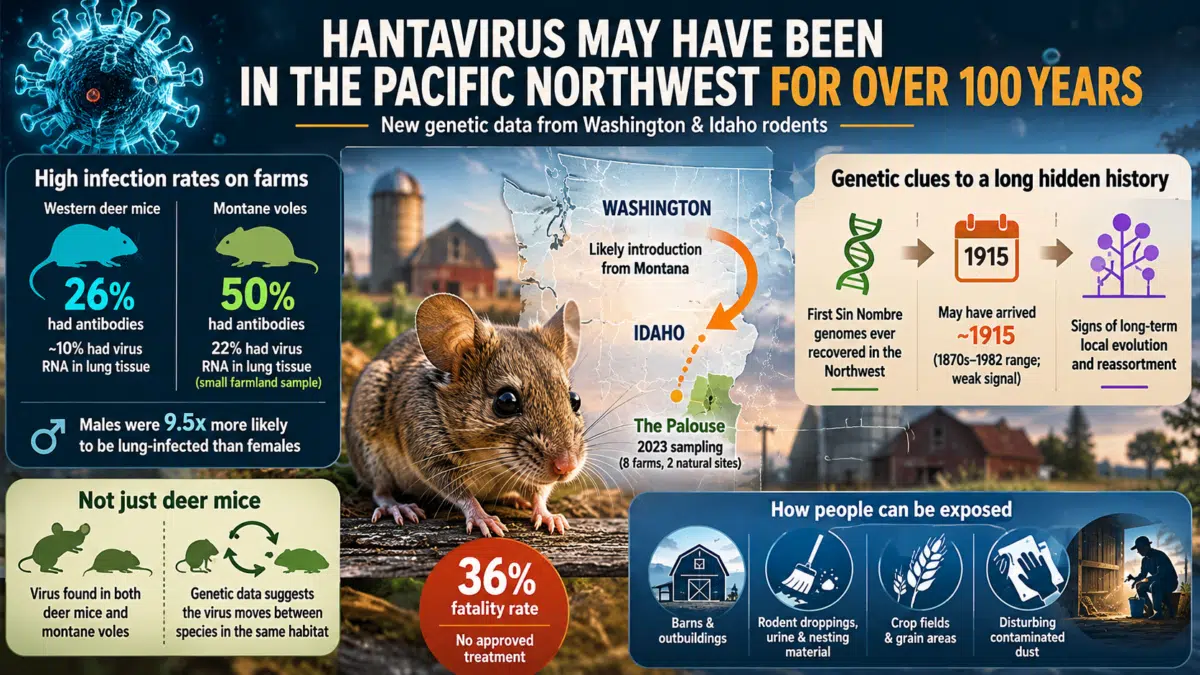
Sin Nombre virus is the primary cause of hantavirus pulmonary syndrome in North America, a severe respiratory illness with no approved treatment. People contract it by inhaling microscopic particles shed in infected rodent droppings, urine, or nesting material — a straightforward exposure risk in barns, outbuildings, or crop fields.
Since the virus was first identified during a 1993 outbreak in the Four Corners region, 864 confirmed U.S. cases have been recorded through 2022, with 109 of those in Idaho, Oregon, and Washington. More than one in three people diagnosed do not survive.
Virtually no genomic data had existed from the Northwest to track the virus’s history or evolution in the region. Without that baseline, scientists had no way to know how established this pathogen actually was, or what it had been doing in the intervening decades.
“We were surprised both by how common the virus was locally and by how little data existed for the Northwest,” said Stephanie Seifert, the study’s corresponding author, in a statement. “We’re really just beginning to understand how widespread and complex this virus is in rodent populations here.”
Sin Nombre Virus Circulating at High Rates on Pacific Northwest Farms
A research team from Washington State University, the University of Washington, and the Washington State Department of Health set out to address that gap. During the summer of 2023, they live-trapped 189 rodents at eight farms and two forested sites in the Palouse, the rolling agricultural landscape straddling eastern Washington and western Idaho. Over three consecutive nights at each location, they collected fecal samples via mark-recapture; on the final night, they also collected blood, lung tissue, and bladder tissue through lethal sampling. All samples were tested for Sin Nombre antibodies and for the virus’s RNA by PCR.
Western deer mice, the rodent species long established as the primary reservoir for Sin Nombre virus in North America, showed a 26% seroprevalence rate across all sites. That means more than one in four carried antibodies signaling past or active infection. Nearly 10% had virus RNA detected in their lung tissue.
Montane voles produced an even more notable result. In the small farmland sample, half of all montane voles tested seropositive for the virus, and more than 22% had virus RNA detected in lung tissue at levels in the same range as infected deer mice. That comparability suggests voles may be more than incidental hosts, though the sample was too small to draw firm conclusions about their role as a sustained reservoir.
Male rodents of both species were far more likely to test positive for lung infection than females, with odds nearly 9.5 times higher. Researchers note this pattern has appeared in prior Sin Nombre studies, though the biological explanation remains unknown.
Genomic Evidence Points to a Century of Undetected Hantavirus Spread
Recovering actual genome sequences from the Palouse rodents was itself a significant step. Fewer than 100 complete Sin Nombre genomes had ever been published globally before this work, and not one had come from the northwestern United States. The team recovered full or near-complete sequences from 10 rodents, including two montane voles, marking the first such data from the region.
When those sequences were compared against the broader national library of Sin Nombre genomes, the Palouse samples formed a distinct genetic cluster most closely related to strains collected in Montana between 2008 and 2009. Phylogeographic modeling, a technique that uses genetic data to reconstruct where and when a virus moved across geography, pointed to an introduction into Washington from Montana that could date to approximately 1915. The confidence interval on that estimate spans from the 1870s to 1982, and the researchers explicitly flag the temporal signal as weak. The implied history is plausible based on the data, not definitively established.
What the genomics reveal more firmly is the pattern of what followed. Palouse sequences show signs of prolonged local diversification, meaning the virus has been replicating and evolving within the region’s rodent populations for an extended period. There is also evidence of reassortment, a process in which two different viral strains swap genetic segments when they infect the same host simultaneously. It is the same mechanism that produces new influenza strains. Topological mismatches across the three genome segments of the Palouse strains fit that pattern, and sequences from both western deer mice and montane voles clustered together with strong statistical support, consistent with the virus moving between species in the same landscape.
A Hantavirus Surveillance Gap That Can No Longer Be Ignored
Surveillance for hantavirus has often centered on deer mice as the primary indicator species. If Sin Nombre is circulating at similar or higher rates in voles and potentially other rodents sharing the same habitat, deer-mouse-only monitoring may be missing a meaningful share of actual exposure risk for people working in affected agricultural areas.
Hantavirus pulmonary syndrome offers little warning. Early symptoms, including fever, fatigue, muscle aches, are easy to dismiss as flu. Within days, the lungs can begin filling with fluid, and the disease can worsen quickly once breathing difficulties begin. Farm workers, hunters, and anyone who regularly disturbs rodent-infested spaces face potential exposure through contaminated aerosols, often without realizing the risk.
The researchers note their findings echo recent work from New Mexico, where similarly elevated Sin Nombre prevalence was documented across multiple rodent species, including successful recovery of infectious virus. Both datasets point to a reservoir that is broader and more deeply rooted than deer-mouse-centric surveillance has captured.
Sin Nombre virus has been quietly present in one of the country’s most productive agricultural regions, largely unsequenced and uncharacterized, for what may be well over a century. Getting a clearer map of where it lives, which animals carry it, and how it is evolving is not an academic exercise — it is the groundwork for understanding who is actually at risk.
Disclaimer: This article is for informational purposes only and does not constitute medical or public health advice. The findings described are based on wildlife surveillance research conducted in a specific geographic region and may not reflect conditions elsewhere. If you believe you have been exposed to rodent droppings, nesting material, or urine in an area where hantavirus is known to circulate, consult a qualified healthcare professional promptly. Do not use this article as a substitute for guidance from a licensed medical provider or your local public health authority.
Paper Notes
Limitations
This study was conducted over a single trapping season (June–August 2023) at a limited number of sites within one agricultural region of eastern Washington and western Idaho. Sample sizes for some species, particularly montane voles, were small enough that prevalence estimates carry meaningful uncertainty. Phylogeographic modeling produced a weak temporal signal, likely reflecting confounding between sampling time and geographic structure; the estimated introduction date of Sin Nombre virus into Washington carries a 95% highest posterior density interval spanning 1873 to 1982, making precise historical dating impossible with the current data. Low statistical support for a direct Montana-to-Washington transmission pathway suggests unsampled intermediate populations exist. Fewer lung samples tested positive by PCR than by serology across all species, which the authors note is biologically expected but limits direct confirmation of active infection. The authors call for broader spatial and temporal sequencing to resolve the regional phylogeny.
Funding and Disclosures
Funding was provided by the Centers for Disease Control and Prevention Center for Forecasting and Outbreak Analytics (cooperative agreement CDC-RFA-FT-23-0069). Authors Stephanie N. Seifert, Ricardo Rivero, and Jennifer Horton received additional support from the U.S. National Science Foundation (grant no. NSF DBI 2515340). No conflicts of interest are disclosed.
Publication Details
Authors: Grant Rickard, Ricardo Rivero, A. Catherine Grady, Jennifer Horton, Cody J. Lauritsen, Stephen Fawcett, Samuel M. Goodfellow, Hanna N. Oltean, M. Pilar Fernandez, and Stephanie N. Seifert. Rickard and Rivero contributed equally as co-first authors.
Affiliations: Washington State University Paul G. Allen School for Global Health (Pullman, WA); University of Washington School of Medicine (Seattle, WA); Children’s Hospital Los Angeles (Los Angeles, CA); Washington State Department of Health Zoonotic and Vector-borne Disease Program (Tumwater, WA).
Journal: Emerging Infectious Diseases, Vol. 32, No. 5, May 2026 (CDC journal).
Title: “Genomic Analysis of Sin Nombre Virus Sequences, Northwestern United States, 2023”
DOI: 10.3201/eid3205.251476


