
(Photo by Unsplash+ in collaboration with Josue Michel)
In A Nutshell
- Gum disease and chronic kidney disease appear to reinforce each other through shared inflammation, with each condition making the other progressively harder to treat.
- Multiple studies link moderate-to-severe gum disease to faster kidney function decline and higher death rates among CKD patients.
- Nonsurgical gum treatment has been associated with measurable reductions in inflammatory markers in kidney patients, with some early signs of improved kidney function.
- Dental care is rarely integrated into kidney disease management, despite evidence that routine oral checkups could help detect and reduce systemic inflammation earlier.
Most people know that skipping the dentist is bad for their teeth. A wide-ranging review published in BMC Nephrology now adds a more alarming reason to keep those appointments. Gum disease and chronic kidney disease appear to reinforce each other through a shared cycle of inflammation, and treating gum disease may be one of the more accessible ways to slow that cycle down.
Chronic kidney disease, known as CKD, is one of the fastest-growing causes of death and disability on the planet, projected to rank among the leading causes of years of life lost by 2040, with Medicare spending in the U.S. approaching $130 billion a year. Severe gum disease affects nearly one billion people worldwide, at an annual dental care cost topping $136 billion in the U.S. alone. When both land in the same patient, researchers argue, the two may create a heavier inflammatory burden than either condition alone.
A multinational team of nephrologists and dental researchers combed through decades of clinical data to map the connections between the mouth and the kidneys. Their review suggests these two conditions are more connected than traditionally treated, with evidence suggesting each may influence the other’s progression in ways that have not yet found their way into standard care.
The Bidirectional Link Between Gum Disease and Kidney Disease
Gum disease, clinically known as periodontitis, is not just a local infection. When bacteria build up below the gumline and trigger chronic inflammation, inflammatory signals can enter the bloodstream and travel to organs throughout the body. Inside the kidneys, those signals promote scarring, damage tiny blood vessels, and speed up the loss of filtering function. Studies in the review found that patients with moderate-to-severe gum disease show faster kidney function decline and higher death rates than CKD patients without serious gum disease. One meta-analysis found the odds of severe CKD were roughly 2.4 times higher in people with periodontitis.
Kidney disease then returns the favor. As kidney function falls, waste products accumulate in the blood and compromise the immune system’s ability to fight infection, leaving the gums more vulnerable and slower to heal. Mineral imbalances driven by CKD also weaken jaw bone over time. Study after study in the review found that gum disease worsens with each stage of kidney decline, each condition making the other progressively harder to treat.
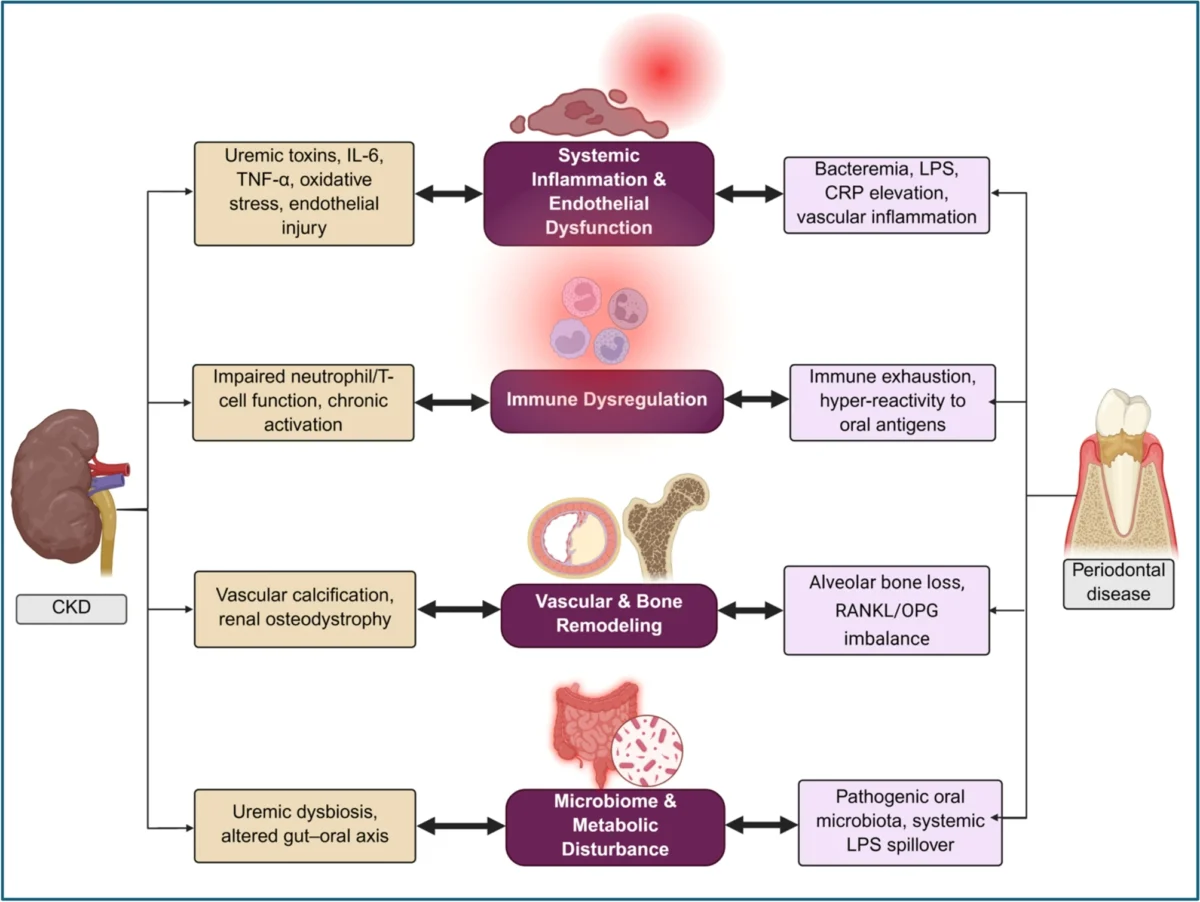
Treating Gum Disease May Help Slow Kidney Disease Progression
Across multiple clinical trials, nonsurgical gum treatment, which involves professional deep cleaning and plaque removal below the gumline, produced measurable drops in those same inflammatory signals among CKD patients. One exploratory trial found that gum treatment was linked to small, early signs of improved kidney function in some patients, as measured by cystatin C, a blood protein used to gauge how well the kidneys are working.
In patients awaiting kidney transplants, the benefits appear to go further. One study in transplant candidates found substantially fewer cardiovascular events among those who received gum treatment before surgery compared with untreated patients, a reduction the authors credit largely to the lower inflammatory load that follows effective oral care.
Even brushing shows up in the data. Twice-daily toothbrushing has been linked in research to better overall health outcomes, including lower cardiovascular risk, making one of the cheapest health habits around a potentially important factor in overall chronic disease management.
Reviewers are careful about their conclusions. Most of the underlying data are observational, effect sizes are modest, and the pathways involved are shared with other chronic diseases, making it hard to pin kidney-specific benefits on dental treatment alone. Larger randomized trials are still needed. Still, the evidence consistently points in the same direction, and the authors argue it is enough to justify putting oral health on the checklist in kidney care.
Oral Complications That Come With Kidney Failure
For patients on dialysis, a process that mechanically filters the blood when the kidneys can no longer do it, or those waiting on a transplant, the mouth often takes a beating that goes largely unaddressed. Fluid restrictions and a heavy drug regimen dry out the mouth, and chronic dry mouth accelerates tooth decay. Cyclosporine, a drug widely used to prevent transplant rejection by suppressing the immune system, causes overgrown gum tissue in a significant share of patients, making eating and speaking uncomfortable. Fungal infections and jaw bone loss, both tied to the immune dysfunction and mineral imbalances of advanced CKD, round out a picture that rarely comes up in a nephrology clinic.
Surveys of transplant centers have found wide variation in whether patients get dental clearance before surgery or have oral infections treated before immunosuppressive drugs begin, a gap with real consequences given how tightly the two systems are linked.
An Overlooked Gap in Chronic Disease Care
Structural barriers make integration difficult. Dental care is left out of universal health coverage in many countries, and dental professionals are scarce in the rural and lower-income areas where CKD is most concentrated. Nearly 80% of people with CKD live in low- and middle-income countries, where access to kidney care is already stretched thin.
Connecting the two disciplines does not require a new drug or new technology. Routine oral checkups built into nephrology visits, and health records that flag dental status alongside kidney function, could go a long way toward closing a gap that has real consequences for millions of patients.
Gum disease has long been dismissed as a dental problem. Science is increasingly recasting it as a systemic one, with growing evidence linking it to kidney health.
Disclaimer: This article is based on findings from a published narrative review and is intended for informational purposes only. Study findings, particularly those from observational research, do not establish direct causation. Always consult a qualified healthcare provider before making changes to your health or treatment plan.
Paper Notes
Limitations
As a narrative review rather than a formal systematic meta-analysis, this paper synthesizes findings across a broad range of study types but does not apply the same statistical rigor as a quantitative meta-analysis. Most of the underlying clinical data are observational, with modest effect sizes, and the inflammatory pathways linking gum disease to kidney disease are shared with other chronic conditions, making it difficult to establish kidney-specific causation. Heterogeneity in study designs, small sample sizes in many trials, and inconsistent use of dental measurement tools limit direct comparisons across studies. Long-term kidney outcomes from periodontal treatment remain uncertain, and adequately powered randomized controlled trials are still needed to confirm causality and quantify the benefit.
Funding and Disclosures
No funding was received for this study. Among the authors, Edgar Lerma disclosed speaker bureau relationships with Novo Nordisk, Opko, Otsuka, and Vertex, and advisory board roles with AstraZeneca, Natera, Otsuka, Travere, Vera, and Vertex. Prakash Gudsoorkar disclosed serving as Deputy Editor for the American Society of Nephrology’s Kidney News, as an Editorial Board Member for Advances in Kidney Disease and Health and BMC Nephrology, and as a member of the Medical Advisory Board for the National Kidney Foundation of Ohio and the advisory boards of Akebia Therapeutics and Amgen. All remaining authors reported nothing to disclose.
Publication Details
Published in BMC Nephrology (2026), Volume 27, Article 201, this paper is titled “Bridging systems: oral-kidney connections – pathophysiological links, clinical implications, and health system integration – a narrative review.” Authors: Priyanka Gudsoorkar, C. Elena Cervantes, Isabella Lerma, Anay Dudhbhate, Sujay A. J. Mehta, Ramprasad Vasthare, Edgar Lerma, Lakshman Samaranayake, and Prakash Gudsoorkar, Department of Medicine, Division of Nephrology, University of Cincinnati. DOI: 10.1186/s12882-026-04843-y. Published online February 24, 2026.


