
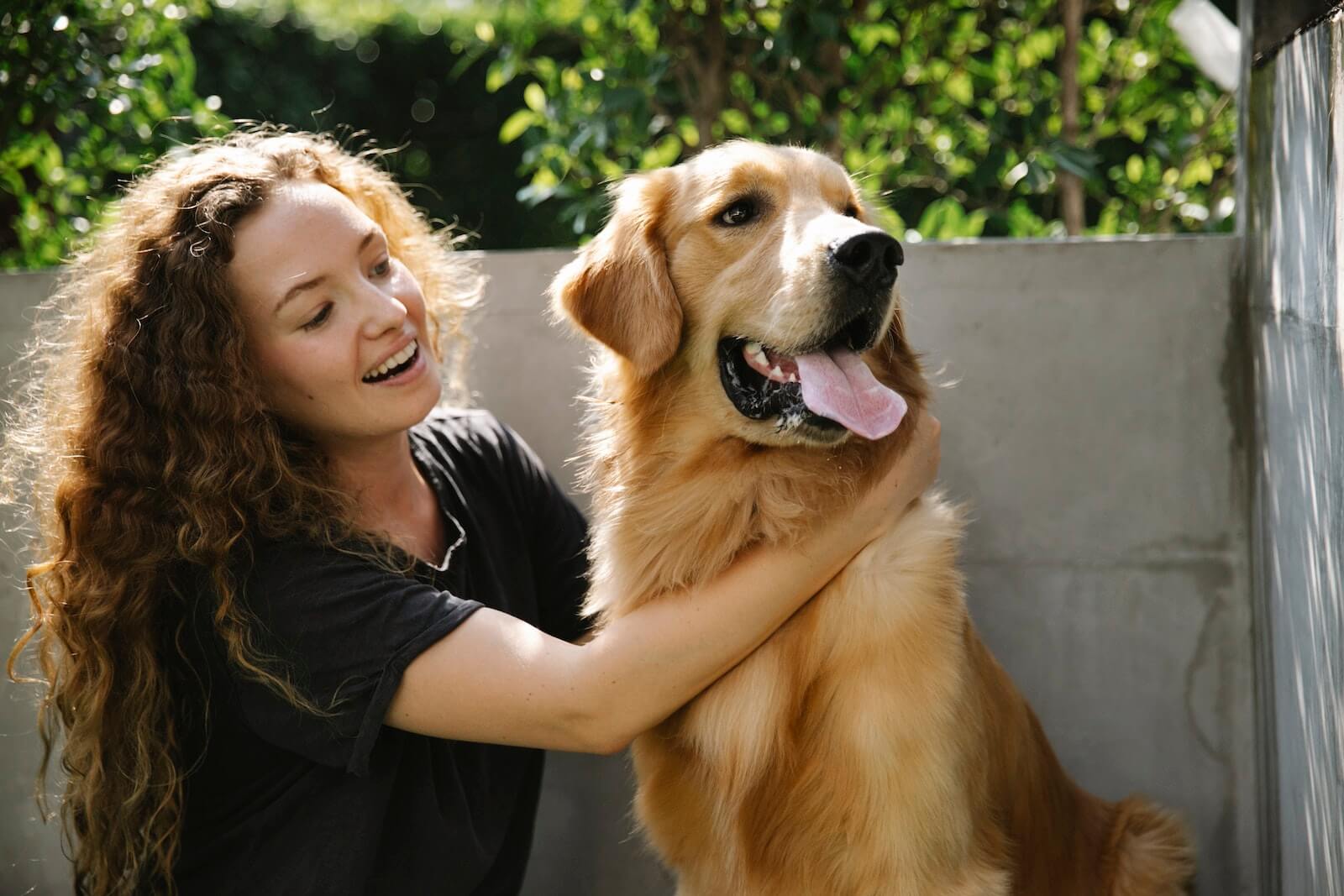
This golden retriever, one of the dogs involved in the study, shows ‘good behavior’. (Credit: Morris Animal Foundation)
People and pups may be more genetically similar than widely believed.
In A Nutshell
- A gene linked to dog aggression is also associated with human intelligence, cognitive performance, and major depression, suggesting that what makes a dog reactive might share biology with what makes humans smart or sad
- Dogs that excel at training carry gene variants tied to human intelligence and emotional sensitivity, meaning “trainable” dogs might just be smarter and more emotionally aware
- Genes for dog fear overlap strongly with human anxiety, depression, and neuroticism; a fearful dog could be experiencing something closer to clinical anxiety than bad behavior
- The same genes matter across species despite millions of years of evolution, making dogs valuable models for understanding human mental health conditions
A dog lunges at another pup at the park. Meanwhile, a person struggles with depression while excelling academically. These two scenarios seem worlds apart, but new research suggests they might share the same genetic roots.
Scientists studying over 1,000 golden retrievers have discovered many of the genes that influence dog behavior also shape human personality, intelligence, and mental health. The overlap is strong enough to challenge typical explanations for what drives behavior in both species.
Take the gene PTPN1. In golden retrievers, variants near this gene more than doubled the odds of a dog showing aggression toward other dogs, though most dogs still didn’t display the behavior. In humans, the same gene connects to intelligence, how well someone performs on cognitive tests, educational achievement, and major depression. A gene linked to a dog’s tendency to snap is also tied to how humans think and feel.
Published in Proceedings of the National Academy of Sciences, the finding challenges a simple view of behavior. When a dog acts aggressively, it might not just be about poor training or a bad temperament. The biology driving that behavior could be related to the same systems that affect mood and cognition in people.
Smart Dogs Learn Differently
Dog trainers often assume that an easily trained dog is simply more obedient or food-motivated. The genetics tell a different story.
Golden retrievers that excelled at training carried variants in genes called ROMO1 and ADGRL2. In humans, ROMO1 is associated with intelligence and cognitive performance. ADGRL2 links to emotional sensitivity and irritability. Dogs that are “trainable” might actually be dogs that are smarter and more emotionally aware, not just more compliant.
This matters for programs that train service dogs. Many rely heavily on food rewards to shape behavior. But if trainability is really about problem-solving ability, programs might be better off selecting dogs based on cognitive tests rather than just how eagerly they chase treats.

What Fear Really Means
The strongest genetic overlaps showed up in fear-related behaviors. Dogs that were afraid of loud noises, strangers, or other dogs carried variants in genes like ASCC3 and PRDX1. In humans, these same genes are linked to anxiety, depression, mood swings, neuroticism, and emotional sensitivity.
That suggests something important: when a dog cowers during a thunderstorm or hides from visitors, the experience might be closer to human anxiety than previously thought. Both species appear to share genetic vulnerabilities in how the nervous system processes threats and regulates emotions.
For owners dealing with fearful or reactive dogs, this reframes the problem. It’s not just about exposure or training. These dogs might have emotional wiring that makes the world feel more threatening. Desensitization training might help, but so could environmental changes that reduce stress or, in severe cases, medication.
Of course, genetics isn’t destiny. Training, early life experiences, and environment still play major roles in shaping how dogs behave. But understanding the genetic component helps explain why some dogs struggle more than others despite similar training and care.
Why Dogs Make Sense as a Research Model
Dogs and humans are distant evolutionary relatives, but the genetic systems controlling behavior haven’t changed much. The same pathways that help a dog assess danger, bond socially, and learn from experience work similarly in people.
That makes dogs useful for understanding the biology of psychiatric traits. Unlike humans, dogs don’t go to school, worry about their careers, or doom-scroll social media. Their behaviors are less tangled up in culture and circumstance, which makes it easier to spot the genetic signal. When a gene shows up as important in both species, it’s a strong hint that the gene really matters.
Golden retrievers were particularly useful here because purebred dogs have less genetic variation than mutts or humans, making it easier to connect specific genes to specific behaviors. The downside is that findings from one breed might not apply to all dogs. But the fact that these same genes matter in humans suggests they’re tapping into something fundamental.
The study also cleared up confusion about body size and behavior. Earlier research had linked the IGF1 gene, which controls how big a dog grows, to fear and aggression. Some scientists thought this was misleading because small dogs might just act differently due to experiencing the world from a smaller vantage point.
In golden retrievers, which are all relatively large, IGF1 variants affected energy levels but not fear or aggression. Dogs with the bigger-size version of the gene were noticeably less energetic, and this had nothing to do with whether they were overweight. So IGF1 does influence behavior, but probably by affecting brain chemistry rather than just making a dog smaller or larger.
What This Means for Treatment
For trainers and vets, the research points to a more nuanced approach. A dog that bites, cowers, or won’t listen might not just need more discipline. The animal could have a genetic predisposition that makes it more reactive, anxious, or less able to regulate emotions. Treatment might need to address the dog’s internal state, not just its external actions.
For psychiatry, the work reinforces that mental health conditions aren’t random quirks. Depression, anxiety, and cognitive differences in humans are rooted in ancient biological systems shared with other mammals. Studying how these systems work in dogs could eventually lead to better treatments for people. When the same gene affects aggression in dogs and intelligence in humans, it hints that these traits might stem from a common mechanism, like how the brain handles stress or processes social information.
Paper Notes
Study Limitations
The research relied on owner-reported questionnaires rather than direct observation of dog behavior, which introduces subjectivity in how owners perceive their pets. Environmental factors like training methods, household dynamics, and life experiences varied widely and could influence behavior. The study included only golden retrievers aged 3 to 7 years, so results may not apply to other breeds, younger or older dogs, or mixed breeds. Several behaviors were rare in the population, with most dogs showing little to no expression, which complicated analysis. Heritability estimates for some traits had large margins of error due to modest sample sizes. Most dogs were spayed or neutered, which could affect hormone-related behaviors. The comparison with human genetic data is observational and doesn’t prove the same variants cause similar traits in both species.
Funding and Disclosures
The Golden Retriever Lifetime Study and this research were funded by the Morris Family Foundation, the Mark and Bette Morris Family Foundation, VCA, the V Foundation, Blue Buffalo Company, Petco Love, Zoetis, Antech Inc., Elanco, the Purina Institute, Orvis, the Golden Retriever Foundation, the Hadley and Marion Stuart Foundation, Mars Veterinary, generous private donors, and the Flint Animal Cancer Center at Colorado State University. Funders had no role in study design, data collection, analysis, publication decisions, or manuscript preparation. Enoch Alex’s PhD studentship is funded by the Cambridge Commonwealth European and International Trust and Jameel Education Foundation Scholarship. Eleanor Raffan and Anna Morros-Nuevo are funded by Morris Animal Foundation. Varun Warrier is funded by the Wellcome Trust, MRC, and UKRI. Authors declared no competing interests.
Publication Details
Authors: Enoch Alex, Paul Gennotte, Anna Morros Nuevo, Yunzhu Yu, Benjamin Keep, Megan Sullivan, Daniel Mills, Varun Warrier, and Eleanor Raffan
Affiliations: Department of Physiology, Development and Neuroscience, University of Cambridge; Department of Psychology, School of Biological and Behavioural Sciences, Queen Mary University of London; Department of Biological and Life Sciences, School of Natural Sciences, University of Lincoln; Department of Psychiatry, University of Cambridge; Department of Psychology, University of Cambridge
Journal: Proceedings of the National Academy of Sciences (PNAS) Title: GWAS for behavioral traits in golden retrievers identifies genes implicated in human temperament, mental health, and cognition Publication Date: November 24, 2025 Volume/Issue: Vol. 122, No. 48 Article ID: e2421757122 DOI: 10.1073/pnas.2421757122 Editor: Kathryn Lord, University of Massachusetts Chan Medical School (guest editor invited by the Editorial Board)


