
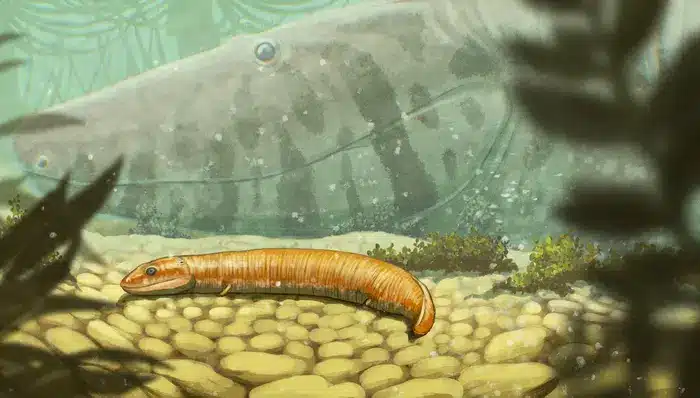
Baby crocodile-like early tetrapods called embolomeres. New fossil evidence suggests that these embolomeres did not undergo a metamorphosis the way that modern amphibians do when growing up, which challenges a long-standing scientific belief that amphibians, reptiles, and mammals evolved from animals that had a tadpole stage. (Credit: Illustration by Berit) Godring
In a Nutshell
- Fossilized hatchlings of early four-limbed animals show no evidence of a tadpole-like larval stage, suggesting they hatched as miniature adults rather than undergoing a dramatic transformation.
- The ability to change from a water-breathing larva into a land-capable adult likely evolved tens of millions of years after the first animals developed limbs and began moving onto land, though the precise timing and evolutionary path remain uncertain.
- The tadpole-style life cycle seen in modern frogs and salamanders may not have been a key stepping stone for the original move onto land. It may have come later, possibly as an adaptation that helped certain animal groups thrive in drier, more seasonal environments.
A set of tiny fossils from an ancient Illinois swamp has upended one of biology’s most familiar origin stories.
For generations, scientists assumed that the ancient creatures making the first moves from water to land passed through something like a tadpole stage, a water-bound baby phase that later reshaped into a more land-ready adult. It made intuitive sense. Frogs do it. Salamanders do it. Why wouldn’t their ancient ancestors?
A study published in the journal Science presents evidence that the earliest four-limbed animals, the pioneers of life on land, may have skipped the tadpole-like phase entirely. Instead of hatching into swimming larvae that later reshaped into adults through a dramatic body overhaul, the lineages and specimens studied appear to have hatched as small versions of their parents, with no sign of a larval transformation. Scientists call this “direct development,” and finding strong evidence for it this far back in the fossil record rewrites a foundational chapter of evolutionary history.
If the first land animals didn’t rely on a larval-to-adult switch to make the water-to-land leap, then the very process long thought to have eased the move onto land may have arrived tens of millions of years after animals first developed limbs and moved ashore. Researchers caution that the exact timing remains an estimate, but that reordering touches one of the most studied transitions in the history of life on Earth.
Baby Fossils From an Ancient Illinois Swamp
Evidence comes from an extraordinary fossil site in central Illinois called the Mazon Creek fossil beds. Thousands of ancient organisms were preserved in fine detail inside iron-rich rocky nodules, essentially natural time capsules, dating back roughly 307 million years. Famous among paleontologists for preserving soft tissues, the site holds outlines of bodies, traces of organs, even the contents of digestive systems. For a question about life stages that hinge on soft features like external gills, few places on Earth are better to look.
Researchers in Chicago surveyed major fossil collections at institutions including the Field Museum itself, the Royal Ontario Museum, the Smithsonian Museum of Natural History, and the Milwaukee Public Museum, as well as notable private collections. Their goal was to find and analyze the youngest, smallest specimens of early four-limbed animals and their closest fish relatives, the group that spans the evolutionary bridge between fish and the first true creatures with four limbs. They identified newly hatched or very early life-stage specimens from three distinct groups: a finned, fish-like creature called a megalichthyid; a legless, worm-like creature called an aïstopod; and a more classically “proto-lizard”-looking animal called an embolomere.
No External Gills, No Transformation
What the team did not find is the heart of the study. In every specimen examined, there were no external gills, the feathery, branching breathing structures that water-bound larvae use and that fall away when a tadpole becomes a frog. In modern frogs, salamanders, and their relatives, the loss of those external gills marks one of the defining moments of that transformation. Their consistent absence across every hatchling studied here is strong evidence that these ancient animals had no gilled larval stage, though the authors acknowledge that the fossil record remains incomplete and the full range of early life-history strategies may not yet be captured.
Held at the Field Museum, the best-preserved specimen shows a complete body outline, a largely hardened skull, and a partially formed skeleton. Detailed imaging with scanning electron microscopy, a technique that uses electrons rather than light to produce extremely close-up images, revealed fine keratinous structures along the mouth margin. Yet no external gills appear anywhere on it, even though the soft tissue of the head and neck is clearly preserved.
A second, smaller specimen showed even less skeletal development, with bone present only in the tooth-bearing portions of the jaw. Its body carried extensive abdominal yolk, meaning the animal had only very recently hatched and had not yet begun feeding. Even at that extraordinarily early point in life, no larval gill structures were present.
A hatchling aïstopod housed at the Smithsonian told the same story. Its head measured about 4.8 millimeters long, its skull barely hardened, with only faint traces of early bone. And no external gills.

Early Four-Limbed Animals and Their Fish Cousins Followed One Pattern
Perhaps equally telling is what the team found among the megalichthyid specimens, the finned, fish-like animals that sit on the fish side of the water-to-land transition, before four limbs fully developed. Cataloged under the name Esconichthys, these creatures had previously been interpreted by some researchers as larval lungfish. The new study proposes they are instead early life stages of a different kind of ancient fish, one the authors classify as more closely related to the ancestors of four-limbed animals. That identification involves specimens long subject to debate and should be read as the authors’ interpretation rather than settled consensus.
At their smallest, these specimens measured about 20 millimeters long. Groups of them were sometimes preserved together, a sign they stayed in clusters after hatching. Bone appeared only in larger individuals, indicating that skeletal hardening occurred gradually after hatching. None showed external gills, the same pattern seen in the four-limbed animals on the other side of the evolutionary divide.
That consistency, across animals both before and after the evolution of limbs, is the core of the argument. Absence of a larval stage was not something that appeared alongside the first limbs. It appears to have been the ancestral condition across this entire lineage.
When Did the Tadpole Stage Evolve in Four-Limbed Animals?
If the earliest four-limbed animals had no tadpole phase, when did that life strategy first appear? Fossils from Mazon Creek offer a clue. Specimens from a group called temnospondyls, distant relatives that sit closer to the ancestry of modern frogs and salamanders, do show external gills in their early life stages. Preserved in the same ancient Illinois deposits, their smaller specimens clearly display the feathery gill structures.
That evidence points toward the tadpole-style larval life cycle emerging somewhere within the broader group that eventually gave rise to modern amphibians. Still, the authors are careful to note that their family-tree analysis supports two equally plausible explanations. The gilled larval stage may have evolved once at the base of that broader group and later been lost in some lineages, or it may have arisen independently in other lineages. The data cannot yet distinguish between those scenarios.
What the authors propose is that this larval strategy appeared well after the main branch of early four-limbed animals had already been established. They put the gap between the first four-limbed animals and the origin of this larval life strategy at least 40 million years, while noting that the upper bound of that estimate carries uncertainty.
That timing matters. For decades, scientists hypothesized that a water-bound larval stage was itself a useful stepping stone during the transition to land, allowing an animal to be a water creature as a baby and a land creature as an adult, easing the difficulty of adapting to dry environments. This new fossil evidence points the other way. Among the lineages and specimens examined, the earliest four-limbed animals appear to have been committed to their environment from the moment they hatched.
Instead, the researchers tentatively suggest that the tadpole-to-adult transformation may have been a later innovation, one that could have helped certain animal lineages cope with drier, more seasonal environments. They add that the precise environmental drivers and timing of that shift remain uncertain. In that reading, the larval stage was not a tool for getting onto land in the first place, but potentially a tool for surviving harsher landscapes once there.
How life first moved from water to land has been studied for well over a century. These tiny fossils, collected from the shale of an ancient Illinois lagoon, add an unexpected wrinkle: the animals that made the move may have hatched already resembling their parents, no tadpole phase required.
Paper Notes
Limitations
Pardo and Mann acknowledge that the fossil record of early life stages in stem tetrapods remains limited, and that the study’s conclusions rest on specimens from specific collections, primarily the Mazon Creek site. While that site is exceptional for soft-tissue preservation, it represents a particular time period and environment, and its fossils may not capture the full range of early tetrapod life-history strategies. Their family-tree analysis also supports two equally plausible explanations for when a gilled larval stage evolved. It remains unclear whether the stage arose once at the base of the tetrapod crown group with later losses, or evolved independently in separate lineages.
Funding and Disclosures
Pardo and Mann acknowledge the Lauer Foundation for Paleontology, Science and Education for funding fieldwork and providing access to equipment used in the study. They declare no competing interests.
Publication Details
Authors: Jason D. Pardo and Arjan Mann, Negaunee Integrative Research Center, Field Museum of Natural History, Chicago, IL. Arjan Mann is also affiliated with the Lauer Foundation for Paleontology, Science and Education, Wheaton, IL. Both authors contributed equally to this work. Corresponding author: Jason D. Pardo ([email protected]).
Journal: Science, Volume 392, page 1290, published 2026.
Paper Title: “Direct development of stem tetrapods across the fin-to-limb transition”


