
Photo by Maël BALLAND from Unsplash
AURORA, Colo. — Where do our limbs come from? It’s a question scientists have wrestled with for more than a century. Some researchers think paired fins came from the gill arch or the lateral fin fold. Now, researchers at the University of Colorado School of Medicine provide new insights into this age-old question.
In their pursuit of answers, the researchers focused on zebrafish as a model organism, studying the development of cells and organs. They made an intriguing discovery: peculiar fibroblast cells with features of connective tissue cells were observed in the developing fins of zebrafish. These cells appeared exclusively in the ventral and pectoral fins, resembling our own arms.
“We always knew these cells were odd,” says Christian Mosimann, Ph.D., associate professor, and Johnson Chair in the Department of Pediatrics, in a media release. “There were these fibroblast-looking cells that went into the so-called ventral fin, the fin at the belly of the developing zebrafish. Similar fibroblast cells didn’t crawl into any other fin except the pectoral fin, which are the equivalent of our arms. So we kept noticing these peculiar fibroblasts, and we could never make sense of what these were for many years.”
Dr. Mosimann’s laboratory, known for its research on cellular development, employed innovative techniques to track the migration of these cells. The team found these peculiar fibroblasts originate from the lateral plate mesoderm, a developmental layer responsible for forming various organs and limbs.
This discovery aligns with the dual origin theory, suggesting that paired appendages arise from the lateral plate mesoderm while maintaining an ancient connection to unpaired lateral fins. By exploring the mechanisms of embryonic development and comparing anatomical structures across species, researchers can unravel the evolutionary journey of limbs.
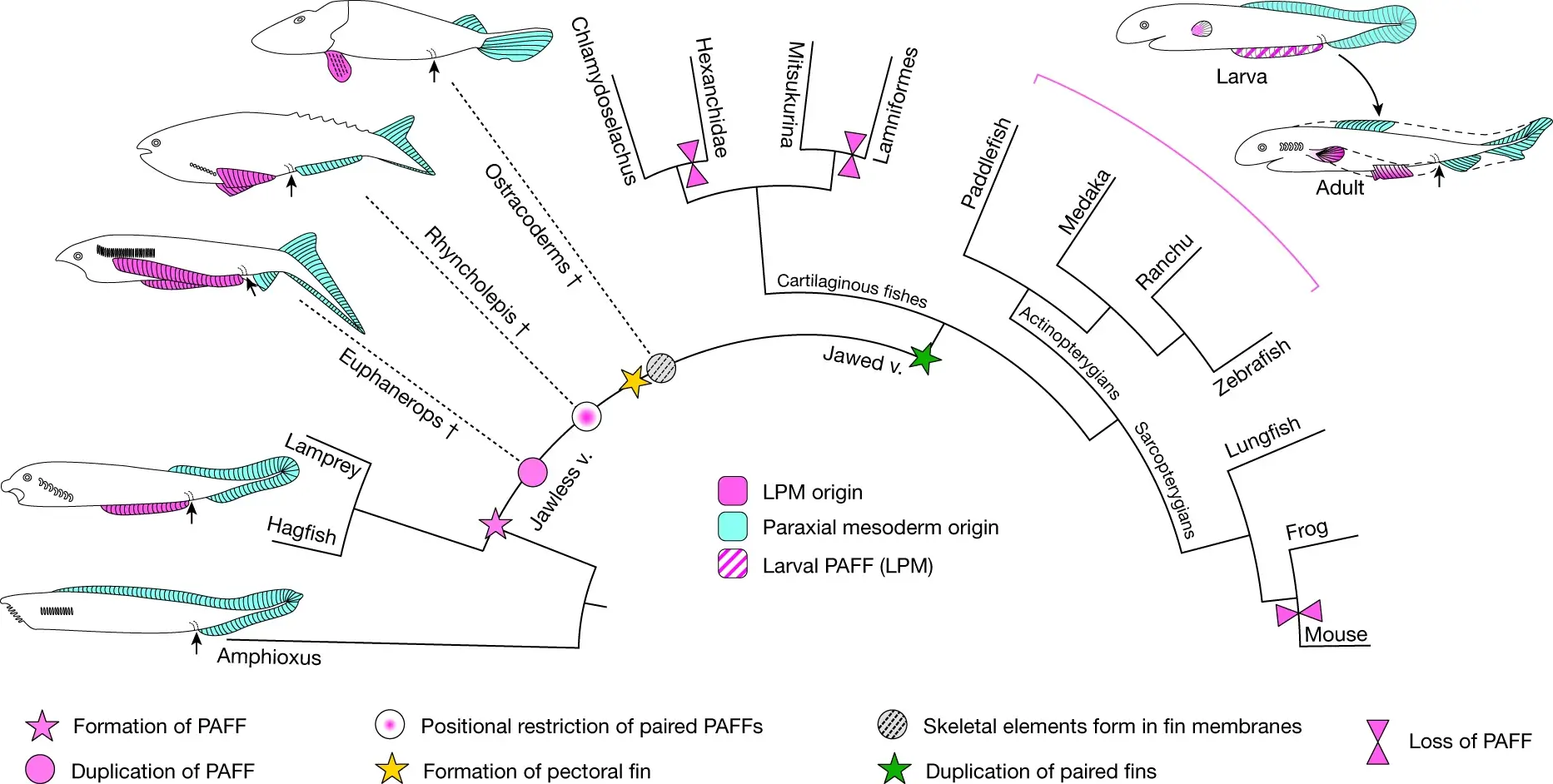
International collaboration played a crucial role in this study, with experts from different laboratories contributing their expertise and data from various animal models. By combining their knowledge, they were able to make groundbreaking discoveries that transcend individual research efforts.
While this study provides valuable insights, the researchers acknowledge that it is not the definitive answer to the limb origin debate. However, it represents a significant step forward and contributes meaningful data toward unraveling this evolutionary question.
As scientists continue to explore the mysteries of limb development, they unlock new understandings of the complex processes that shape our bodies. This study offers a molecular and genetic puzzle piece, bringing us closer to comprehending the origin of limbs and adding to the ongoing discussion that has spanned over a century.
The study is published in the journal Nature.


