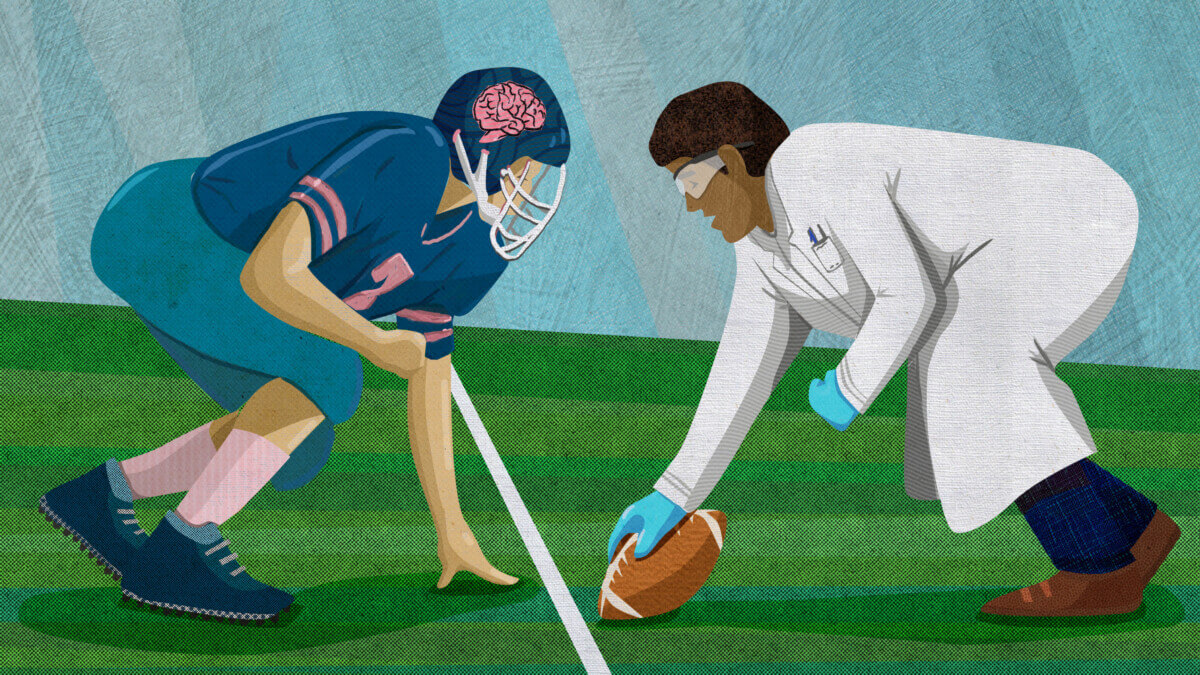
(© Molly Ferguson Art - stock.adobe.com)
Surprisingly, early-stage CTE showed no link to cognitive decline
In A Nutshell
- CTE severity had no link to depression, anxiety, or behavioral issues, contradicting popular assumptions about the disease
- Doctors misdiagnosed CTE as Alzheimer’s disease in 40% of advanced cases, with only 17% correctly identifying the brain condition
- Roughly 8 in 10 former athletes with the most severe CTE (stage IV) had dementia before death, compared to just 16% without CTE
- Early-stage CTE showed no connection to memory problems or dementia, suggesting the brain can tolerate limited damage
When former athletes with severe brain damage experience cognitive issues, doctors have been quick to blame Alzheimer’s disease in recent years. Notably, however, autopsies later revealed many of those patients actually had no Alzheimer’s at all. They had chronic traumatic encephalopathy (CTE). Researchers estimate CTE was misdiagnosed as dementia in 40% of advanced cases.
The finding comes from a Boston University study of 614 brain donors, including 366 with CTE. Among the 99 donors with advanced CTE who had been diagnosed with dementia during life, only 17% of physicians correctly identified CTE as the cause. The misdiagnosis rate points to a troubling gap in how doctors recognize this disease.
The study, published in Alzheimer’s & Dementia, also revealed differences by disease stage. Among donors with the most severe CTE (stage IV), roughly 8 in 10 had dementia before death, compared to just 16% of those without CTE. Those with stage IV were more than four times as likely to have had dementia. But surprisingly, early-stage CTE showed no connection to memory problems at all. Moreover, despite common assumptions, CTE severity had no link to depression or behavioral issues.
How the Disease Progresses
CTE comes in four stages as abnormal proteins gradually spread through the brain. Early stages (I and II) involve small pockets of damage in the frontal regions. By stage III, the proteins reach deeper memory areas. Stage IV means widespread damage across much of the brain.
Family members of the deceased athletes filled out detailed surveys about memory problems, personality changes, and daily functioning before death. Researchers combined these accounts with medical records to determine who had dementia.
The connection became clear at advanced stages. Stage IV donors scored about twice as high on cognitive difficulty assessments as people without CTE. They struggled far more with basic tasks like managing finances or remembering appointments.

Early-Stage CTE Shows No Symptoms
Early-stage CTE showed no link to dementia or memory problems at all. Stages I and II looked essentially the same as having no CTE.
“It is uncertain if low-stage CTE clinically manifests,” the authors wrote. This suggests the brain can initially tolerate small amounts of damage before symptoms appear.
This finding challenges assumptions that any amount of CTE causes problems. The brain appears capable of withstanding limited damage without triggering memory loss or personality changes. It’s only when the disease reaches advanced stages that dementia becomes highly likely.
Why the Confusion Happens
Both CTE and Alzheimer’s attack memory first, and patients show similar symptoms in the doctor’s office. Former football players often struggle to recall recent events and conversations, just like Alzheimer’s patients do. Without a brain scan that can detect CTE, doctors often assume the more common diagnosis.
Vascular dementia accounted for another 10% of misdiagnoses, and 38% of doctors labeled the condition as “dementia unspecified or unknown.” Among all the physicians who diagnosed dementia in patients with advanced CTE, only 17% correctly identified CTE as the cause.
This raises a troubling possibility: some former athletes with dementia may be told they have Alzheimer’s when the real cause is CTE. The study can’t put a number on how often this happens among living people, but the mismatch researchers found in autopsy cases suggests it could be more common than anyone realizes.
Severe CTE Strongly Linked to Dementia
CTE severity had no connection to depression, anxiety, or impulsiveness in this study. That finding contradicts popular assumptions that CTE directly causes the mood and behavior problems many former athletes experience.
More likely, those symptoms come from multiple sources. Brain imaging often shows damage to white matter (the brain’s wiring) and blood vessels in former players. Chronic pain, sleep problems, and past substance use probably contribute too. CTE might be one factor among many, rather than the sole culprit for behavioral issues.
Some former athletes struggle with anger, depression, or impulsive behavior for years before memory problems appear. This study suggests those early struggles may not come from CTE itself, but from the accumulated toll of repeated hits, injuries, and the lifestyle that often accompanies professional sports.
Even after researchers accounted for blood vessel damage and other brain issues, the link between severe CTE and dementia held firm. Mood symptoms remained unconnected to disease stage.
What This Means for Athletes
The study focused almost entirely on male athletes, with 80% having played American football. Most with severe CTE had played at the college or professional level for many years. Those with the worst brain damage had typically started playing young and continued for decades.
The good news, if any exists here, is that mild CTE may not cause symptoms. The brain appears capable of withstanding limited damage without triggering memory loss or personality changes. The bad news is that once CTE reaches advanced stages, dementia becomes highly likely.
Researchers also found that age matters less than disease severity. Even when they looked specifically at donors 52 and older to control for natural aging, advanced CTE still carried the same elevated dementia risk. The disease itself, not just getting older, drives cognitive decline.

The Challenge of CTE Diagnosis
Right now, doctors cannot diagnose CTE in living people. Brain tissue must be examined under a microscope after death to spot the telltale protein deposits around blood vessels. This leaves athletes and their families in limbo, wondering whether symptoms stem from CTE or something else entirely.
Researchers are racing to develop imaging tests or blood markers that could spot the disease earlier. Such tools would help doctors distinguish CTE from Alzheimer’s and could potentially open the door to treatments if caught early enough.
The study did have limitations. Families reported symptoms from memory, which may not always be accurate. Brain donors also tend to be people who had more severe symptoms, so the findings may not apply to all former athletes. The sample was overwhelmingly white males who played football, leaving questions about how CTE affects women and athletes from other sports or backgrounds.
Paper Summary
Limitations
The study excluded donors with certain neurodegenerative diseases but did not eliminate all potential confounding pathologies. Hippocampal TDP-43 protein deposits were present in many stage III and IV cases but were not excluded because removing them would have eliminated most donors with severe CTE and dementia. Age differences existed across CTE stages despite statistical controls. The retrospective design relied on informant reports that may be affected by recall bias. Selection bias likely enriched the sample for symptomatic cases. The sample consisted primarily of white males who played American football, limiting generalizability to women, underrepresented groups, and other sources of repetitive head impacts.
Funding and Disclosures
This work was supported by the National Institutes of Health/National Institute of Neurological Disorders and Stroke (U54 NS115266) and National Institute of Neurological Disorders and Stroke/National Institute on Aging (R01NS122854, R01NS139383). Several authors disclosed relationships with the Concussion and CTE Foundation, NFL Players Association committees, and various medical and legal consulting roles. Dr. Nowinski is cofounder and CEO of the Concussion and CTE Foundation. Full author disclosures are available in the published paper.
Publication Details
Layden RM, Groh JR, Miner AE, Kidd A, Nosek SB, Gonzalez Gil S, Abdolmohammadi B, Lenio S, Nowinski CJ, Tripodis Y, Martin BM, Palmisano JN, Dwyer BC, Katz DI, Goldstein LE, Cantu RC, Stern RA, Stein TD, McKee AC, Daneshvar DHD, Mez J, Alosco ML. “CTE neuropathology alone is associated with dementia and cognitive symptoms,” published in Alzheimer’s & Dementia, January 27, 2026;22:e71032. DOI: 10.1002/alz.71032. Boston University Alzheimer’s Disease Research Center and Boston University CTE Center, Boston University Chobanian & Avedisian School of Medicine, Boston, Massachusetts, USA, along with additional affiliated institutions.


