
© Martí Rosselló - stock.adobe.com
In A Nutshell
- Feeling economically worse off than peers was linked to lower scores across all six measures of well-being, even after accounting for a person’s actual income.
- The links were strongest in young women and weakest in older men, a pattern earlier researchers have called a “double disadvantage,” where gender inequity sharpens the sting of economic comparison.
- Among the roughly 62% of participants who returned for a follow-up survey a year later, those who started out feeling more left behind still scored lower across every well-being measure, a sign the connection did not simply disappear over time.
A particular kind of dismay has nothing to do with hunger or struggling to pay rent. It is the slow, grinding awareness that everyone nearby seems to be pulling ahead, that one person is falling behind, not in absolute terms, but in comparison to peers. A new international study tracking more than 200,000 people across 22 countries finds that this feeling is linked to measurable harm across nearly every dimension of a good life. Among young adults, the connection was sharpest for women.
Researchers found that the wider the gap between what someone earns and what their peers earn, the less happy, healthy, purposeful, and socially connected that person tended to be. Those links showed up at a single moment in time and were still detectable a year later, the longest the study followed anyone. Being poor is not the subject here. Feeling poor by comparison is, and that difference turns out to matter more than the paycheck itself.
Social scientists have long known that income inequality can damage health. This study, published in Social Science & Medicine, pushed into less-explored territory: what inequality does to the fuller picture of human well-being, what researchers call flourishing, meaning a person’s sense of thriving across happiness, physical health, purpose, relationships, and character. Being on the wrong end of an economic comparison, the data showed, does more than make people unhappy. It makes them languish.
A Study Built for Scale
Data came from the Global Flourishing Study, an international survey that in its first round reached 207,919 people across Argentina, Australia, Brazil, Egypt, Germany, Hong Kong, India, Indonesia, Israel, Japan, Kenya, Mexico, Nigeria, the Philippines, Poland, South Africa, Spain, Sweden, Tanzania, Turkey, the United Kingdom, and the United States. Participants ranged from young adults aged 18 to 24, to middle-aged adults, to people 65 and older. About a year later, roughly 62% of the original group (128,868 people) completed a follow-up survey, so the year-later findings reflect that smaller subset rather than the full first-round sample.
To measure well-being, the study used a standardized tool covering six areas of life: happiness and life satisfaction, mental and physical health, meaning and purpose, character and virtue, close social relationships, and financial and material stability. Each area was scored on a scale from zero to ten.
At the center of the work sat a concept called “relative deprivation,” a measure of how much less someone earns compared to others in their demographic group within the same country, accounting for factors like age and education. Researchers measured it separately from a person’s actual income, which let them tell apart the effects of feeling economically left behind from the effects of simply having less money.
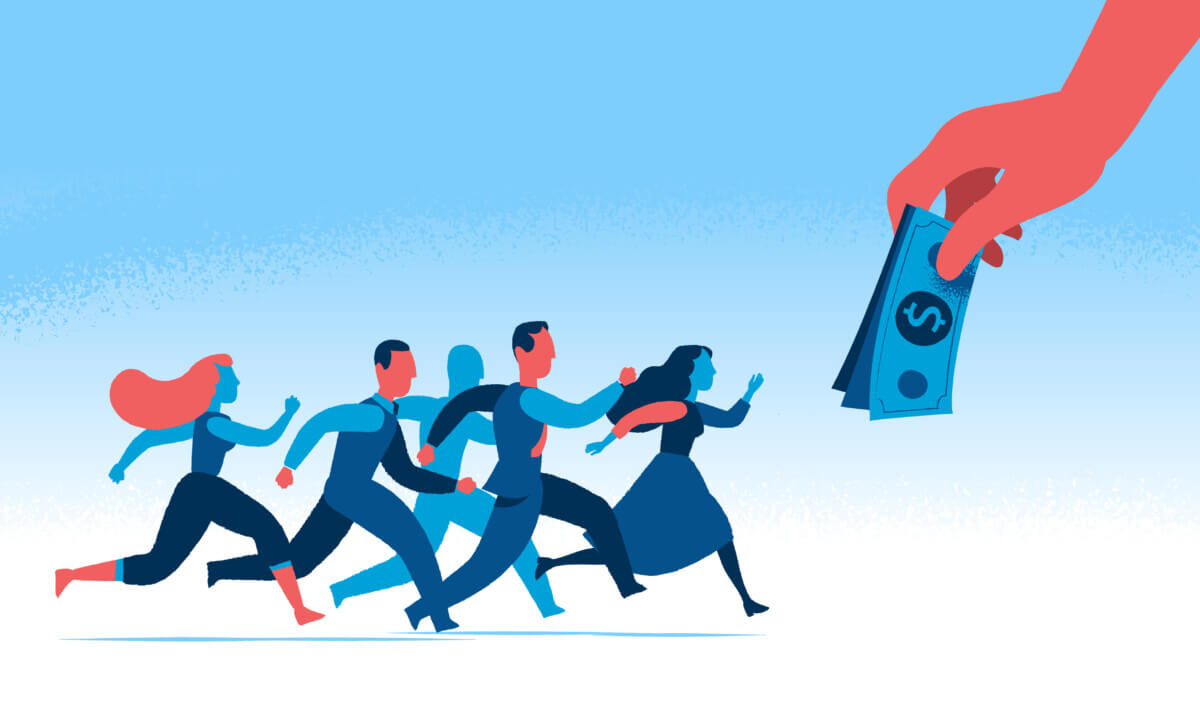
Relative Deprivation Hits Every Corner of Well-Being
Higher relative deprivation was linked to lower scores in every one of the six well-being categories, even after accounting for each participant’s actual income. Put another way, two people with identical earnings could report very different levels of well-being depending on how their pay compared to those around them.
Financial and material stability took the largest hit, which makes intuitive sense. Damage spread well beyond money, though. People who felt economically outpaced by their peers also reported less happiness, worse mental and physical health, a thinner sense of purpose, fewer close relationships, and even a reduced sense of their own character and virtue, meaning their capacity to act with integrity and weigh the long term.
On that last point, the authors cite other research suggesting that “the psychological distress and negative emotions induced by relative deprivation may reduce individuals’ capacity for prosocial behavior and long-term self-regulation.” In plain terms, feeling left behind was tied to lower scores on the character and virtue measure, which asked people about doing good under pressure and weighing the long term over an immediate reward.
Young Women Bear the Brunt of Economic Comparison
Relative deprivation weighed on everyone to some degree, but it pressed hardest on young adults, and among them, the link was sharpest for women. Earlier researchers have called this a “double disadvantage,” where the pressure of economic comparison collides with inequities that young women already face.
Older adults, particularly older men, showed the weakest connections between economic comparison and lower well-being. Whether that reflects a kind of settling that comes with age, a different set of reference points, or something else, the data does not fully explain, though the gap across generations held steady.
A reason the youth findings worry the authors: late adolescence and early adulthood are formative years for building an identity, forming relationships, and setting goals for the decades ahead. Young people who spend those years weighed down by economic comparison still showed lower well-being a full year later, the longest stretch the study could track.
Why ‘Just Get Richer’ Won’t Fix Relative Deprivation
Perhaps the most policy-relevant takeaway is this. Because the researchers accounted for absolute income, the harm tied to relative deprivation cannot be erased simply by making everyone wealthier. Economic growth, if it lifts all groups by roughly the same amount, does not change where anyone stands next to their neighbors, coworkers, or peers.
As the authors put it plainly, “Policy actions that reduce income inequality and RD could yield intangible social benefits that cannot be achieved through economic growth or increased wealth.” Research on inequality points to a related idea, that poverty itself is not the most reliable predictor of poor health; poverty lived alongside plenty is. Being surrounded by people who have more can be what makes a person feel poor in the first place.
A few limits are worth keeping in view. About 38% of the original participants did not complete the second survey, and those who dropped out skewed younger, female, lower-income, and higher in relative deprivation, which could bias the year-later results. Income was collected in broad bands rather than exact figures, adding some imprecision. And because the survey recorded gender as either male or female, it could not capture the experiences of non-binary people.
Even so, the size of the sample, its geographic reach, and the consistency of the pattern across cultures give the results unusual weight. Across 22 countries and dozens of cultural settings, the same picture emerged: the further people fall behind their peers economically, the more they tend to suffer, well past their bank balance.
A gap between what a person has and what the people around them have, it turns out, may matter as much as the number on the paycheck.
Disclaimer: This article describes an observational study. It can show that feeling poorer than one’s peers travels together with lower well-being, but it cannot prove that one causes the other. Other factors the survey did not capture may shape both. Findings report group-level patterns and do not predict how any single person will feel or fare. Anyone weighing personal, financial, or mental-health decisions should consult a qualified professional rather than draw conclusions from these results alone.
Paper Notes
Limitations
Several limitations are named directly by the authors. Roughly 38% of the original sample did not return for the second survey cycle, and that dropout was not random: participants who were younger, female, lower-income, immigrants, or living alone were more likely to leave, which could bias the year-later results. Because the dataset lacked community identifiers or geocodes, relative deprivation was calculated against country-level peer groups rather than local or neighborhood comparisons, which may have weakened the measured connections and pushed estimates toward zero. Household income was collected in broad bands rather than exact figures, adding statistical noise. A one-year gap between cycles limited the ability to study longer-term effects, and additional survey waves would have strengthened the conclusions. Finally, gender was recorded as biological sex used as a proxy for gender identity, which would have misclassified non-binary people and limits what the study can say about gender differences.
Funding and Disclosures
Funding came from grants by the Canadian Institutes of Health Research (PJT-165971) and the Social Sciences and Humanities Research Council of Canada (435-2019-1083), both awarded to lead author Frank J. Elgar. A CRediT contribution statement covers each author’s role, and no competing interests are reported in the text. Gallup Inc. conducted the data collection, and its Institutional Review Board approved the study protocol on November 16, 2021 (approval number 2021-11-02). Data were collected in accordance with the ethical standards of the 1964 Helsinki Declaration, informed consent was obtained from all participants, and participants were paid $3 to $6 USD per survey.
Publication Details
Authors: Frank J. Elgar (Department of Equity, Ethics and Policy, McGill University, Montreal, Canada), Valerie E. Michelson (Department of Health Sciences, Brock University, St. Catharines, Ontario, Canada), Nathan King (Department of Psychiatry and Department of Public Health Sciences, Queen’s University, Kingston, Ontario, Canada), and William Pickett (Department of Health Sciences, Brock University; Department of Public Health Sciences, Queen’s University). | Journal: Social Science & Medicine, Volume 399, 2026, Article 119203. | Paper Title: “Left out and languishing: A cross-national analysis of relative deprivation and human flourishing.” | DOI: 10.1016/j.socscimed.2026.119203 | Received December 24, 2025; revised March 1, 2026; accepted March 16, 2026; published online March 20, 2026.


