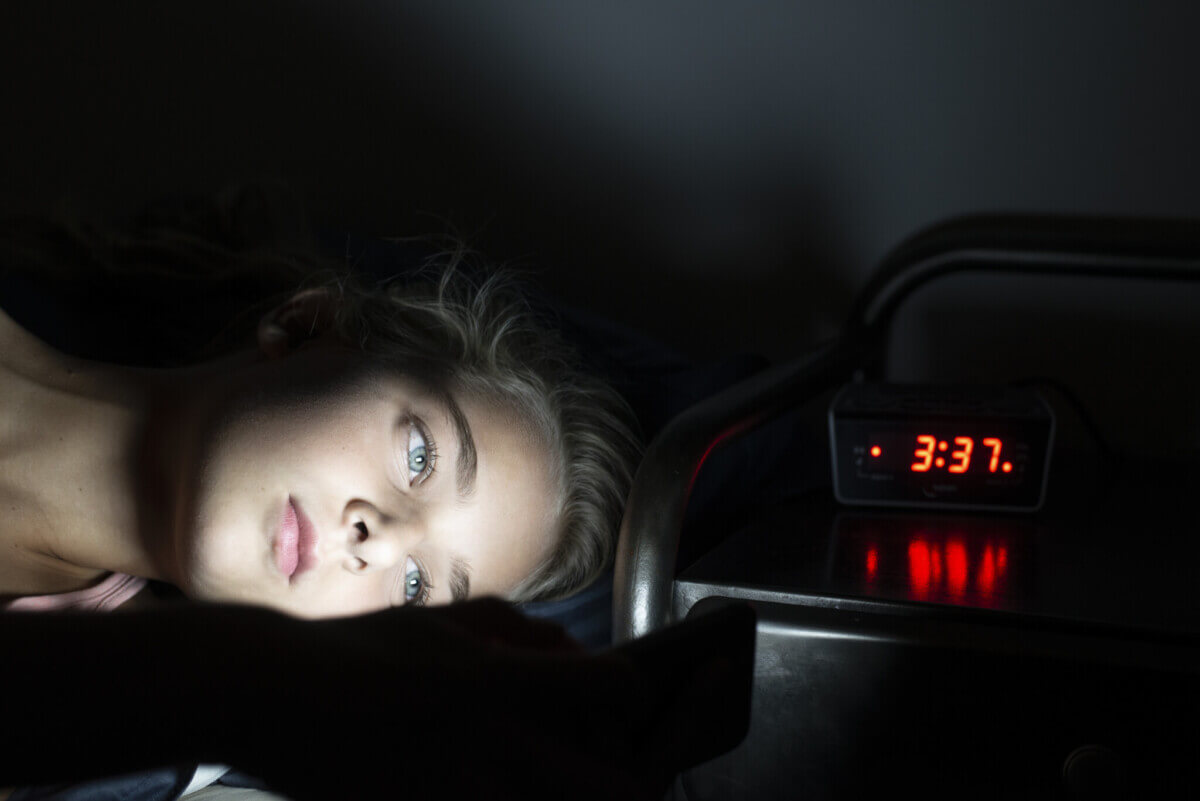
(© patrick - stock.adobe.com)
Struggling Teens May Need Better Sleep More Than Less Screen Time, Research Suggests
In A Nutshell
- A large study of thousands of adolescents found sleep quality was the most consistent lifestyle factor linking mental health symptoms to worse grades and social problems.
- For teens with higher anxiety symptoms, sleep alone explained more than 36% of the connection to lower grades, out of 48% explained by all lifestyle factors combined.
- Sleep mattered even more for peer and social difficulties, where it was the only lifestyle factor that consistently showed an effect across every mental health measure studied.
- Financial hardship weakened sleep’s link to grades but strengthened its link to social problems, suggesting one-size-fits-all approaches may not work for every family.
When a teenager with anxiety symptoms starts slipping in school, most parents and teachers look for obvious culprits like too much stress, too little motivation, or perhaps a difficult teacher. But a large new study suggests another factor may be hiding in the bedroom: how well, or how poorly, that teenager is sleeping.
Researchers analyzed data from roughly 6,750 to 7,550 young adolescents and found sleep quality was the most consistent lifestyle factor linking higher mental health symptom scores to worse school performance or peer difficulties. The findings, published in Psychological Medicine, examined four lifestyle factors: sleep, screen time, physical activity, and diet. Sleep was the one that mattered most, though the study cannot prove that sleep is the direct cause.
For families watching a child struggle academically or socially while also dealing with mental health symptoms, the finding points to a potentially addressable factor. Sleep is a behavior, not a fixed trait, so researchers may view it as a factor worth examining in future prevention studies.
Data for this analysis came from the ABCD Study, one of the largest long-term studies of child brain development in the United States. Researchers tracked mental health symptoms at age 10 to 11, lifestyle habits a year later, and grades and social functioning a year after that. Social functioning was scored on a standardized questionnaire covering peer relationships, loneliness, teasing, and immaturity, while mental health was measured across depression, anxiety, distressing unusual perceptions, and overall symptom levels.
Sleep Stood Out Among the Four Lifestyle Factors
When all four lifestyle factors were analyzed together, sleep quality came out as the dominant link between mental health symptoms and academic performance in most models. For higher anxiety symptoms, sleep alone explained more than 36% of the total connection to lower grades, out of 48% explained by all four factors combined. For higher depression symptoms, sleep explained more than 18%. For distressing unusual perceptions, sleep explained roughly 8%. For the broadest symptom measure, sleep’s contribution was not statistically significant, and screen time was the strongest individual factor in that particular model.
These percentages describe how much of the statistical association passed through sleep, not that poor sleep caused that share of the academic difficulty. Screen time was the next most meaningful factor overall, with weekend use showing a stronger association than weekday use. Physical activity and diet made small but real contributions in some models, though their effects were modest enough that changes to those habits alone would be unlikely to move grades much.

Poor Sleep and Teen Social Problems: An Even Stronger Connection
When researchers shifted focus to social problems rather than grades, sleep quality became even more dominant, the only lifestyle factor that consistently mattered across all mental health measures examined. Among adolescents with distressing unusual perceptions, sleep explained about 23% of the link to social difficulties. For both depression and anxiety symptoms, sleep explained close to 20% each.
That pattern stands out because, for academic outcomes, several lifestyle factors carried at least some weight. For social difficulties, sleep did almost all of it. Screen time, diet, and physical activity barely registered here, even though screen time had shown a real, if smaller, effect on grades. The social outcome itself covered peer relationships, loneliness, teasing, and immaturity, suggesting sleep may be more tightly bound up with day-to-day peer life than any other habit measured in the study.
Financial Stress Reshapes the Sleep Connection
One of the more revealing parts of the study examined whether family circumstances altered these patterns, looking at neighborhood safety, school quality, family conflict, and financial hardship. The results cut in two different directions depending on the outcome.
For grades, financial hardship weakened sleep’s role. The connection running from symptoms through sleep quality to grades was smaller for families under serious economic stress than for children in stable situations. Researchers suggest one reason: economic pressures like resource limits or unstable housing may weigh on grades so heavily that they overshadow whatever benefit better sleep would otherwise provide. For social difficulties, the opposite happened: as financial hardship and family conflict increased, sleep quality became an even stronger link to peer problems. That flip suggests any future sleep-focused program would need to account for a family’s financial strain and home environment rather than treating every household the same way.
What This Means for Teens and Families
Sleep is already known to matter for adolescent health, but this study adds real weight to a specific idea: when a young teen is struggling emotionally, checking on their sleep may be a more useful first move than assuming the problem is purely about willpower or attitude. That holds for both grades and friendships, though the size of the connection varies by symptom and by outcome.
This is an observational study, meaning it tracks associations but cannot prove that fixing sleep will improve outcomes. Mental health symptoms can also cause poor sleep, so the direction of influence likely runs both ways, and shared parent reporting may have inflated some connections. Sleep’s consistent appearance across nearly every model still makes it a sensible factor for families and clinicians to discuss, and for researchers to test more directly.
Disclaimer: This article summarizes findings from a peer-reviewed observational study and is intended for general informational purposes. It is not a substitute for professional medical or psychological advice. Readers with concerns about a child’s mental health or sleep should consult a qualified health care provider.
Paper Notes
Limitations
Researchers identified several important limitations. Although mental health symptoms, lifestyle factors, and outcomes were measured at different time points in sequence, the study design cannot prove cause and effect, as it is observational rather than experimental. Bidirectional effects remain possible, meaning symptoms could be causing sleep problems rather than the other way around. Additionally, sleep quality, screen time, and academic grades were all reported by parents, which may have inflated the apparent connections between them due to shared reporter bias. Differences in how precisely each lifestyle factor was measured (sleep quality was assessed with 26 questions while physical activity relied on a single question) may have affected how large each factor appeared in the results. Some effect sizes were modest and may not hold equally across all developmental stages. Diet information was only available at one time point rather than two, and the researchers noted that data from future ABCD Study releases would be needed to examine these patterns across later adolescence. Results describe patterns across large groups and cannot predict what is driving any individual child’s academic or social difficulties.
Funding and Disclosures
According to the paper, the ABCD Study is supported by the National Institutes of Health and additional federal partners under a series of listed award numbers. Author Jason Smucny is supported by grant K01-MH125906, and author Nicole R. Karcher is supported by grant R01-MH139880, both from the National Institute of Mental Health. The authors declared no competing interests.
Publication Details
Authors: Jason Smucny (Department of Psychiatry and Behavioral Sciences, University of California, Davis, Sacramento, USA), Tyler A. Lesh (University of California, Davis), Tara A. Niendam (University of California, Davis), and Nicole R. Karcher (Department of Psychiatry, Washington University in St. Louis, USA). | Journal: Psychological Medicine, published by Cambridge University Press. | Paper Title: “Mediating effects of healthy lifestyle factors on associations between mental health and functional outcomes in early adolescence” | Published: 2026, Volume 56, e215, pages 1-12. | DOI: https://doi.org/10.1017/S0033291726105121 | Data Source: Adolescent Brain Cognitive Development (ABCD) Study, Release 5.1. DOI: 10.15154/z563-zd24.


