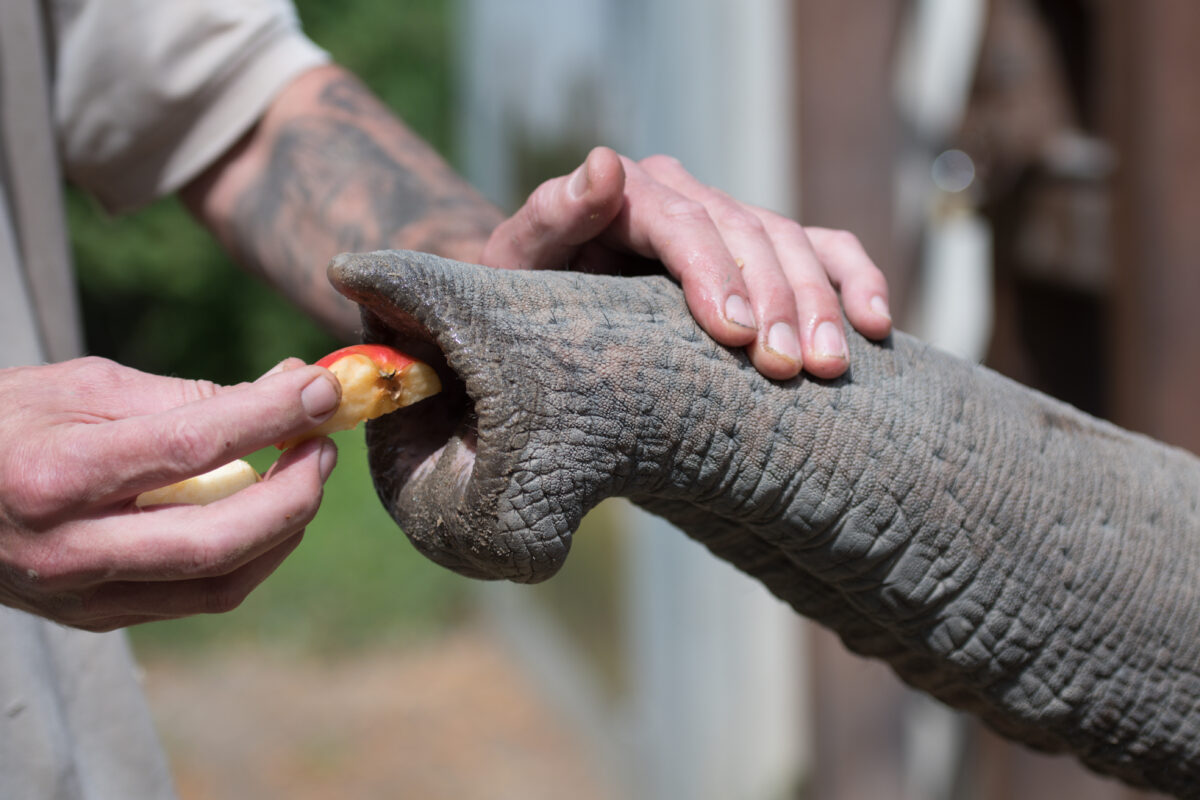
Photograph of a zookeeper feeling the unusual whiskers that cover an Asian elephant trunk. (Credit: MPI-IS/A. Posada and Heidelberg Zoo)
In A Nutshell
- Elephant whiskers have “physical intelligence”: Three built-in gradients (geometry, porosity, and stiffness) work together to amplify touch signals and encode contact location without requiring complex brain processing.
- Built to last decades: Unlike rats whose whiskers regrow continuously, elephant whiskers appear permanent, so they’re engineered like shock-absorbing horns with 70% hollow bases that resist breakage across 60+ year lifespans.
- Signal strength varies 20-fold: The dramatic stiffness shift from rigid base to flexible tip means touching a whisker halfway down produces roughly 20 times more vibration power than touching the tip, helping elephants pinpoint exactly where contact occurred.
- Two whisker types, two jobs: Blade-shaped whiskers on the trunk’s tip flex with stretching and probe textures, while thicker circular whiskers near the face act as obstacle detectors to compensate for elephants’ poor eyesight.
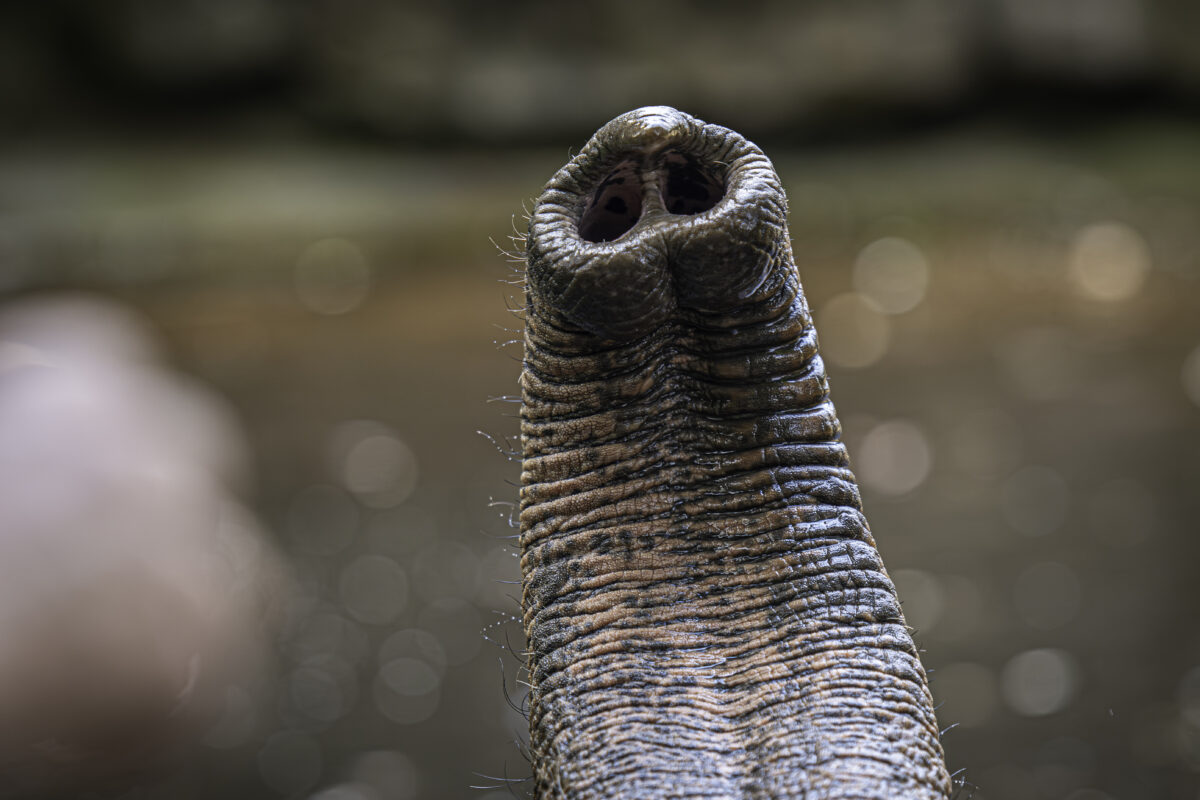
Around 1,000 whiskers cover an Asian elephant’s trunk, and they don’t just detect touch. They’re built with what scientists call “physical intelligence,” a design so clever it amplifies signals, pinpoints exactly where something made contact, and does it all without breaking despite decades of constant use.
Surprisingly, elephant whiskers can’t move on their own. Rats, cats, and many other mammals can twitch their whiskers to actively sweep their surroundings, but elephants can’t. Scientists at the Max Planck Institute for Intelligent Systems wondered how elephant whiskers could be useful without that ability. What they found was unexpected: elephant whiskers evolved a completely different strategy.
Instead of relying on movement, elephant whiskers are built with three separate features that change dramatically from base to tip. Think of it like a precision tool that’s been custom-engineered at every point along its length. The base is thick, circular, and rigid, like a stiff polymer. The tip is thin, oval-shaped, and bendy, like a soft rubber band. In between, the whisker transitions through what amounts to an entire material transformation.
When something brushes against one of these whiskers, vibrations race back to nerve endings at the base. The way the whisker is built automatically tells the elephant exactly where the contact happened. Touch near the tip and the elephant feels a gentle vibration. Touch closer to the midpoint and the signal amplifies dramatically. The whisker’s structure shapes the signal before it even reaches the brain, doing some of the computational work in the material itself.
Whiskers That Last a Lifetime
Unlike rodents whose whiskers grow back continuously throughout their lives, elephants don’t continuously replace their whiskers. Adult elephants appear to keep the same whiskers they develop early on. When you can live 60-plus years in the wild and spend 16 hours a day foraging, you need whiskers tough enough to last.
Evolution solved this problem with an unexpected design borrowed from bighorn sheep horns. The base of each elephant whisker is about 70% hollow, riddled with tiny air tubes running lengthwise through the structure. This makes the whiskers 45% lighter than if they were solid, allowing elephants to whip their trunks around without the whiskers adding extra weight. But the hollow tubes do something else: they absorb impacts, the same way crumple zones in cars protect passengers during crashes.
By the time you reach the middle of a whisker, those air tubes have disappeared and the structure becomes completely solid. This rapid transition keeps the whisker lightweight where it matters (at the base, where mass would slow down trunk movements) while maintaining strength along the length that actually interacts with objects.
The outer surface tells another story. Adult elephant whiskers don’t have the overlapping scales you’d see on cat whiskers or human hair. Instead, they’re scarred and rough, similar to the texture of animal horns or hooves. Baby elephants do have scales at the base of their whiskers, but by adulthood those scales are gone, possibly worn away during the nearly two years young elephants spend learning to control their trunks.
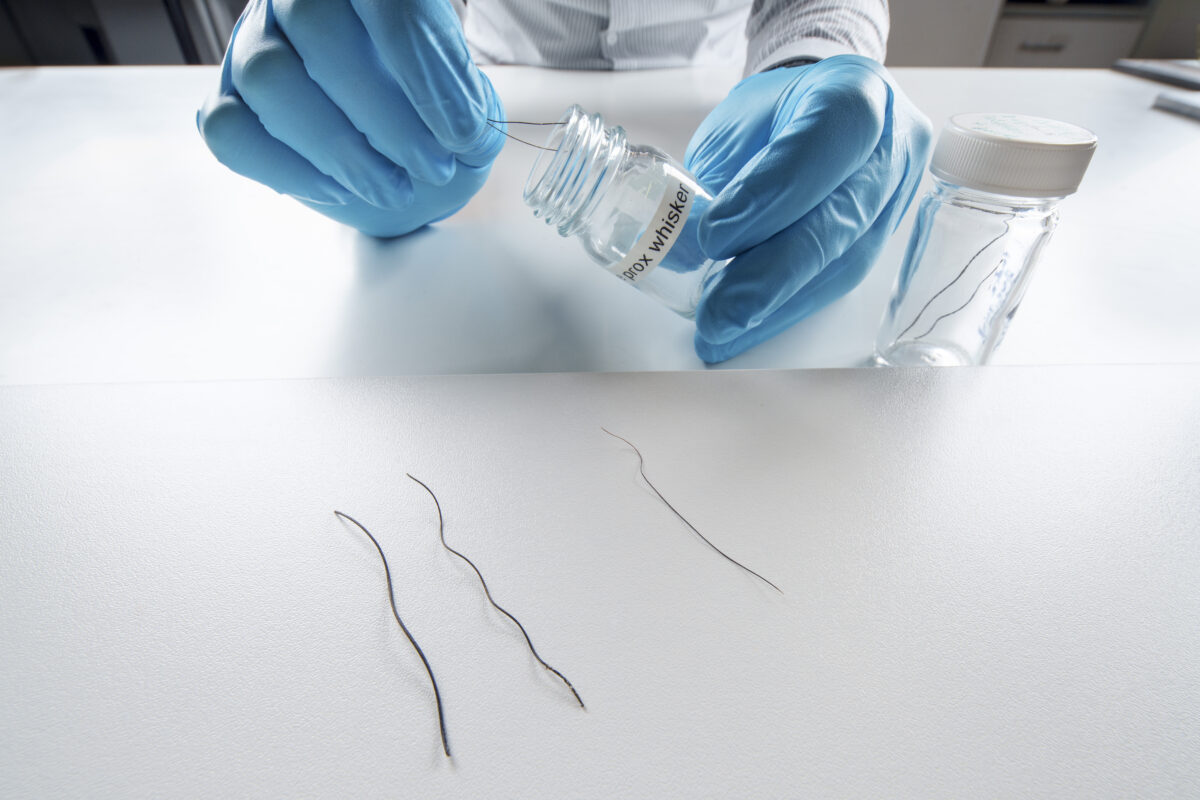
MPI-IS/W. Scheible)
Two Types of Elephant Whiskers for Two Jobs
Not all elephant whiskers are created equal. The whiskers near the trunk’s tip are thin, blade-like, and dramatically tapered. Their oval shape aligns with the wrinkles on the trunk, and they bend easily in one direction but resist bending in the other. This matters because elephant trunks can stretch up to 35% longer at the tip during reaching and manipulation. The blade-like whiskers can flex with that stretching without snapping.
These tip whiskers appear designed for precision sensing. When an elephant wraps its trunk around a branch it can’t see, the whiskers on the sides get pressed in their stiff direction, sending strong signals about the object’s shape and size. The thin tips can even penetrate into the tiny crevices of rough surfaces, helping elephants distinguish textures.
The whiskers closer to the elephant’s face look completely different. They’re thicker, nearly circular, and only gently tapered. Some have a wavy pattern along their length, similar to the whiskers of seals (which reduce vibrations when swimming underwater). These facial whiskers probably work as obstacle detectors, compensating for elephants’ notoriously poor eyesight by alerting them when something is nearby.
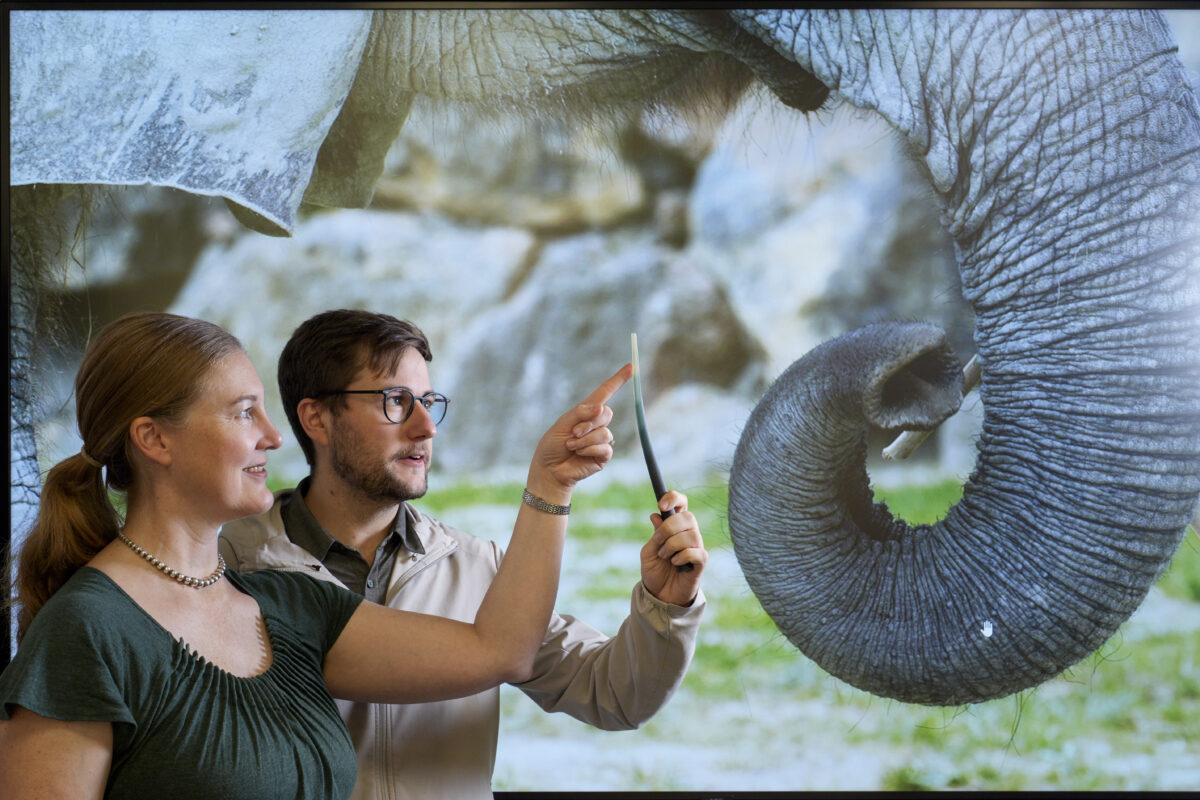
MPI-IS/W. Scheible)
A Dramatic Difference in Signal Strength
The most dramatic feature is invisible from the outside. Researchers tested the stiffness of elephant whiskers by pressing into them with a microscopic probe at different points along the length. The base is extremely rigid, about as stiff as hard plastic. The tip is remarkably soft and flexible, closer to the feel of a rubber band.
The stiffness changes by roughly 40 times from base to tip: what materials scientists describe as spanning nearly two orders of magnitude. For comparison, rat whiskers show only about a doubling in stiffness from base to tip. Cat whiskers show the same dramatic base-to-tip transition as elephants, despite cats being able to actively move their whiskers with muscles.
Computer simulations, published in Science, revealed what this gradient does for touch sensing. Touching a whisker about halfway along its length produces a signal roughly 20 times more powerful than touching the very tip. This dramatic gradient likely helps the elephant’s nervous system distinguish where along the whisker contact occurred, effectively encoding location into the signal’s strength.
The soft tip provides another advantage. When an elephant brushes its trunk against a rock or tree trunk, the flexible tip can bend around the rigid surface without storing up energy that could cause the whisker to snap. The stiff base, meanwhile, stays firmly anchored in the skin and experiences less stress even when the tip deflects dramatically.

Physical Intelligence in Action
Scientists describe elephant whiskers as having “physical intelligence,” the material itself performs computations that would otherwise require more complex neural processing. When an elephant uses its trunk to feel its way through dense vegetation in the dark, each whisker is simultaneously doing several jobs: bending preferentially in useful directions based on its oval shape, staying lightweight and impact-resistant thanks to the hollow base, and encoding contact location through its stiffness gradient.
The elephant’s brain receives rich information from each touch, with much of the preliminary processing already done by the whisker’s design. The whisker has already transformed the raw contact into meaningful data about where, what, and how hard.
This type of physical intelligence shows up in other animals. The beak of a Humboldt squid has a similar base-to-tip stiffness gradient that helps it bite through tough prey without breaking. Bird feather shafts change shape along their length to control how they bend during flight. Seal whiskers alternate between thick and thin sections to reduce drag underwater.
For engineers designing robotic sensors, elephant whiskers offer a blueprint. Most artificial whiskers are made from uniform materials: either too soft (producing weak signals) or too stiff (breaking easily). An artificial whisker built like an elephant’s, with gradients in shape, density, and stiffness, could be both sensitive and durable while automatically encoding touch location.
The researchers created an open-source computer model that lets engineers experiment with different combinations of these features. As robots increasingly need to operate in unpredictable environments (disaster sites, deep ocean, other planets) the elephant whisker demonstrates how smart material design can replace complex sensors and computing.
Baby elephants already show a material stiffness difference between base and tip, though not as extreme as adults. As elephants mature, the base becomes progressively stiffer while the tip stays soft, expanding the gradient over time. Whether this happens through the addition of new material at the base or through changes in the existing whisker structure remains unclear.
Evolution spent millions of years perfecting a design that does more with less. Three simple gradients (in geometry, porosity, and stiffness) combine to create a sensing system that rivals anything engineers have built artificially. And it does so using nothing but keratin, the same protein that makes up human fingernails.
Paper Notes
Limitations
The research examined whiskers from a limited number of Asian elephants (both babies and adults), focusing on two trunk regions. The study did not test live elephants to confirm whether the predicted signal amplification actually occurs in the nervous system, nor did it examine whether elephants with damaged whiskers show reduced tactile ability. The computer simulations make assumptions about how vibrations travel through tissue and which nerve types respond to different deformation patterns. African elephant whiskers were not studied, so these findings may not apply to both elephant species.
Funding and Disclosures
This work was supported by the Alexander von Humboldt Foundation, The Max Planck Society, The Carl-Schneider-Stiftung, BCCN Berlin, Humboldt University of Berlin, and German Research Foundation Grant EXC-2049–390688087. The authors declared no competing interests.
Publication Details
Authors: Andrew K. Schulz, Lena V. Kaufmann, Lawrence T. Smith, Deepti S. Philip, Hilda David, Jelena Lazovic, Michael Brecht, Gunther Richter, Katherine J. Kuchenbecker | Affiliations: Haptic Intelligence Department and Materials Central Scientific Facility at Max Planck Institute for Intelligent Systems, Stuttgart, Germany; Bernstein Center for Computational Neuroscience Berlin and Humboldt University of Berlin, Germany; Institute of Materials Science, University of Stuttgart, Germany | Journal: Science | Paper Title: “Functional gradients facilitate tactile sensing in elephant whiskers” | DOI: 10.1126/science.adx8981 | Publication Date: February 12, 2026


