(Photo by Towfiqu Ahamed Barbhuiya on Shutterstock)
In A Nutshell
- A new survey of 2,000 U.S. adults found that 65 percent openly call themselves “picky” about water, and 57 percent say they can identify what they’re drinking without being told the source.
- More than a third (37 percent) said they would rather stay thirsty than drink their least favorite type of water, and 35 percent now bring their own water with them whenever they leave the house.
- Despite strong opinions, Americans showed real knowledge gaps, with only 33 percent saying they’re “very aware” of where their favorite bottled water is actually sourced.
Most American adults have gotten remarkably particular about what fills their drinking glass. A new survey shows roughly two-thirds openly call themselves “picky” about water, and a sizable chunk claim they can identify what they’re drinking the moment it touches their lips. For a substance often dismissed as tasteless, water has quietly become one of the most opinionated categories in the American pantry.
Results come from a nationally sampled poll of 2,000 U.S. adults conducted by Talker Research on behalf of Crystal Geyser Alpine Spring Water. Across the board, respondents described strong loyalties, vivid taste memories, and a willingness to go without water altogether rather than drink a version they dislike. More than a third said they would rather stay thirsty than gulp down their least favorite type.
And these aren’t casual preferences. Many respondents described behaviors that sound closer to wine-tasting than hydration. Some said they can detect brand differences blind; others insisted they can tell tap from bottled before the second sip. What emerges is a portrait of a country that has developed a refined palate for something that technically has no flavor profile at all.
How Americans Say They Can Tell One Water From Another
Among the 2,000 adults surveyed, 65 percent described themselves as picky about water. A slightly smaller group, 57 percent, said they could identify what type of water they were drinking without being told its source. Within that group, 39 percent believed they could clock the difference between tap and bottled water from the first sip. About 1 in 10 said they only needed to see the cup, and 13 percent claimed they could identify water by smell alone.
Preferences extended into daily habits. Forty-three percent said they refuse to drink tap water in certain places, and 35 percent admitted they bring their own water with them whenever they leave the house. Twenty-eight percent believed they can taste the difference between specific bottled brands, while 27 percent said they can distinguish filtered water from spring water.
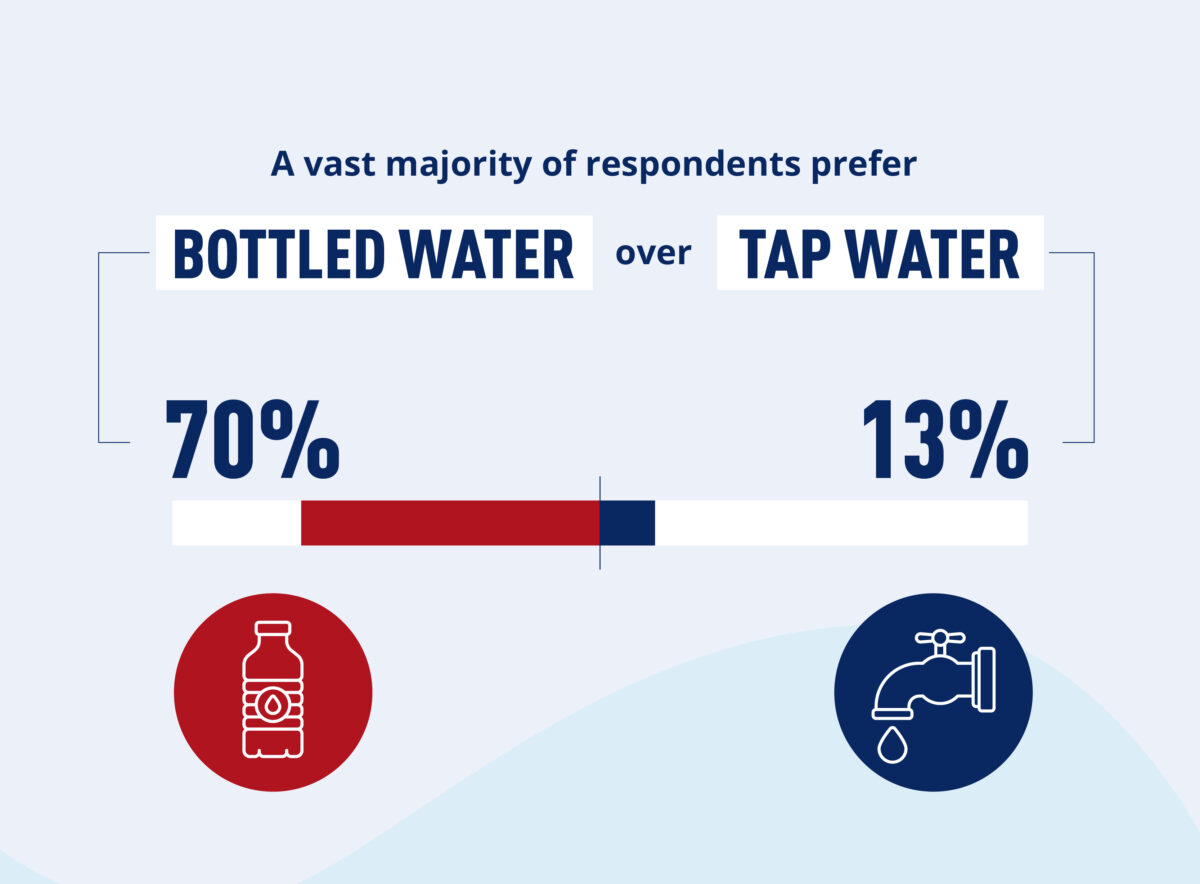
Asked to rank their overall loyalties, 70 percent of respondents chose bottled over tap, compared to just 13 percent who preferred what comes out of the faucet. Spring water edged out filtered water, 46 to 38 percent. More than half, 54 percent, said they had a specific favorite bottled brand, and 64 percent of those brand-loyal respondents said they kept a running mental list of the best and worst bottled waters on the market.
Why Water Source Matters More Than Price for Picky Drinkers
One of the more revealing findings: the top reason people gave for loving their favorite bottle wasn’t cost or convenience. Forty-two percent said it was because the water was sourced naturally, or from a spring. That beat cost at 34 percent and availability at 33 percent.
Yet knowing a water is “natural” and actually understanding where it comes from are two different things. Though 81 percent said they had read the label on their favorite brand, just 33 percent described themselves as “very aware” of the source, and only 30 percent felt confident about what is actually in their bottled water. Still, 62 percent said sourcing information mattered to them, and 63 percent said they would be open to switching brands if they learned more about where their current favorite came from.
Anne-Charlotte de La Porte, Vice President of Marketing at CG Roxane, the company behind Crystal Geyser, framed it plainly: “Our research shows that Americans care deeply about where their water comes from, not just how it tastes.” She noted that 61 percent correctly identified natural spring water as coming from underground aquifers that flow to the surface on their own.
Confidence Outruns Knowledge Among Picky Water Drinkers
For all the certainty respondents expressed about their palates, the survey also surfaced some puzzling blind spots. One in five believed all bottled water is heavily treated, a claim that isn’t accurate for spring water. Forty-five percent understood that one purpose of water treatment is to remove harmful chemicals, and about a third were familiar with the need to filter out man-made contaminants.
Awareness around spring water specifically dropped off further. Only 27 percent knew that spring water isn’t heavily purified. Just 25 percent knew it contains naturally occurring electrolytes, and a mere 16 percent understood that spring sources are generally easier to monitor for consistent quality.
“Spring water comes directly from nature, which means it doesn’t require heavy treatment or filtration,” de La Porte added. “Because it’s collected as it naturally flows to the surface, it retains naturally occurring minerals that contribute to its character.”
A Nation of Self-Styled Water Experts
Whether most Americans actually possess the refined palate they claim is another question entirely. Respondents weren’t put through a blind taste test, so the 39 percent who say they can identify tap versus bottled from the first sip are being taken at their word. What the data does show is that water has quietly become a personal, opinion-driven product in a way few would have predicted a generation ago. Americans want to know where their water comes from, believe they can taste the difference, and are willing to act on those beliefs, even when the underlying facts about sourcing and treatment haven’t fully caught up with their confidence.
Survey Methodology
Talker Research surveyed 2,000 general population Americans with internet access on behalf of CG Roxane, the parent company of Crystal Geyser Alpine Spring Water. The survey was administered and conducted online between March 19 and March 23, 2026. Because the survey was commissioned by a bottled water brand, the framing of questions and interpretation of results should be considered in that commercial context. The poll was not peer-reviewed, and the complete methodology is available through Talker Research’s participation in AAPOR’s Transparency Initiative.


