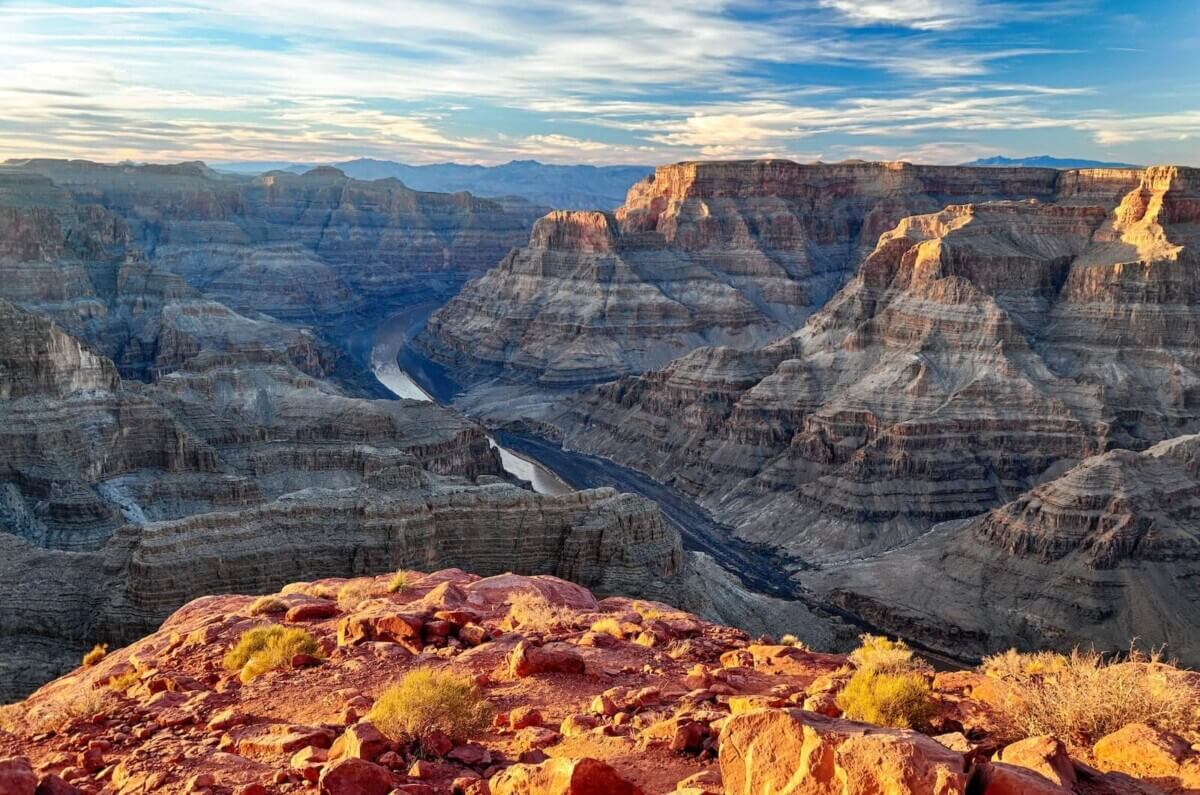
The Grand Canyon (Photo by Omer Nezih Gerek on Unsplash)
Rising and Sinking Land May Explain a Grand Canyon Mystery
In A Nutshell
- Computer models suggest slow churning of hot rock inside Earth may explain a gap of 200 million years or more in the rock record.
- In the models, some ancient continents, including the core of North America, rose for a long stretch, then sank.
- Glaciers likely did much of the scraping, but rising land may have set the stage for them.
- Any link to the rise of animal life still needs testing.
In the walls of the Grand Canyon, rock layers read like a history book, with the oldest rock at the bottom and the youngest on top. Near the base, though, a chapter is missing. Much younger layers sit directly on rock that is far older, with nothing in between to say what happened. Geologists call this break the Great Unconformity, and the gap runs about 200 million years or longer.
A new study in Nature points a finger at the slow churn of hot rock inside the planet. Researchers Santosh Dhungana and Nicolas Flament of the University of Wollongong in Australia built computer models of Earth’s mantle, the thick layer of rock beneath the crust. They ran the models back one billion years. In their simulations, the churn lifted some ancient continents for a long stretch, then let them sink. Rising land gets worn away, and sinking land gets buried, a combination well suited to erasing rock and then hiding the evidence.
Three ancient landmasses fit the pattern: Laurentia, the core of North America; Baltica, a block that is now part of Europe; and North China. All three are places where geologists have documented the gap.
Great Unconformity Still Has No Confirmed Cause
Smaller breaks in the rock record are common, but this one is enormous. First described in the Grand Canyon, it has been mapped across North America. There, the oldest sediment sitting on top of it is between 635 million and 482 million years old. Around the start of the Cambrian period, when animal life began diversifying rapidly, the amount of sediment preserved worldwide more than doubled.
Candidates include huge glaciers during Snowball Earth, a run of global ice ages about 720 to 635 million years ago. The list also includes continents splitting apart, falling seas, and uplift driven by the mantle. In the authors’ words, “The cause or causes of the Great Unconformity are unknown.” None of those ideas had been tested with computer models of how Earth changes over time, the study notes.

Computer Models Predict Some Continents Rose, Then Sank
To test the mantle idea, the team ran six versions of a mantle model. Each used slightly different settings, and each followed reconstructions of how Earth’s plates drifted over the past billion years. Mantle rock moves a bit like a pot of thick soup simmering on very low heat, with hotter material rising and cooler material sinking. Land riding on top gets pushed up or let down, slowly, over about 20 million years at a time. Because the models tend to exaggerate how high land rises, the team focused on the overall trend rather than exact heights.
A computer method then sorted locations on the continents by how their height changed over time. One group, including Laurentia, Baltica, and northeastern North China, rose gradually through the global ice ages, then sank for a long stretch starting roughly 600 million years ago. Laurentia followed that rise and fall in five of the six models, while Baltica and North China showed the rise in four. Most of Africa and Asia stayed low on average throughout, and the models predicted no Great Unconformity there.
Predictions were then checked against real sediment records, drawn from geologic maps and borehole drilling. The amount of sediment on each continent matched the models everywhere except Africa. In Africa, older mountain ranges and rivers that never reached the ocean complicated the picture.

Glaciers May Have Done the Carving After the Land Rose
Glaciers wear rock away about ten times faster than rivers, the paper notes. A gently tilting continent would not create slopes steep enough for rivers to remove that much stone. In the authors’ proposal, mantle uplift raised the land during the ice ages, giving glaciers a long runway to scour it. Uplift and sinking on that scale would have taken more than 900 million years, which may help explain why gaps this large are so rare.
Models also hint at why North America is the best place to see the gap. Laurentia covered a huge area, and in the models’ reconstruction its edges stayed relatively undisturbed for hundreds of millions of years, so the scraped surface survived. Baltica, by contrast, was hit by repeated mountain building along its eastern edge, which could explain why its gap lies mostly buried underground. In the Grand Canyon, a much younger uplift and the Colorado River’s downward cutting helped bring the old boundary into view.
Great Unconformity May Connect to the Rise of Animal Life
Earlier research proposed that the erosion behind the Great Unconformity changed seawater chemistry and helped set off the Cambrian explosion of animal life. If the mantle started that erosion, the first push in the chain came from inside the planet itself. Dhungana and Flament lean toward that idea but leave testing it to future work, since their models did not examine that link.
Glaciers likely did much of the scraping, but this study makes a case that the Grand Canyon’s missing chapter began far underground.
Disclaimer: This article summarizes one published study for general informational purposes. The results come from computer models, and other researchers may interpret the evidence differently.
Paper Notes
Limitations
Mantle flow results in this study depend heavily on tectonic reconstructions, which carry large uncertainty that increases further back in time. One of the six models, built on a paleomagnetic reference frame for plate motion, matched present-day mantle structure poorly and did not predict notable uplift for Laurentia. Precambrian uplift appeared in only four of six models for Baltica and North China, with marked differences in size and duration. The modeling setup is known to overpredict the height of long-wavelength dynamic topography by about a factor of two, and it leaves out sources of topography closer to the surface, so the authors emphasize trends over amplitude. The models track land height rather than erosion itself, so predictions were compared with preserved sediment records, and the authors list erosion and sedimentation effects as future work. Africa’s record did not fit the predicted pattern as well as other continents. The proposed link to seawater chemistry and the Cambrian explosion was not tested.
Funding and Disclosures
The authors disclose support from Australian Research Council grant FT230100001. Open access funding was provided by The University of Wollongong. The authors declare no competing interests.
Publication Details
Santosh Dhungana and Nicolas Flament, Environmental Futures, School of Science, University of Wollongong, Wollongong, New South Wales, Australia. “The deep Earth origin of the Great Unconformity.” Nature, Vol. 659, starting on page 106 (November 5, 2026 issue). Received December 1, 2025; accepted September 11, 2026; published online November 4, 2026. Open access. DOI: https://doi.org/10.1038/s41586-026-11156-5


