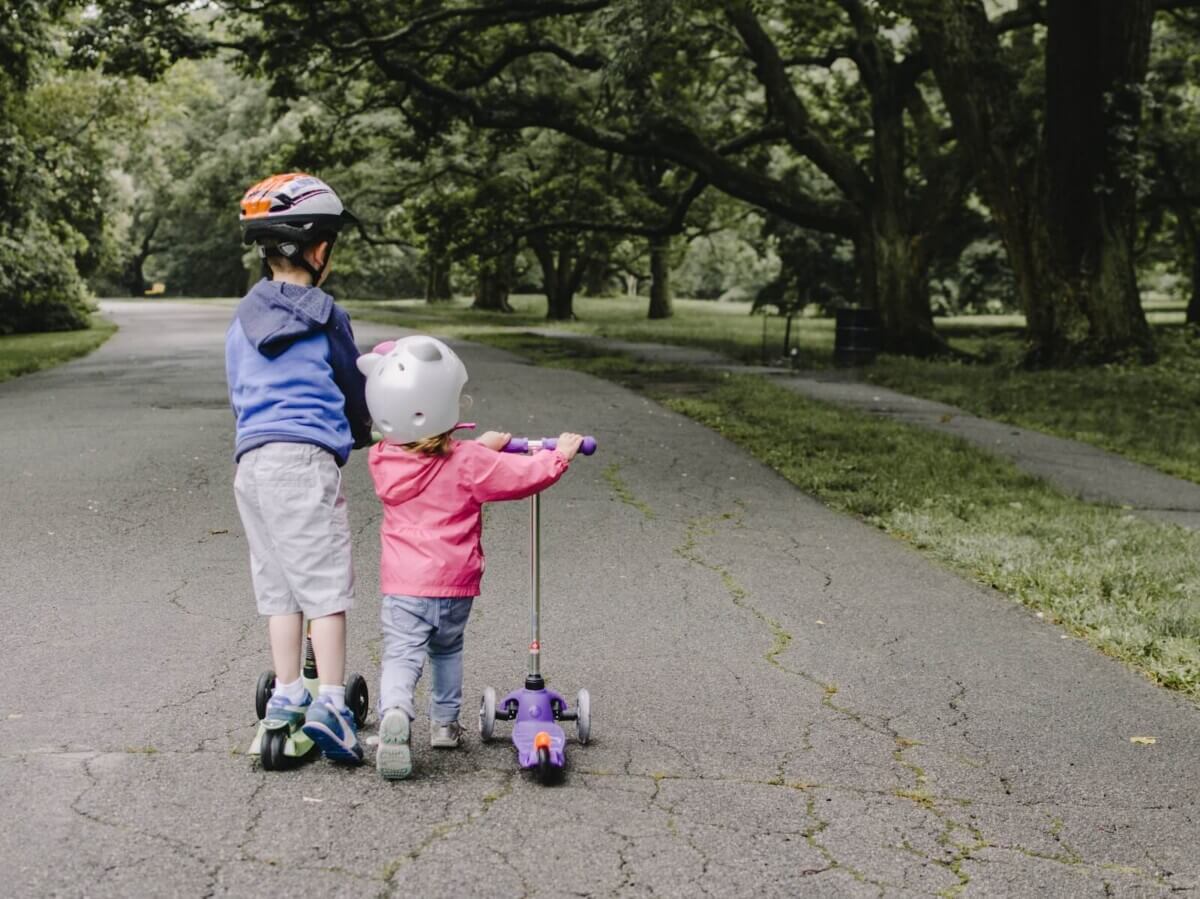
(Photo by Kelly Sikkema on Unsplash)
Study of Nearly 12,000 Kids Links Green Space to Attention
In A Nutshell
- Kids near more trees and parks scored higher on attention and reading tests.
- Cleaner air explained about 7 percent of the link, while exercise did not explain it.
- Score gaps were small, under one point per 10 points of greenery.
- One-time data cannot prove trees cause better focus.
Kids who live near more trees and parks tend to score higher on tests of attention, reading, and vocabulary, and cleaner air may be part of the reason. Exercise, an explanation proposed in earlier research, did not account for the pattern.
A team at Washington University in St. Louis reported the results in the journal Environment International after analyzing data on nearly 12,000 American children. The link between greenery and higher scores held up even after the researchers adjusted for neighborhood disadvantage, screen time, and several other factors that can skew results.
Attention problems among American kids are rising, and reading and math scores have hit record lows, according to the authors. Earlier studies on whether greenery helps have disagreed, with some finding benefits and others finding nothing. Those studies largely skipped whether a child feels safe outside, has ADHD, or sleeps poorly, any of which can hide a green space effect. This study accounted for all three, which is why a large, carefully adjusted look matters.
Green Space Is Linked to Better Attention and Reading Scores
Researchers drew on the Adolescent Brain Cognitive Development study, a long-running project that recruited children at 21 sites across the country, mostly through schools, between 2016 and 2018. The final group included 11,868 kids with an average age just under 10, roughly half boys and half girls. About 52 percent were white, 21 percent Hispanic, 15 percent Black, and 2 percent Asian, and household incomes ranged from under $5,000 to over $200,000 a year. Rural children were underrepresented in the sample, since many sites sit in or near cities.
Greenery was measured by averaging two figures for each child’s home census tract, a small neighborhood zone defined by the Census Bureau: the share covered by tree canopy and the share covered by parks. Children then completed hands-on tests rather than relying on parent opinions. Attention scores combined five tasks covering memory, self-control, flexible thinking, and processing speed. Reading and vocabulary came from two achievement tests. Both were scored like IQ tests, where 100 is average.
Each 10 percentage point increase in a neighborhood’s tree and park cover, roughly the gap between a neighborhood with 5 percent coverage and one with 15 percent, was tied to a 0.76 point higher attention score and a 0.83 point higher reading and vocabulary score. Those gaps are small, under one point each. But roughly half the children lived in neighborhoods with less than 10 percent green space, and about 1 in 10 had less than 1 percent, so the authors speculate that even a modest boost in greenery could matter.

Cleaner Air Partly Accounts for the Green Space Link, but Exercise Does Not
Next, the team tested two popular explanations: that kids in greener areas simply move around more, or that they breathe cleaner air. Kids averaged about 3.5 days a week of at least an hour of activity, and more activity was tied to better scores on its own. It did not, however, explain the green space connection. Tiny airborne particles known as PM2.5 did, to a degree. Greener neighborhoods had less of this pollution, and lower pollution went along with higher scores.
That share was small, though. By a calculation from the paper’s reported figures, pollution accounted for about 7 percent of the total link, so most of the connection remained even after air quality was factored in. That leftover link is what Attention Restoration Theory, a decades-old idea, would predict. Phones, TVs, and traffic grab attention completely, the theory says, while natural settings are “softly fascinating,” holding interest without demanding effort and giving the brain’s focus system a chance to rest.
Going in, the team had predicted that neither air quality nor exercise would play a role, and the authors wrote that the pollution result “was surprising to us.” They also noted that exercise may have gone undetected because of the children’s age and the way activity was measured, which relied on kids’ own reports.
A Single Snapshot Cannot Prove Trees Cause Better Focus
All of the data came from one point in time, so the study can show a connection but not that moving a child to a greener block would raise grades or attention. Adding household income to the models, on top of neighborhood disadvantage, cut the attention link roughly in half, to 0.40 points, though it held up. The reading and vocabulary link fell to 0.35 points and was no longer clearly more than chance. The authors raise the possibility that attention responds to greenery quickly while reading skills build slowly, but the data could not test that. Swapping in a satellite-based measure of plant cover produced the same pattern for both outcomes.
This study did not test whether planting trees raises test scores, and the authors say the benefits of greening the areas around schools still need to be tested. If something as fixable as planting more trees and building more parks could help kids focus and learn, that deserves a real experiment, one that follows children as their neighborhoods get greener.
Disclaimer: This article reports on published research for general informational purposes only. It is not medical, psychological, or educational advice. Parents and caregivers with concerns about a child’s attention, learning, or health should consult a qualified professional.
Paper Notes
Limitations
Because the study captured a single point in time, it cannot establish that green space causes better attention or achievement. The attention score blended several cognitive tasks rather than relying on one pure attention test, and the achievement measure covered only reading and vocabulary, not math, science, or writing. The study included fewer rural children, so results may not reflect rural life. The main green space measure and the secondary satellite measure were assessed at different spatial resolutions, and the analysis could not account for clustering by census tract because that information is considered potentially identifiable and was unavailable. The air pollution finding comes from a statistical analysis of possible pathways, not an experiment.
Funding and Disclosures
Data came from the Adolescent Brain Cognitive Development Study, supported by the National Institutes of Health and additional federal partners. Additional support for this research came from National Institute of Environmental Health Sciences grants R01-ES032295 and R01-ES031074. The authors declared no known competing financial interests or personal relationships that could have influenced the work.
Publication Details
Title: “Green space is associated with better directed attention and higher crystallized intelligence in middle childhood: Evidence from the ABCD study” | Authors: Carina H. Fowler, Joan L. Luby, Theresa M. Bastain, Carrie V. Breton, and Deanna M. Barch, Washington University in St. Louis | Journal: Environment International, Volume 215 (2026), Article 110502. Accepted August 31, 2026; available online September 1, 2026. Open access under the CC BY license. | DOI: https://doi.org/10.1016/j.envint.2026.110502


