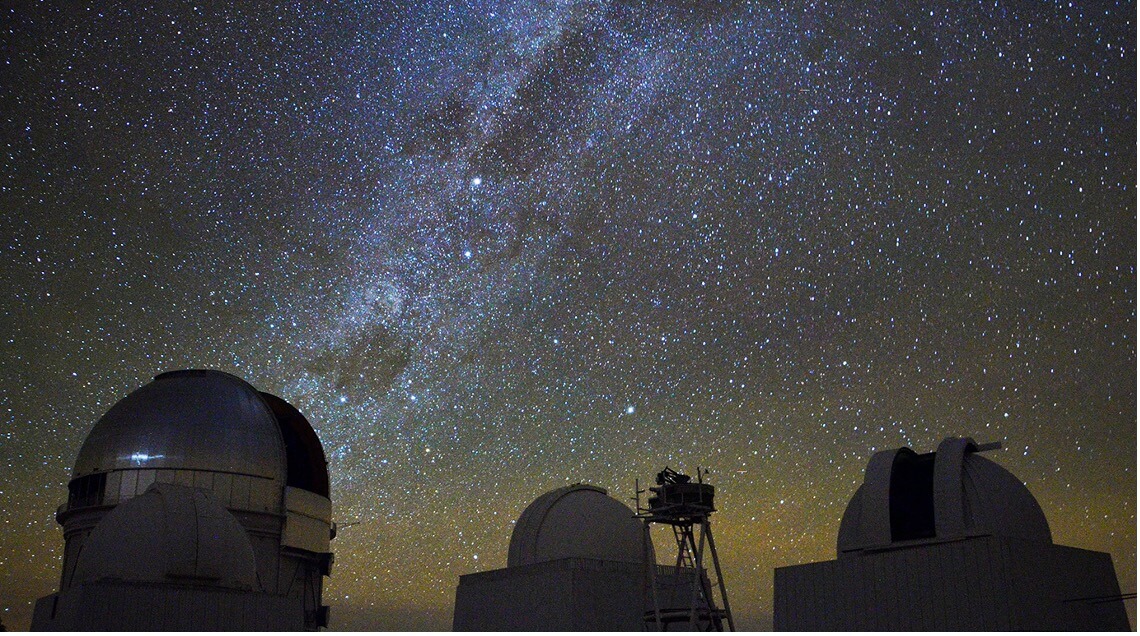
(Credit: Photo by Andreas Papadopoulos)
In A Nutshell
- Astronomers have identified 18 ancient, dust-shrouded galaxies from the universe’s first billion years that most previous surveys failed to detect.
- These galaxies were forming stars at a furious pace but were hidden from prior telescopes because thick dust absorbed their visible light.
- Using NASA’s James Webb Space Telescope and the ALMA radio observatory, researchers developed a new method to spot these objects based on their color and star-formation activity.
- The galaxies may represent a missing evolutionary link between the universe’s earliest bright galaxies and the massive, star-dead galaxies seen in the cosmos today.
Every census has a blind spot. For decades, astronomers building their picture of the early universe couldn’t quite account for an entire class of galaxies, wrapped in thick blankets of cosmic dust, missed by most previous surveys, including major space and ground-based observations. Now, using NASA’s James Webb Space Telescope (JWST) alongside a powerful radio observatory in Chile’s Atacama Desert, scientists have found 18 of them. The discovery may help fill in a missing piece of how the universe’s biggest galaxies formed.
These ancient objects were producing new stars at a furious pace nearly 13 billion years ago. Yet most previous surveys failed to identify them. Hubble couldn’t see them. Specialized radio telescopes didn’t catch them. Ground-based observatories passed right over them. The universe, it turns out, was keeping a major chapter of its own history under wraps.
Where these galaxies fit in the cosmic timeline is what makes the discovery worth paying attention to. The research team believes they may be the evolutionary bridge between the very first bright galaxies ever spotted by JWST and the massive, long-dead galaxies we see scattered across today’s universe: a dusty, star-forming middle chapter that nobody knew existed. “This faint population seems to have been missed by most of the previous submillimeter/millimeter surveys and ground- and space-based UV–near-IR observations,” the authors wrote.
Published in The Astrophysical Journal Letters, the study was led by Jorge A. Zavala of the University of Massachusetts Amherst, alongside dozens of collaborators from institutions across North America, Europe, Asia, and South America.
Why Early Universe Dusty Galaxies Kept Hiding From Every Telescope
The most intensely star-forming galaxies in the early universe were buried in their own dust. Stars pump out enormous amounts of light, but dust absorbs that light and converts it into heat, which radiates at wavelengths most telescopes aren’t built to detect. The further away a galaxy is, the more that signal gets stretched and weakened by the universe’s expansion. Faint dusty galaxies from the universe’s first billion years were, in practical terms, completely off the radar.
JWST changed that. Its infrared sensitivity, far beyond anything Hubble could manage, finally allowed astronomers to catch the faint glow of starlight leaking through the dust. Six are undetected in JWST’s bluest filter. These weren’t galaxies that slipped through the cracks. They were simply too faint for most previous instruments to detect.

How Scientists Found What Everyone Else Missed
Two powerful telescopes working together made the find possible. ALMA, a vast array of radio dishes in the Chilean desert, had already cataloged around 420 bright dusty galaxies in a patch of sky as part of a program called CHAMPS. JWST, meanwhile, had produced an extraordinarily detailed map of the same region called COSMOS2025, capturing the colors and brightness of hundreds of thousands of galaxies across a wide range of wavelengths.
With those two datasets combined, the team looked for a pattern that could identify dusty galaxy candidates without requiring a direct radio detection. They found one: galaxies forming stars rapidly and carrying enormous amounts of stellar mass show up as unusually red objects in specific JWST camera filters. Applying that color-and-mass test to the COSMOS2025 catalog and focusing on galaxies from the universe’s first billion years, the researchers narrowed a field of hundreds of thousands down to 73 candidates, then to 18 after cross-checking against the ALMA data and removing imaging artifacts.
None had appeared in major existing millimeter catalogs. To verify the dusty signal was real, the team effectively combined the faint radio data from all 18 galaxy positions at once, stacking them like transparencies on an overhead projector until a clear image emerged. The result was a confident detection of dust emission. Running the same test at random sky positions produced nothing, confirming the signal belonged to those galaxies specifically. Confirmed distances for three of the candidates place them firmly in the universe’s first billion years.
The Missing Link Between the Universe’s First Galaxies and Today’s Cosmic Giants
What really caught researchers’ attention is how these dusty galaxies fit into a larger story. Scientists have long puzzled over two seemingly unrelated populations: the extremely bright, fast-growing galaxies JWST has been spotting from the universe’s earliest era, and the enormous, star-formation-dead galaxies that appear to have burned themselves out surprisingly early in cosmic history. How one became the other has never been fully explained.
The team argues these galaxies could represent the missing middle stage: descendants of those early bright galaxies, still actively building stars under a veil of dust, before eventually exhausting their fuel and going quiet. It’s a plausible three-act story for some of the universe’s most massive objects, and these 18 galaxies are among the first strong candidates identified for that middle role.
Researchers are careful to call this a hypothesis. Most of the 18 still need their distances precisely confirmed, and some may turn out to be closer than current estimates suggest. “Future spectroscopic campaigns will be essential to confirm the redshifts and physical properties of these massive, faint, high-redshift DSFG candidates,” the authors noted. More observations are coming.
Still, the core point stands: a whole population of dust-shrouded, star-forming galaxies from the universe’s first billion years was likely undercounted in previous surveys. What that means for our understanding of the universe’s earliest history is now an open and genuinely exciting question.
Disclaimer: StudyFinds strives to report research accurately and accessibly. Scientific studies — particularly those involving early universe observations — often involve estimates, models, and hypotheses that require further confirmation. The findings described here reflect the authors’ interpretations and should not be taken as settled scientific consensus. Always refer to the original published study for full methodology and context.
Paper Notes
Study Limitations
The most significant limitation is that most of the 18 candidate galaxies lack precise, spectroscopically confirmed distances. Current distance estimates are based on fitting galaxy colors across many wavelengths, a method that carries real uncertainty — particularly for dusty galaxies, which can mimic the appearance of galaxies at different distances. Independent analysis using a separate software package confirmed roughly 80 percent of candidates are likely within the target era, but about 20 percent showed best-fit estimates outside that range. The sample of 18 is also small, introducing statistical uncertainty into the estimated space density. Additionally, the ALMA survey footprint covers only about 30 percent of the broader JWST catalog area, and the stellar masses and star formation rates used in the analysis carry their own uncertainties — particularly in cases where an active galactic nucleus may be influencing the galaxy’s appearance.
Funding and Disclosures
Funding sources include NSF grant 2407752 (D.B. Sanders), FONDECYT grant No. 1252054 and ANID Basal Project FB210003 and ANID MILENIO NCN2024_112 (M. Aravena), Villum Fonden research grants 37440 and 1316 (G.E. Magdis), the Dunlap Institute endowment through the University of Toronto (S. Fujimoto), JSPS KAKENHI grant Nos. JP22K21349 and JP23K13149 (Y. Fudamoto), and the National Science Foundation under award No. 1519126. ALMA data are from program ADS/JAO.ALMA#2023.1.00180.L. JWST data were obtained from the Mikulski Archive for Space Telescopes and can be accessed via doi:10.17909/ahg3-e826. No conflicts of interest are disclosed.
Publication Details
Authors: Jorge A. Zavala (lead; University of Massachusetts Amherst) and 40 co-authors from institutions including Caltech/IPAC, Universidad Diego Portales, UC Santa Barbara, Rochester Institute of Technology, the University of Tokyo, the Niels Bohr Institute, and numerous other international collaborators from the CHAMPS and COSMOS-Web collaborations. | Journal: The Astrophysical Journal Letters | Title: “ALMA and JWST Identification of Faint Dusty Star-forming Galaxies up to z ∼ 8 and Their Connection with Other Galaxy Populations” | Volume/Issue: 998:L36 (11 pp), published February 20, 2026 | DOI: https://doi.org/10.3847/2041-8213/ae382a | Received: September 25, 2025; revised January 12, 2026; accepted January 13, 2026


