
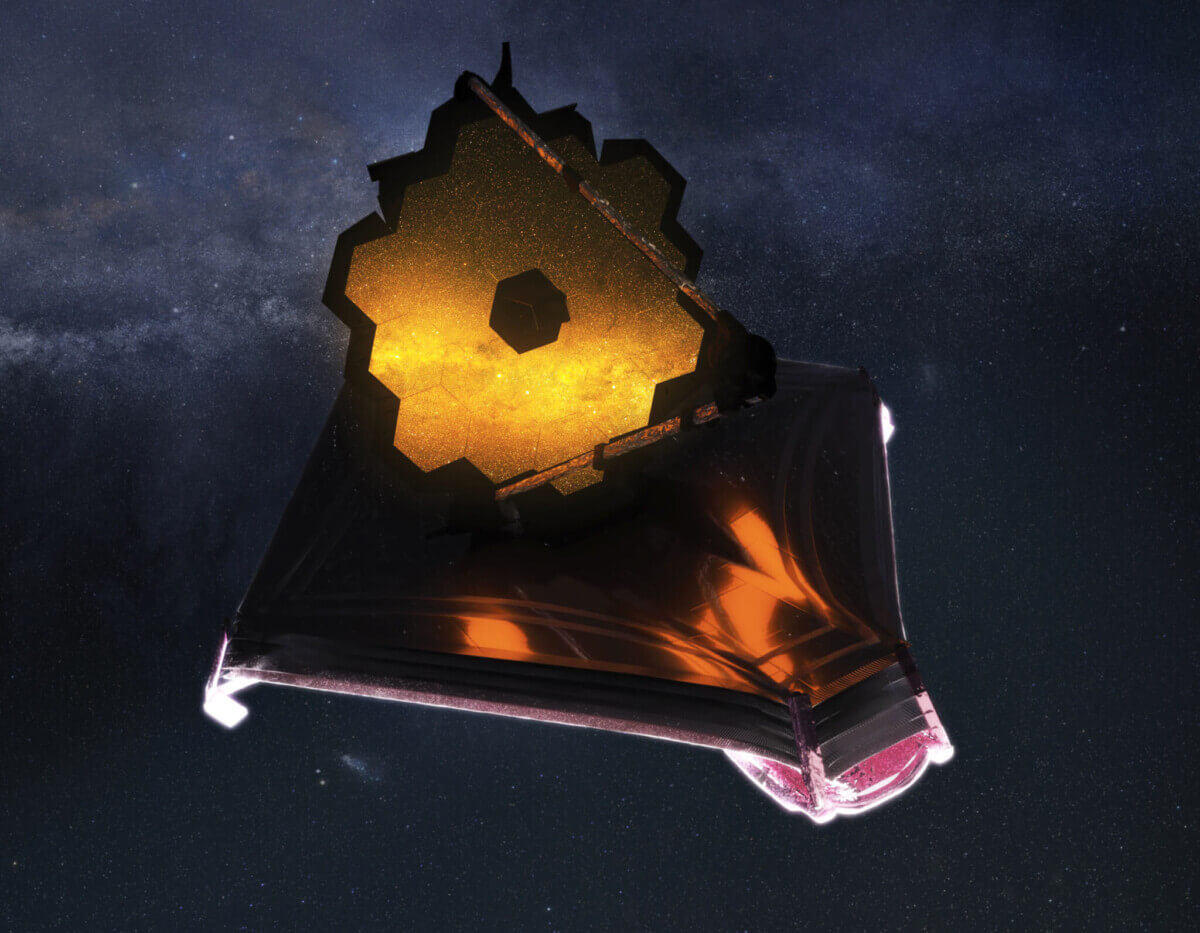
Graphic showing the mysterious objects in the universe that the University of Missouri researchers identified.in their study. (Credit: Bangzheng “Tom” Sun/University of Missouri)
In A Nutshell
- JWST survey targeted 300 extremely bright galaxy candidates from early universe using “dropout” technique.
- Main sample of 137 with mid-infrared data showed ~67% are low-redshift dusty galaxies, ~7% are likely high-redshift, ~25% undecided.
- Results highlight high contamination rates for the brightest candidates and the need for spectroscopic confirmation.
COLUMBIA, Mo. — Astronomers searching for some of the universe’s first galaxies have uncovered a surprising case of mistaken identity. In a detailed study using the James Webb Space Telescope (JWST), researchers found that most of the brightest-looking candidates for galaxies from the universe’s infancy are actually much closer, older galaxies that happen to look the part.
The team examined a special subset of 300 extremely luminous objects selected using a technique designed to catch galaxies from the first billion years of cosmic history. Of the 137 objects in this set that also had mid-infrared observations, roughly two-thirds turned out to be much later galaxies, their redness caused by dust rather than distance. The rest were either genuine early galaxies or too ambiguous to classify with current data.
In telescope images, both genuine early galaxies and certain nearby dusty galaxies appear strikingly red, but for different reasons. Light from galaxies in the early universe is stretched to redder wavelengths during its long journey to Earth, and shorter wavelengths are absorbed by intergalactic hydrogen gas. Dusty galaxies closer to home, on the other hand, look red because tiny particles scatter and block shorter-wavelength light. To JWST’s cameras, the two can appear nearly identical.
How Astronomers Hunt for the First Galaxies
Researchers Bangzheng “Tom” Sun and Haojing Yan from the University of Missouri used a classic method known as the “dropout” technique. This approach identifies galaxies that “disappear” from view in certain filters because their blue light is absorbed along the way.
The study combined JWST data from four major survey fields, covering about 500 square arcminutes, roughly the area of the full moon on the sky. The team focused on only the brightest candidates, those that would be among the most luminous early galaxies ever found if they truly came from the first billion years. This level of brightness would require either unusually massive and rapidly forming stars or other extreme conditions.
Separating the Real from the Imitators
Using three different software tools to estimate distances from each object’s light spectrum, the researchers sorted their main sample into likely high-redshift (ancient) galaxies, likely low-redshift (later) galaxies, and undecided cases.
The breakdown:
- Low-redshift (later) galaxies: 93 objects (~67% of the main sample)
- Likely early galaxies: 10 objects (~7%)
- Undecided: 34 objects (~25%)
Spectroscopic measurements, the gold standard for distance, were available for seven of the objects. Six of these proved to be from a later cosmic era, around three billion years after the Big Bang. Only one was confirmed to date from just 600 million years after the universe began.
The One Confirmed Ancient Heavyweight
That lone confirmed high-redshift galaxy, identified as f115d_brt_ceers_062, shines at an ultraviolet brightness and mass level that place it among the most extreme galaxies yet found from such an early epoch. According to the paper, it does not currently pose a major challenge to the latest theoretical models of early galaxy formation, but its existence helps mark the outer limits of what those models can explain.
Other candidates in the sample, if confirmed to be truly ancient, could still test the boundaries of these theories because of their extreme luminosities and large inferred stellar masses.

What This Means for Cosmic Archaeology
The findings show that even JWST’s powerful infrared instruments can be fooled by cosmic lookalikes, especially when searching at the bright end of the early galaxy population. The results suggest that very bright candidates have high contamination rates and may require extra caution (or different techniques) to confirm their distances.
Rather than lessening the significance of early galaxy discoveries, the work highlights how exceptional the confirmed ones really are. In a universe full of dusty impostors, the real ancient galaxies stand out as rare, remarkable survivors from the dawn of time.
Paper Summary
Methodology
Researchers analyzed public data from the James Webb Space Telescope covering four blank sky fields totaling about 500 square arcminutes. They used the classic “dropout” technique to identify candidate early galaxies, selecting only the brightest objects that appeared to drop out of certain wavelength bands, a signature of very distant, ancient galaxies. The team applied strict brightness criteria and used both infrared instruments for wide-ranging analysis. They employed three different advanced light analysis techniques to study 137 objects that had both infrared and mid-infrared coverage, categorizing them based on distance estimates using redshift measurements (a way scientists measure cosmic distances).
Results
Of 300 very bright dropout candidates identified, 137 had sufficient mid-infrared data for detailed analysis. The study found that approximately 67% of these objects are likely low-redshift galaxies (meaning they’re relatively nearby) rather than genuine early universe galaxies, while about 7% could still be authentic high-redshift objects (genuinely ancient galaxies). Direct distance confirmation was available for 10 objects, with 7 receiving reliable measurements. Six of these seven were confirmed as closer galaxies, while one was confirmed as a genuine early galaxy dating to when the universe was 600 million years old.
Limitations
The study acknowledges that advanced light analysis techniques have inherent limitations in distinguishing between dusty nearby galaxies and genuine early galaxies, as both can produce very similar observational signatures. The direct distance measurement sample size was limited to only 10 objects, making broader statistical conclusions challenging. Additionally, the study focused only on very bright objects, which may not represent the broader population of early galaxy candidates.
Funding and Disclosures
The research was supported by the University of Missouri Research Council grant URC-23-029 and NSF grant AST-2307447. The authors acknowledge no conflicts of interest. Data were obtained from the Mikulski Archive for Space Telescope (MAST) at the Space Telescope Science Institute.
Publication Details
Bangzheng Sun and Haojing Yan. “On the Very Bright Dropouts Selected Using the James Webb Space Telescope NIRCam Instrument.” The Astrophysical Journal 987, no. 60 (2025): 19 pages. DOI: 10.3847/1538-4357/addbe0


