
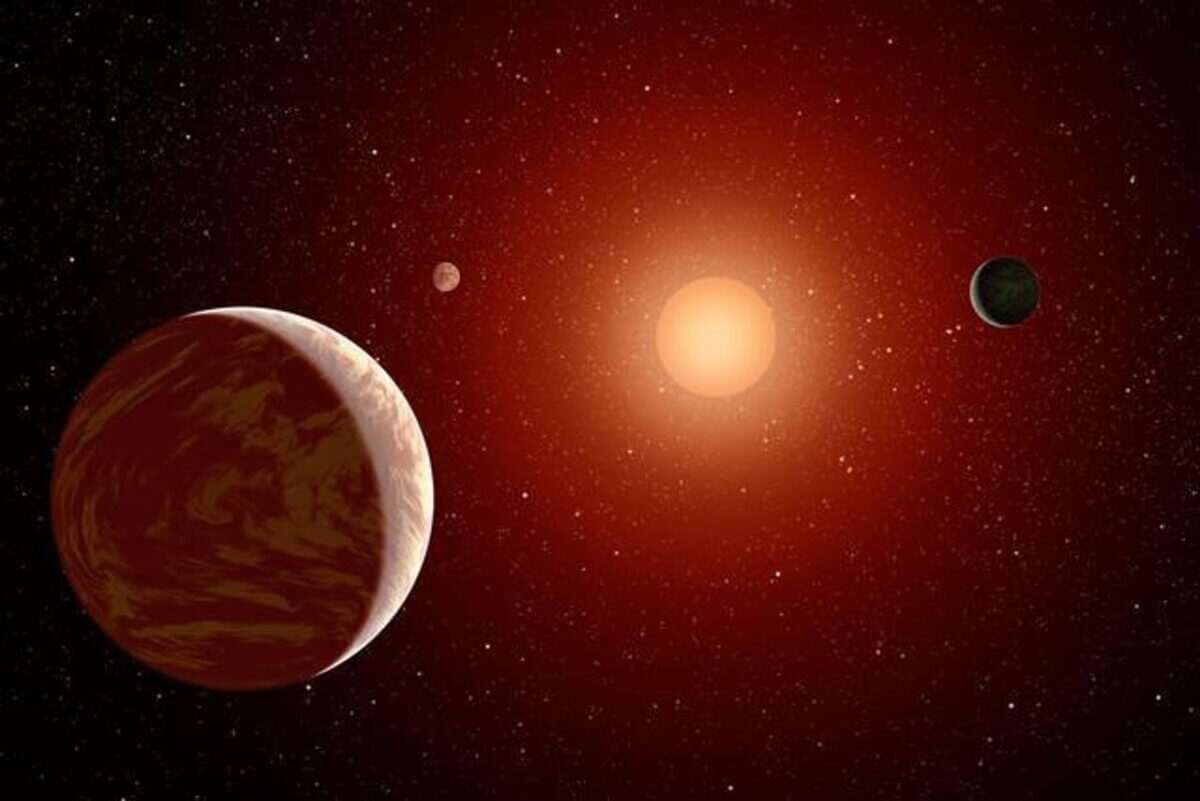
Artistic representation of a dark dwarf. (Image created by Sissa Medialab staff with Adobe Illustrator)
In A Nutshell
- New theoretical models predict “dark dwarfs” — objects powered by dark matter annihilation.
- These cosmic bodies would shine steadily near the galactic center for billions of years.
- They retain lithium-7 that normal stars would destroy, offering a unique detection clue.
- Confirming dark dwarfs would show dark matter directly powers visible cosmic structures.
HONOLULU — Celestial objects that glow with steady, eternal light powered not by nuclear fusion like our sun, but by dark matter — the invisible substance that makes up most of the universe — may already exist near the center of our galaxy. According to research from the University of Hawaii and Durham University in the U.K., these strange entities called “dark dwarfs” could be awaiting discovery.
The study, published in the Journal of Cosmology and Astroparticle Physics, reveals that dark matter doesn’t just passively float through space. Instead, it can actively power stellar objects in ways never before imagined, fundamentally changing how astronomers think about the building blocks of the cosmos.
“Dark dwarfs retain their initial lithium-7 in mass ranges where brown/red dwarfs would destroy it, providing a method for detecting them,” the researchers wrote, offering astronomers a potential roadmap for finding these elusive objects.
When Failed Stars Get a Dark Matter Boost
Brown dwarfs are essentially failed stars: sub-stellar objects (celestial bodies smaller than stars) too small to sustain the nuclear fusion that powers stars like our sun. They’re cosmic also-rans that briefly flicker with nuclear activity before cooling down and fading into darkness over billions of years.
Red dwarfs, meanwhile, are the smallest true stars, just barely massive enough to maintain steady hydrogen fusion. They sit right at the boundary between success and failure in the stellar world.
Dark matter changes this entire equation. When dark matter particles collide and annihilate inside these sub-stellar objects, they release energy that can keep them glowing indefinitely. This process transforms what would normally be a cooling brown dwarf into something entirely new: a dark dwarf.
Unlike their conventional counterparts, dark dwarfs maintain constant temperature, size, and brightness over time. They’re essentially cosmic perpetual motion machines, powered by the universe’s most mysterious substance.
The Galactic Center Connection
The research team used complex mathematical models to predict where these objects might exist. Their calculations point to a specific location: the center of our galaxy, where dark matter density reaches extreme levels. Study authors believe they are more than 1,000 times denser than dwarfs in our solar neighborhood.
This geographic limitation explains why astronomers haven’t spotted dark dwarfs yet. Most telescopic surveys focus on objects relatively close to Earth, but dark dwarfs would primarily exist in the crowded, dust-obscured region around our galaxy’s supermassive black hole.
How to Spot a Dark Dwarf
Perhaps the most intriguing aspect of dark dwarfs is how astronomers might identify them. The key lies in the aforementioned lithium-7, a light element that gets destroyed in the cores of conventional stars and brown dwarfs when temperatures rise high enough.
Because dark dwarfs operate at lower core temperatures than their conventional counterparts, they preserve their original lithium-7 content. This creates a distinctive signature: objects that appear to have the mass of normal stars but retain lithium levels that should have been burned away long ago. It’s like finding fingerprints at a crime scene, the clear evidence that something unusual happened.
Current estimates suggest dark matter makes up about 85% of all matter in the universe, yet scientists know virtually nothing about its properties beyond its gravitational effects. Dark dwarfs could change that, offering a window into dark matter’s behavior and interactions.
The research also indicates that the minimum mass required for hydrogen burning — a fundamental threshold in stellar physics — isn’t actually fixed. Instead, it depends on local dark matter conditions, meaning stellar evolution works differently in different parts of the galaxy.
Future telescopic surveys targeting galactic center regions could potentially spot dark dwarfs by looking for objects with unusual lithium signatures. The discovery of these objects would represent the first confirmed case of dark matter directly powering visible cosmic phenomena, providing astronomers with natural laboratories for studying the universe’s most elusive component. Rather than being passive cosmic scaffolding, dark matter could play an active role in powering and sustaining celestial objects throughout the universe.
Paper Summary
Methodology
The researchers used mathematical models based on stellar physics to simulate how dark matter annihilation would affect sub-stellar objects. They employed equations describing stellar structure and energy conservation to calculate how objects close to the stellar limit would evolve in regions of high dark matter density.
Results
The study found that dark matter annihilation can prevent brown dwarfs from cooling by providing a steady energy source, creating stable “dark dwarf” configurations. These objects maintain constant luminosity, radius, and temperature over time, unlike conventional brown dwarfs that cool continuously. Dark dwarfs would primarily exist near galactic centers where dark matter density is extremely high, and they retain lithium-7 that would be destroyed in normal stellar objects of similar mass.
Limitations
The research is entirely theoretical and based on mathematical modeling rather than observational evidence. The approximations become less valid for very low-mass objects due to complex particle interactions. The models assume specific dark matter properties and annihilation rates that may not reflect reality. Additionally, the predicted locations of dark dwarfs in galactic centers make them difficult to observe with current telescopic capabilities.
Funding and Disclosures
The research was supported by the Science and Technology Facilities Council (STFC) under Grant No. ST/T001011/1 and the National Science Foundation under Grant No. 2207880. The authors declared no competing interests, and their computational code is publicly available through Zenodo for reproducibility.
Publication Information
The paper “Dark Dwarfs: Dark Matter-Powered Sub-Stellar Objects Awaiting Discovery at the Galactic Center” was authored by Djuna Croon (Durham University), Jeremy Sakstein (University of Hawaii), Juri Smirnov (University of Liverpool), and Jack Streeter (Durham University). It was published on July 7, 2025 in the Journal of Cosmology and Astroparticle Physics.


