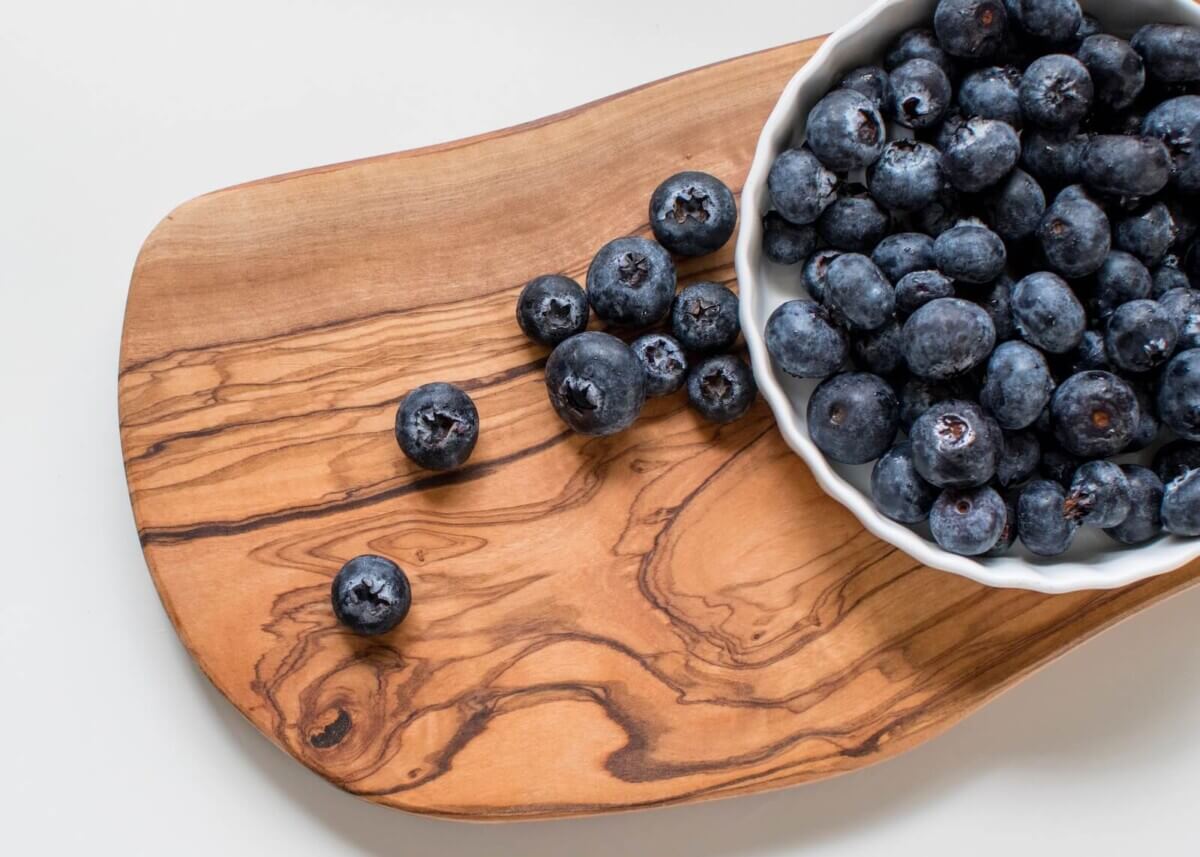
Blueberries on brown wooden chopping board (Photo by Davies Designs Studio on Unsplash)
Small Trial Ties Daily Blueberries to Gut Changes in Older Adults With Low Mood
In A Nutshell
- Older adults with mild depressive symptoms who ate blueberry powder equal to about two cups of fresh berries daily for three months showed changes in how common six groups of gut bacteria genes were.
- One change involved a bacterial pathway that could feed into making GABA, a calming brain chemical, but GABA itself was not shown to increase.
- Depression scores improved in both the blueberry and placebo groups, with no reliable difference between them.
- Only 18 adults finished this pilot trial, so the results are early clues rather than proof.
A daily dose of blueberry powder, equal to about two cups of fresh berries, changed how common certain genes were among the gut bacteria of older adults with mild depressive symptoms. One change involved a bacterial pathway that could feed into making GABA, a calming brain chemical, although the study never showed that GABA itself increased. Mood scores showed only a faint and unproven edge over a fake powder.
Depression is common in this age group. Between 8 and 16 percent of older adults living in the community have clinically relevant depressive symptoms, and milder symptoms that fall short of a formal diagnosis are two to three times more common than major depression. Antidepressants have limited usefulness for older adults, and therapy is often underused, so researchers are hunting for accessible alternatives.
One candidate is the gut microbiome, the trillions of bacteria in the digestive tract that can send chemical signals to the nervous system. Blueberries are rich in fiber and anthocyanins, the pigments that give the fruit its deep blue color, and both interact with gut bacteria. Researchers at Hebrew SeniorLife and Harvard Medical School tested whether blueberries could nudge that bacterial community in a helpful direction. Results appeared in The Journal of Nutrition, Health and Aging.
Blueberry Powder Shifted Six Gut Bacteria Gene Groups in 10 Older Adults
Twenty sedentary adults aged 65 and older with mild depressive symptoms enrolled, and 18 finished. Participants were randomly assigned to eat either 48 grams of freeze-dried blueberry powder daily or a look-alike placebo powder made mostly of maltodextrin, a starch. Neither participants nor researchers knew who received which. Everyone was asked to avoid blueberries and other foods rich in fiber or anthocyanins. The blueberry dose added roughly 8 grams of fiber a day, about 30 percent of the recommended intake.
Eight people finished in the placebo group and 10 in the blueberry group. Average ages were 75 in the placebo group and 71 in the blueberry group. Most participants were women, and nearly all were white.
Stool samples collected before and after the three months let researchers read the DNA of gut bacteria, revealing which species were present and which genes they carried. Questionnaires tracked depression, anxiety, sleep, and emotional well-being, and blood tests measured a brain-health protein.
Overall species makeup stayed put, and so did two byproducts of fiber digestion measured in stool. Six groups of bacterial genes, each tied to a specific chemical job, became more or less common in the blueberry group but not in the placebo group. Most handle routine cell maintenance, so linking them to mood is difficult.
One group stood out: genes for a protein that shuttles several compounds, including one called putrescine, across bacterial cell membranes became more common. Bacteria can convert putrescine into GABA, though that is a minor route and the same protein does other jobs. A lab experiment using a model of the intestine, cited in the paper, had found that blueberries increased GABA. With no matching signal in the wider pathway analysis or in stool chemicals, the authors called their interpretation “speculative at this stage.”

Depression Scores Improved in Both Blueberry and Placebo Groups
Scores for depression, anxiety, sleep, and emotional well-being all improved over three months in both groups, a common pattern in mood studies, since regular contact with research staff can lift spirits on its own. Differences between the groups were too small to rule out chance, with one exception. Anxiety showed a clear gap, though the authors say it is likely explained by the blueberry group starting out with higher anxiety.
Even so, the drop in depression symptoms appeared larger and more consistent among blueberry eaters, a clue that has not been confirmed.
A blood protein called BDNF, which supports brain cells and is thought to play a role in how antidepressants work, edged up slightly in the blueberry group and slipped slightly in the placebo group. That difference was not large enough to count as reliable, and the measurements came from the larger study this project was part of, which had a few more participants. Across the full sample, bigger BDNF gains tended to go with bigger drops in depression scores, but that link narrowly missed the usual threshold for a solid result.
Tiny Sample of 18 Adults Limits What the Results Can Show
Researchers designed this as a pilot, meant to test whether the approach is workable and to gather early clues for planning a larger trial. Participants were also mostly highly educated, a narrow slice of older adults, which limits how far the results extend. Differences between the small groups at the start, including smoking history, could have influenced the results too.
Other gaps remain. Only one stool sample was collected at each visit despite day-to-day swings in gut bacteria. Acetate, the most abundant fiber byproduct in stool, could not be measured. Maltodextrin in the placebo may not be completely neutral in the gut. Symptoms were also very mild, which may have left little room for improvement.
Whether blueberries can ease low mood in older adults remains unanswered. A possible biological link paired with a hint of clinical benefit is enough to make the question worth testing in a larger trial, which is exactly what the researchers say should come next.
Disclaimer: This article is for informational purposes only and is not medical advice. The study described was a small pilot trial with preliminary results. Decisions about diet, supplements, or depression treatment should be made with a qualified health professional.
Paper Notes
Limitations
Authors describe this work as a pilot trial with a small sample, intended to test feasibility and gather preliminary data rather than prove an effect. Participants were a select, homogeneous group, mostly white, female, and highly educated, so results may not generalize to the wider aging population. Baseline differences between groups, including higher anxiety scores in the blueberry group and differences in smoking history, could have confounded the analyses. Only one stool sample was collected per visit despite known day-to-day variability in gut bacteria, and the laboratory method could not capture acetate, the most abundant short chain fatty acid in stool. Maltodextrin, the main ingredient in the placebo, may itself affect the gut microbiome. Participants had very mild depressive symptoms, which may have created a floor effect, and BDNF was measured in a parent trial with more participants than the gut analysis. No formal power analysis was performed, and the authors describe their interpretation of the GABA-related finding as speculative at this stage.
Funding and Disclosures
Berries, Bugs, and the Blues was funded by a USDA AFRI NIFA grant (2023-67017-39055). The parent trial was funded by the Boston Roybal Center for Active Lifestyle Interventions and the National Institute on Aging (P30 AG048785-09). The US Highbush Blueberry Council provided both the blueberry and placebo powders and had no role in study design, conduct, or analyses. Lewis A. Lipsitz is a committee member of the Boston Roybal Center for Active Lifestyle Interventions. Douglas P. Kiel has received grant support from Solarea Bio, serves on the Scientific Advisory Boards of Solarea Bio and Johnson & Johnson, and receives publication royalties from Wolters Kluwer. All other authors reported no disclosures. The authors stated that no generative AI or AI-assisted technologies were used in preparing the manuscript.
Publication Details
Courtney L. Millar, Mohit P. Chopra, Xochitl Morgan, Emily A. Green, Alex Wolfe, Kerry A. Pierce, Lidan Gao, Christopher N. Blesso, Alyssa B. Dufour, Douglas P. Kiel, and Lewis A. Lipsitz wrote the Brief Report titled “A pilot study of daily blueberry intake modulates the gut microbiota enzyme commissions in older, sedentary adults with mild depressive symptoms.” Millar, the corresponding author, is affiliated with the Hinda and Arthur Marcus Institute for Aging Research at Hebrew SeniorLife and Harvard Medical School in Boston. The paper was published in The Journal of Nutrition, Health and Aging, volume 30 (2026), article 100958, and became available online August 21, 2026, after acceptance on August 13, 2026. It is open access under a CC BY-NC-ND license. The trial is registered at ClinicalTrials.gov as NCT05817383, and the digital object identifier is https://doi.org/10.1016/j.jnha.2026.100958.


