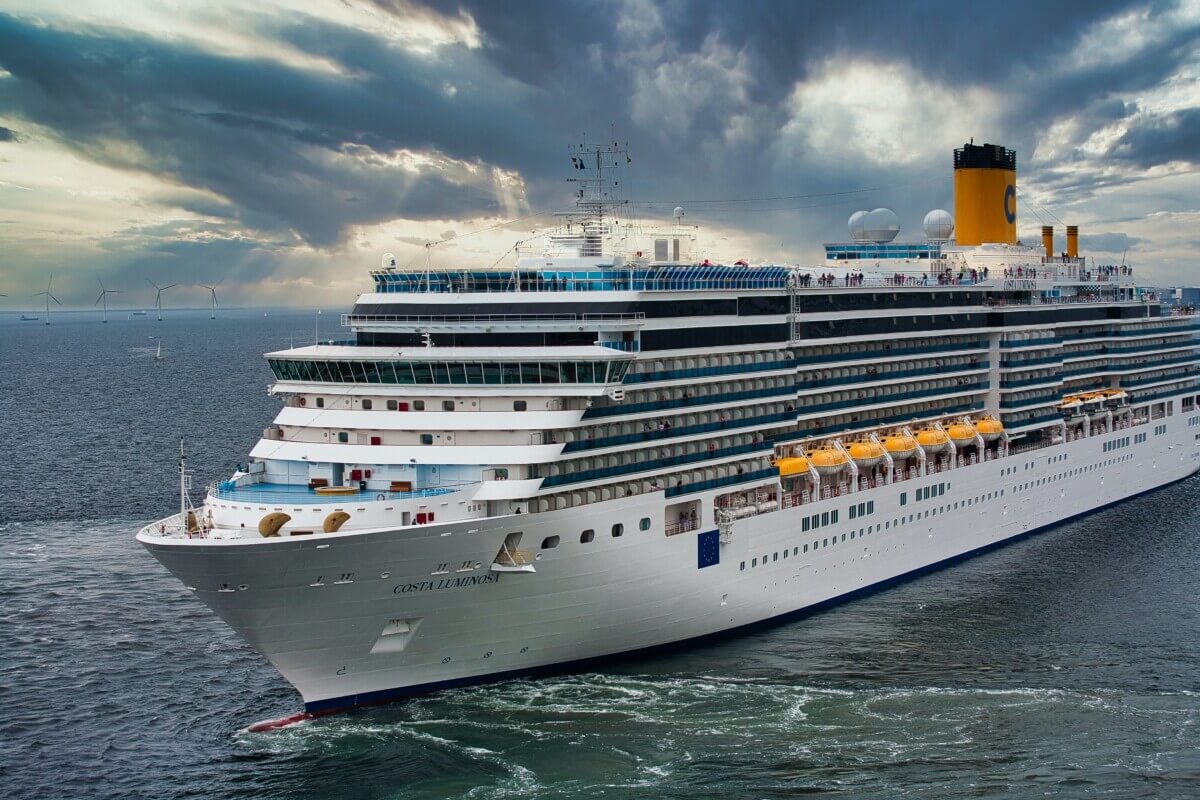
(Credit: Photo by Daniele D'Andreti on Unsplash)
In a Nutshell
- Tiny particles from cruise ships burning heavy fuel oil are rich in metals, and one, vanadium, drove the harmful effects in the lab.
- In lung cells, vanadium sparked heavy inflammation while turning down the genes that defend against viruses.
- Cells exposed to vanadium let a common cold virus and the coronavirus multiply more, with coronavirus infection rising nearly fivefold.
A summer cruise brings to mind sun decks and buffet lines, but the smoke drifting off those towering ships may carry something that reaches well beyond the passengers. New laboratory research points to a metal in cruise ship exhaust that appears to leave human lung cells less able to fight off viruses, including the one behind COVID-19.
Scientists studying the air near one of Europe’s busiest cruise ports, in a study published in the journal Environment International, found that the tiniest particles pouring out of ships burning heavy fuel oil are rich in metals, and one of them, vanadium, set off runaway inflammation in lab-grown lung cells while turning down those cells’ antiviral defenses. In dishes where cells were exposed to vanadium, a common cold virus and the coronavirus both multiplied more freely.
Air pollution ranks among the deadliest environmental hazards on Earth, linked to nearly 9 million premature deaths annually, according to the study. Car and truck emissions have drawn decades of scrutiny, yet what comes out of ships has largely gone unexamined, even though more than 80% of global trade moves by sea and many people live within breathing distance of working docks.
Inside the Cruise Ship Air Pollution Study
Researchers based the work at the Port of Southampton on England’s south coast, the port that handles more cruise passengers than any other in Europe and sits right next to a city of about 260,000 people. That setup made it a useful place to ask how port fumes reach the people living nearby.
Between February 2018 and March 2020, the team set up air-collecting equipment at five spots inside the port, each tied to a different activity: a truck gate, a scrap metal yard, a small research dock, a container ship terminal, and a cruise ship terminal. A sixth station sat about five kilometers away at the University of Southampton to record ordinary city air for comparison. Samples were also gathered at the cruise terminal in winter, when few cruise ships were coming and going, to see how the seasons stacked up.
Particles were sorted into three sizes: coarse, fine, and ultrafine. Ultrafine particles, smaller than one ten-thousandth of a millimeter, are the ones that slip deepest into the lungs and can even cross into the bloodstream. Current air quality rules set no specific limits on particles this small and do not routinely track them.
A Chemical Fingerprint Pointing to Cruise Ships
One location jumped out once the chemistry came back: the cruise terminal, but only during the busy summer season. Ultrafine particles collected there were packed with three metals, vanadium, nickel, and cobalt, at levels far above every other site, including the ordinary city air. Those same metals were not raised at the cruise terminal in winter.
Vanadium and nickel are well-known signatures of heavy fuel oil, the thick, tar-like fuel many large ships burn. Cobalt appeared as a possible new signature, which the authors suggest may be linked to the chemistry used to strip sulfur from ship fuel. Wind readings backed this up, with the highest vanadium levels blowing in from exactly where the cruise ships docked.
Heavy fuel oil matters because burning it produces metal-rich particles that, in the lab, hit lung cells harder than particles from cleaner fuels, though the study notes that lower-sulfur fuels are not automatically safe either. Even after two decades of international rules meant to cut sulfur pollution from ships, these metals still turned up in large amounts in the smallest, most dangerous particles. Scrubbers, the exhaust-cleaning systems ships use to meet sulfur limits, do a poor job of capturing particles smaller than 1 micrometer, which is exactly the size range that carries the metals.

What Cruise Ship Air Pollution Does to Lung Cells
To test the health angle, researchers dripped the collected particles onto two kinds of human lung cells grown in the lab, one from the airways and one from deep in the lungs where oxygen enters the blood. Worth noting: the doses were far higher than anything a person would breathe day-to-day, since the goal was to spot biological hazards, not to replicate real-world exposure.
Cruise ship ultrafine particles set off a much stronger inflammatory reaction than particles from anywhere else. Cells pumped out high levels of inflammation-signaling proteins, several of them the same ones linked to the immune overreaction seen in severe COVID-19. Gene readouts told the other half of the story: exposure turned down a wide range of genes that make up the body’s early-warning system against viruses.
When the metals were tested one at a time, vanadium was the culprit. It alone reproduced both the inflammation and the collapse of antiviral defenses, while nickel and cobalt did neither. Follow-up infection tests sealed the case. Human airway cells from healthy donors produced more copies of rhinovirus-16, a common cold virus and a major asthma trigger, after exposure to vanadium. In a separate test, vanadium increased coronavirus infection by nearly fivefold compared with untreated cells. Researchers found evidence pointing to a protein called SOCS3, which vanadium appears to switch on. SOCS3 acts as a brake on the cell’s antiviral alarm, and with the brake pressed, viruses spread more easily.
Where the Rules Fall Short
Perhaps the sharpest point in the paper is about policy rather than biology. Air quality rules focus on the total weight of larger particles and say nothing specific about ultrafine particles or their chemistry. Under those rules, a ship can pass inspection while still releasing plenty of metal-laden ultrafine particles.
Southampton sits inside one of the world’s strictest shipping emission zones, where fuel sulfur has been capped at just 0.1% since 2015. Ships that keep burning heavier fuel are allowed to run scrubbers to meet the sulfur limit, but those scrubbers miss the sub-micrometer particles carrying the most vanadium. Metal-rich particles, the authors caution, may still be reaching port communities, even though the study did not directly measure what people in those neighborhoods breathe or how their health fared.
Similar shipping rules govern the North Sea, Baltic Sea, Mediterranean, and North American coastlines, so the results could affect many communities near major ports and shipping lanes. Cruise ships stand out partly because of the enormous “hotel loads,” up to roughly 10 megawatts, needed to keep lights, kitchens, and air conditioning running while docked. Decades of blame aimed at car exhaust have left ship pollution in the background, and the authors call for population studies in port towns to learn what these lab findings mean for real people.
For the passengers, a cruise ends at the gangway. For the neighborhoods that host these ships, the question the study leaves behind is whether the air on the dock is making it harder to fight off the next virus that comes around.
Disclaimer: This article summarizes laboratory research for a general audience. The experiments used lung cells grown in the lab, not living people, and the particle doses were far higher than anyone would breathe in daily life. The findings show a biological mechanism and a possible hazard; they do not measure real-world health outcomes in port communities. Nothing here is medical advice. Anyone with questions about air quality and their own health should speak with a qualified healthcare professional.
Paper Notes
Limitations
The authors point to several limits. This work relied on laboratory cell cultures rather than living people, and the particle doses used were far higher than a person would realistically inhale in daily life, a choice made to reveal biological mechanisms rather than to replicate real-world exposure. Organic components of the particles, such as polycyclic aromatic hydrocarbons, were not measured because the filter materials best suited to toxicology testing are not ideal for organic chemical analysis, and collecting sufficient material for both simultaneously would have been difficult, especially for the smallest particles. A full source analysis would be needed to pin down every contributor at each site, and some of the vanadium detected may come from sources other than cruise ships. How much these results translate into real health outcomes near ports remains an open question that will need population-level studies.
Funding and Disclosures
Funding came from the Leverhulme Trust, the National Institute for Health Research (NIHR) Southampton Biomedical Research Centre, the AXA Research Fellowship, Wessex Medical Research, the Medical Research Council Doctoral Training Programme, the Biotechnology and Biological Sciences Research Council, the Southampton Marine and Maritime Institute, the NC3Rs, and the UK Health Security Agency. On conflicts of interest, one author is a co-founder and shareholder in Synairgen, a company focused on treating severe viral lung infections; another author reports grants from Boehringer Ingelheim and consultancy fees from Skyhawk Therapeutics; and one author sits on the UK Committee on the Medical Effects of Air Pollutants (COMEAP), though the paper states its views are the authors’ own and do not represent COMEAP.
Publication Details
Paper title: “Ultrafine particulate matter emitted from ships drives inflammation and susceptibility to viral infection.”
Authors: Natasha H.C. Easton, Lareb S.N. Dean, James G.H. Parkin, Joseph A. Bell, Matthew J. Cooper, Robert Ridley, Franco Conforti, Elizabeth R. Davies, Carmelo Sofia, Liam Edgeway, Alice Eminton, P. Sargent Bray, Florentin M.J. Bulot, Catriona D. Menzies, Agnieszka Michalik, Julia A. Tree, Helen Berryman, Amanda C. Horton, Serena Chee, Christian Ottensmeier, Aiman Alzetani, Debbie C. Crans, Simon J. Cox, Steven J. Ossont, Flemming R. Cassee, Cornelia Blume, Emily J. Swindle, Damon A.H. Teagle, Mark G. Jones, Donna E. Davies, Gavin L. Foster, and Matthew Loxham. Affiliations include the University of Southampton, Durham University, the UK Health Security Agency (Porton Down), the University of Liverpool, Colorado State University, RIVM (Netherlands), Utrecht University, and Università Cattolica del Sacro Cuore (Rome).
Journal: Environment International, Volume 214, 2026, Article 110381.
DOI: 10.1016/j.envint.2026.110381
Published online: June 22, 2026.


