
(© cendeced - stock.adobe.com)
HAMILTON, Mt. — For millions of patients dealing with COVID-19, there’s a period where they can spread the virus to others before they recover. For most patients, health officials say this lasts about a week. If you’re dealing with other health issues however, a study reveals this period could be much longer. Researchers say one person has been found still shedding the virus for over two months.
Researchers from the National Institute of Allergy and Infectious Diseases reveal a 71-year-old woman from Washington state was infected with coronavirus for at least 105 days. This patient, who has leukemia and a low antibody count, was also found to be infectious for 70 days. During this entire illness however, the study finds the patient somehow remained asymptomatic.
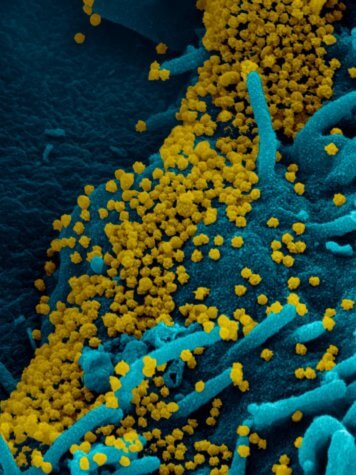
“At the time we started this study, we really didn’t know much about the duration of virus shedding,” says senior author and virologist Vincent Munster says in a media release. “As this virus continues to spread, more people with a range of immunosuppressing disorders will become infected, and it’s important to understand how SARS-CoV-2 behaves in these populations.”
Researchers discovered the patient was positive for SARS-CoV-2, the virus causing COVID, after she was hospitalized for severe anemia. Along with chronic lymphocytic leukemia, the patient also suffers from hypogammaglobulinemia, a condition which impairs the immune system.
“This was something that we expected might happen, but it had never been reported before,” Munster adds.
Are all people with preexisting conditions at higher risk for COVID?
The study concludes that the 71-year-old remained infectious for so long due to her compromised immune system. With antibodies, the patient could not mount a proper response to the virus.
Researchers note she was once treated with convalescent plasma, but Munster says the therapy had no effect because of the 71-year-old’s lack of antibodies. Despite carrying the virus for more than three months, the study finds the patient never developed COVID-19.
“We’ve seen similar cases with influenza and with Middle East respiratory syndrome, which is also caused by a coronavirus,” the Montana researcher explains. “We expect to see more reports like ours coming out in the future.”
The team discovered several gene variants of the virus over several samples taken from the 71-year-old. Although SARS-CoV-2 appeared to change several times throughout her infection, researchers find the mutations didn’t play a major role in why it stuck around in her system so long.
The study appears in the journal Cell.


