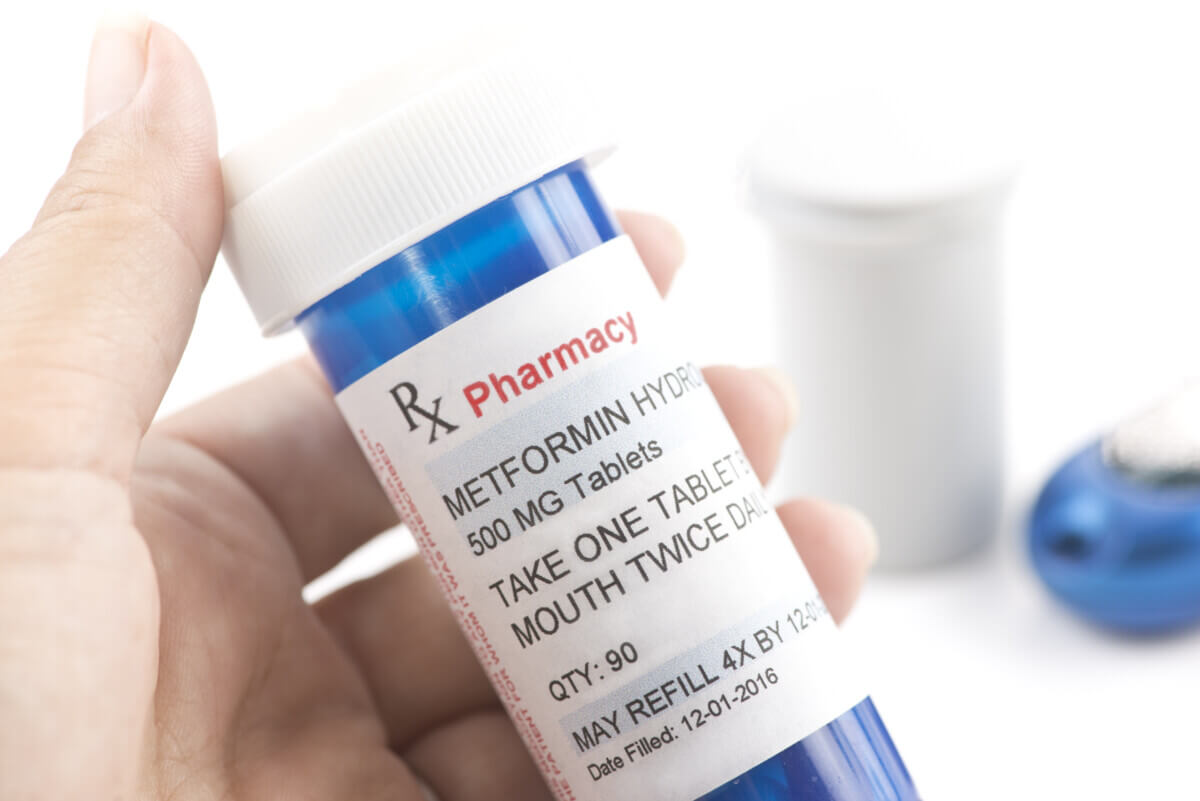
(© Sherry Young - stock.adobe.com)
Metformin’s Real Secret May Be in Your Gut, Not Your Liver
In A Nutshell
- A new study suggests metformin lowers blood sugar mainly by forcing the gut to absorb and burn excess glucose, not by acting on the liver as long believed.
- Researchers confirmed the mechanism using genetically modified mice whose intestinal cells were made resistant to the drug’s key action, causing metformin to largely stop working.
- Berberine, a popular over-the-counter supplement, appears to lower blood sugar through this exact same gut-based switch, which may explain why it works despite being poorly absorbed into the bloodstream.
- Every dose matters: in mouse experiments, the blood-sugar benefit came from each individual dose hitting the intestine, not from any lasting change that built up over time.
For decades, metformin has been the go-to pill for managing type 2 diabetes, prescribed widely around the world. Now, a new study from researchers at Northwestern University Feinberg School of Medicine suggests the answer to why it works may have been hiding in the lining of the small intestine.
Research published in Nature Metabolism finds that metformin’s blood-sugar-lowering effects may depend far more on the gut than scientists once appreciated, rather than acting mainly through the liver alone. Specifically, the drug appears to work by blocking a key piece of cellular machinery in intestinal cells, forcing the gut to act like a sponge that soaks up excess sugar from the bloodstream. That finding reshapes more than 30 years of scientific thinking about one of the most-used medications on the planet.
It also reaches beyond metformin itself. The same gut-based mechanism appears to drive the blood-sugar-lowering effects of two other compounds: phenformin, a related drug pulled from the market due to safety concerns decades ago, and berberine, a plant-derived supplement sold over the counter. All three, despite their different origins, appear to work through the same fundamental switch inside intestinal cells.
How Metformin Actually Lowers Blood Sugar
To understand what the researchers found, it helps to know how cells make energy. Deep inside nearly every cell, structures called mitochondria act like tiny power plants, using a chain of molecular machines to convert food into usable energy. The first of these machines, called complex I, is essentially the on-switch for the whole process.
Metformin jams that switch in intestinal cells. When complex I is blocked, cells can’t run their normal energy-making process. Instead, they’re forced into an alternative route that burns through glucose rapidly and produces lactate as a byproduct. The intestines get pressed into consuming excess sugar, pulling it out of circulation and keeping blood sugar down.
This also explains something that has puzzled cancer doctors for years. A scan called FDG-PET, widely used for tumor detection, tracks which tissues are consuming sugar fastest. Patients taking metformin lit up in their intestines during these scans badly enough that stopping the drug before imaging became standard practice by the early 2010s. This research reveals why: metformin was turning the intestines into a sugar-hungry organ.

Mice With a Built-In Override
At the heart of the study was a genetic approach using male mice. Researchers engineered a mouse model in which intestinal cells were given a special protein, borrowed from baker’s yeast, that bypasses the energy-making switch metformin blocks. In these modified mice, intestinal cells could keep making energy normally even with metformin present.
Normal mice receiving metformin showed blood sugar drops during glucose tolerance tests, a standard measure of how the body handles a sugar load. In mice with the bypass, metformin largely failed to do its job: no extra glucose uptake in the gut, no increase in lactate, and no meaningful blood sugar reduction.
One unexpected finding involved timing. In these mouse experiments, the glucose-lowering benefit appeared to depend on repeated dose-by-dose exposure in the gut, not a lasting change after the drug cleared. When metformin was delivered through drinking water over an extended period, it failed to improve blood sugar control regardless of whether mice had the intestinal bypass. Each dose hitting the intestine acutely appears to be the key event.
Berberine: The Supplement That Works the Same Way
Perhaps the most practical part of the study involves berberine, a yellow plant compound used in traditional medicine for centuries and now widely sold in health food stores. Studies have suggested it works for blood sugar, but the mechanism was murky, partly because berberine is poorly absorbed from the gut into the bloodstream.
That poor absorption, the researchers argue, turns out to be a feature rather than a bug. Berberine stays concentrated in the intestinal lining, exactly where it needs to be to block the energy switch. When researchers paired a low dose of berberine with encequidar, a drug that changes how the gut handles berberine, berberine’s glucose-lowering effect appeared in normal mice. That effect disappeared in mice whose intestinal cells carried the bypass, a cleaner result even than what was seen with metformin, suggesting the gut is essentially the only place berberine acts.
Berberine is classified as a stronger inhibitor of that cellular energy switch than either metformin or phenformin at the molecular level, according to measurements cited in the paper. Even so, the study was conducted primarily in male mice, not in human clinical trials, and was not designed to test whether berberine should replace prescribed diabetes medication.
Metformin has been prescribed for type 2 diabetes for generations, and it works. Knowing how it works opens the door to designing better versions, or entirely new drugs, that target the gut’s energy machinery more precisely. For patients already taking it every day, the most important action has apparently been happening quietly in the gut all along.
Disclaimer: This article is based on a single peer-reviewed study conducted primarily in male mice. Findings have not been confirmed in large-scale human clinical trials. Nothing in this article should be taken as medical advice. Consult a qualified healthcare provider before making any changes to diabetes medication or supplement use.
Paper Notes
Limitations
The study’s mouse experiments used exclusively male animals, which the authors note throughout. This limits conclusions about whether the same mechanism operates identically in females, and future research would need to address potential sex differences. The researchers also acknowledge that the intestinal bypass approach used in the mice does not fully replicate mammalian complex I function, because the bypass protein cannot perform all the same tasks as the original machinery, such as pumping protons across the mitochondrial membrane. This means the mice may not be completely resistant to metformin, which could account for the partial rather than complete reduction in the drug’s effectiveness seen in some experiments. The authors note that their findings do not rule out the possibility that metformin acts on additional targets in other organs beyond the intestine. Chronic low-dose metformin delivered through drinking water did not achieve glycemic control in the mouse models used, which the authors suggest reflects pharmacokinetic differences from clinical pill-based dosing, a limitation that may affect how directly some findings translate to human treatment patterns.
Funding and Disclosures
The study received support from NIH grants R35CA197532, P01HL154998-03, and P01AG049665 (all to N.S. Chandel), along with National Heart, Lung, and Blood Institute grant T32HL076139-11 (to C.R. Reczek), the Northwestern University Pulmonary and Critical Care Division Cugell Predoctoral Fellowship (to R.P. Chakrabarty), Cellular and Molecular Basis of Disease grant T32GM008061 (to K.B. D’Alessandro), NRSA Training Program in Signal Transduction and Cancer grant T32CA070085 (to Z.L. Sebo), the Glenn Foundation for Medical Research Postdoctoral Fellowship in Aging Research (to Z.L. Sebo), National Heart, Lung, and Blood Institute grant T32HL076139-21 (to Z.L. Sebo), Schmidt Science Fellows in partnership with Rhodes Trust (to R.A. Grant), the Simpson Querrey Fellowship in Data Science (to R.A. Grant), Training Program in Lung Sciences grant T32HL07139 (to A.R. Koss), Medical Sciences Training Program grant T32GM008152 (to A.R. Koss), and Stand Up 2 Cancer Convergence 3.1416 (to S.M. Davidson and J.L.E. Blum). Additional support came from Northwestern University core facilities, including the Pulmonary NextGen Sequencing Core and the Robert H. Lurie Comprehensive Cancer Center Metabolomics Core. The authors declare no competing interests.
Publication Details
Paper Title: Metformin inhibits mitochondrial complex I in intestinal epithelium to promote glycaemic control | Authors: Zachary L. Sebo, Ram P. Chakrabarty, Rogan A. Grant, Karis B. D’Alessandro, Alec R. Koss, Jenna L. E. Blum, Shawn M. Davidson, Colleen R. Reczek, and Navdeep S. Chandel, all affiliated with Northwestern University Feinberg School of Medicine, Chicago, IL. Navdeep S. Chandel is also affiliated with the Chan Zuckerberg Biohub, Chicago, IL. | Journal: Nature Metabolism | DOI: https://doi.org/10.1038/s42255-026-01530-y | Received: May 19, 2025 | Accepted: April 10, 2026 | Published online: May 8, 2026


