
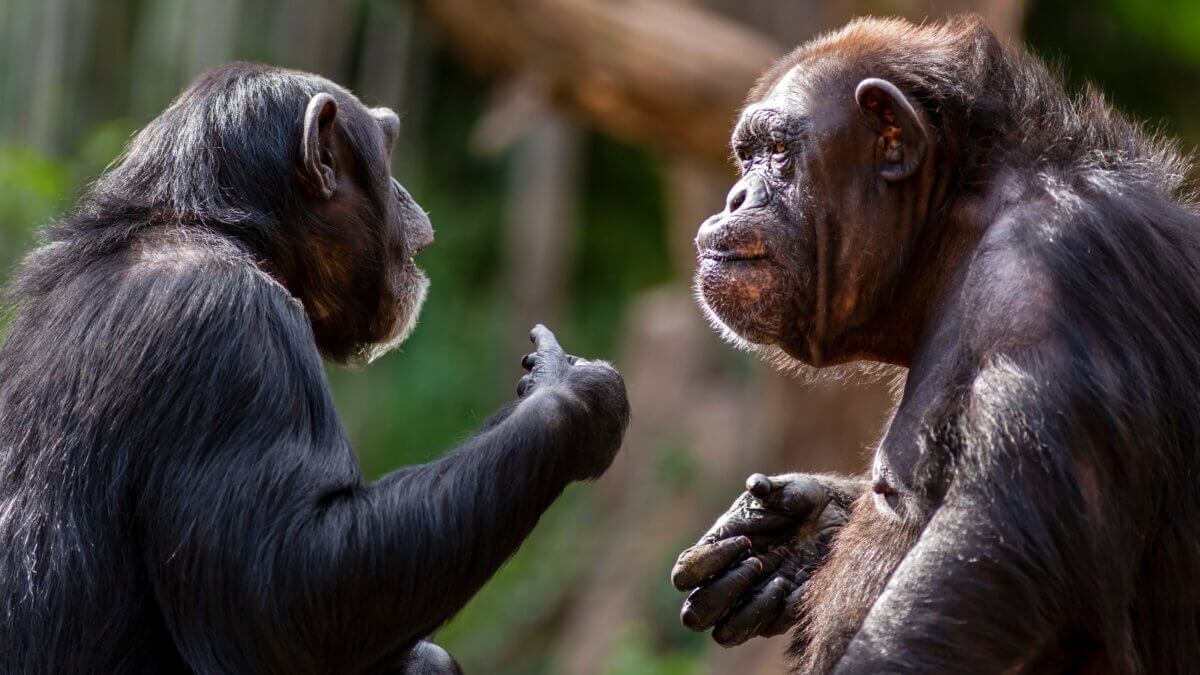
Social grooming between two chimpanzees in the Budongo Forest. (Photograph by Dr Elodie Freymann).
In a nutshell
- Wild chimpanzees in Uganda’s Budongo Forest have been documented treating both their own and others’ injuries using plant-based poultices, saliva, and careful wound care, behaviors strikingly similar to human first aid.
- These healthcare behaviors extend beyond family lines: chimps have been observed helping unrelated individuals, including removing snares and applying medicinal plants, suggesting a capacity for empathy and prosocial care.
- The chimpanzees selectively use plants with known antibacterial and anti-inflammatory properties, indicating a form of cultural knowledge about natural medicine that may parallel early human healthcare practices.
OXFORD, England — For decades, scientists watching chimpanzees in Uganda have dismissed reports of chimps treating each other’s wounds as rare anomalies. New international research reveals these “anomalies” are actually part of a sophisticated healthcare system where apes diagnose, treat, and even perform emergency medicine on their neighbors.
Deep in Uganda’s Budongo Forest, researchers have documented wild chimpanzees licking each other’s wounds, applying chewed plant material like natural bandages, and even helping remove dangerous wire snares from trapped community members. The study, published in Frontiers in Ecology and Evolution, reveals these acts of medical care often cross family lines, with chimps helping genetically unrelated individuals in what appears to be genuine altruism.
Scientists say this is the first comprehensive documentation of prosocial wound care at Budongo. The findings suggest that our closest living relatives possess a sophisticated understanding of healthcare that goes far beyond basic self-preservation.
For over 30 years, researchers have been observing two chimpanzee communities in the Budongo Forest called Sonso and Waibira. These chimps systematically clean wounds, apply what appear to be medicinal plants, and demonstrate a level of medical knowledge that rivals early human societies.
How Chimpanzees Practice Medicine in the Wild
Researchers break down their healthcare behaviors into two categories: self-care and what scientists call “prosocial care,” helping others. Self-care is impressive enough: chimps lick their wounds (which actually helps prevent infection thanks to antimicrobial properties in saliva), press their fingers to injuries after licking them, and dab wounds with leaves. Some even chew plant material and apply it directly to cuts, creating primitive poultices.
But it’s the prosocial behaviors that truly astonished researchers. In one documented case, a juvenile female named NT watched her mother NB treat her own wound by chewing leaves from a suspected medicinal plant called Alchornea floribunda. NT then mimicked the behavior, chewing the same type of leaves and applying them to her mother’s wound while also licking her fingers and pressing them to the injury.
Researchers documented 34 total cases of self-care and seven instances of prosocial healthcare across both communities. The helping behaviors aren’t just limited to family members. Adult males have been observed licking wounds on unrelated females, and females have provided care to unrelated males.
It was previously thought that animals only help relatives because they share genes. Instead, this research suggests chimps may be somewhat capable of empathy and altruism toward unrelated community members.
“All chimpanzees mentioned in our tables showed recovery from wounds, though of course we don’t know what the outcome would have been had they not done anything about their injuries,” says study author Elodie Freymann of the University of Oxford, in a statement.
While it’s impossible to run controlled experiments on wounded wild animals, the fact that treated individuals consistently healed suggests these behaviors serve a real medical purpose.
Chimpanzees Use Natural Medicine Like Ancient Humans
Scientists analyzed which plants the chimps selected for wound care and found they weren’t choosing randomly. Species like Acalypha, Pseudospondias microcarpa, and Alchornea floribunda all have documented antibacterial, anti-inflammatory, and pain-relieving properties. Some are used in traditional human medicine for treating wounds and ulcers. Chimps appear to have developed their own pharmacological knowledge through generations of experience.
One of the most dramatic examples involved snare removal, a life-or-death situation where chimps face wire traps set by human poachers. In one case, an adult male named NK helped an unrelated female named KW remove a nylon snare. In another instance, a mother named NB assisted her juvenile daughter NT who had become trapped. Given that roughly 40% of the Sonso community has suffered confirmed snare injuries, these interventions can mean the difference between permanent disability and recovery.
Research teams reviewed 30 years of field station logbooks, analyzed video archives containing over 13,000 clips, and conducted direct observations during two four-month periods. They documented everything from simple wound licking to complex multi-step treatments involving plant applications.
“We also documented hygiene behaviors, including the cleaning of genitals with leaves after mating and wiping the anus with leaves after defecation — practices that may help prevent infections,” says Freymann.
For post-coital hygiene, male chimps frequently chose Senna spectabilis leaves, which have strong antifungal and antimicrobial properties, essentially nature’s version of antiseptic wipes.
How This Compares To Human Medicine
Behaviors varied between the two communities studied. Sonso community, which has been observed longer and faces more human-related threats, showed more diverse healthcare behaviors than the newer Waibira community. This could suggest that medical knowledge develops and spreads through chimpanzee societies over time, much like human medical traditions.
Not all healthcare behaviors involved plants. About 44% of documented cases used only saliva-based treatments—licking wounds directly or licking fingers before pressing them to injuries. Mammalian saliva contains antimicrobial compounds that can help prevent infection and promote healing.
Prosocial care also wasn’t totally random. While they didn’t measure social bonds directly, the patterns suggest that chimps are more likely to help individuals they have positive relationships with, even if they’re not related.
“These behaviors add to the evidence from other sites that chimpanzees appear to recognize need or suffering in others and take deliberate action to alleviate it, even when there’s no direct genetic advantage,” says Freymann.
Human encroachment continues to threaten chimpanzee habitats. However, chimps are essentially running their own type of medical system, complete with emergency care, wound treatment, and preventive hygiene. By protecting the medicinal plants they rely on and reducing human-caused injuries like snares, we can help preserve not just individual chimps but their sophisticated medical traditions.
Paper Summary
Methodology
Researchers collected data from two chimpanzee communities (Sonso and Waibira) in Uganda’s Budongo Forest over multiple decades. They used four primary data sources: archival logbooks from 1993-2021 containing daily observations, an online survey collecting anecdotes from researchers, a video database with over 13,000 clips from the communities, and direct observations during two four-month periods (2021 in Sonso, 2022 in Waibira). The team documented all instances of wound care, snare removal, and hygiene behaviors, collecting plant samples for identification and analyzing the medicinal properties of species used by the chimps.
Results
Scientists documented 34 cases of self-directed care and 7 instances of prosocial healthcare. Self-care behaviors included wound licking, pressing licked fingers to wounds, dabbing wounds with leaves, and applying chewed plant material. Prosocial care involved the same behaviors directed toward other chimps, including both related and unrelated individuals. About 56% of all healthcare events involved plant use. The chimps selected plants with documented medicinal properties including antibacterial, anti-inflammatory, and pain-relieving compounds. Healthcare behaviors were more frequent and diverse in the longer-studied Sonso community compared to Waibira.
Limitations
The study had several limitations including potential observation bias between communities due to different research histories and habituation levels. Waibira data were less comprehensive because logbooks weren’t digitized. The researchers couldn’t measure social bond strength, which likely influences prosocial care patterns. Sample sizes for some behaviors were small, and the team couldn’t determine whether behaviors are socially learned or transmitted between individuals.
Funding and Disclosures
The research was funded by the Clarendon Fund, Keble College Oxford, the Explorers Club, the European Union’s Horizon 2020 program, and FCT-Fundação para a Ciência e a Tecnologia. The authors declared no conflicts of interest and stated that no generative AI was used in creating the manuscript.
Publication Information
Freymann, E., Hobaiter, C., Huffman, M.A., Klein, H., Muhumuza, G., Reynolds, V., Slania, N.E., Soldati, A., Yikii, E.R., Zuberbühler, K., and Carvalho, S. (2025). The paper “Self-directed and prosocial wound care, snare removal, and hygiene behaviors amongst the Budongo chimpanzees” is authored by Freymann, E., Hobaiter, C., Huffman, M.A., Klein, H., Muhumuza, G., Reynolds, V., Slania, N.E., Soldati, A., Yikii, E.R., Zuberbühler, K., and Carvalho, S. It was published in Frontiers in Ecology and Evolution on May 14, 2025.


