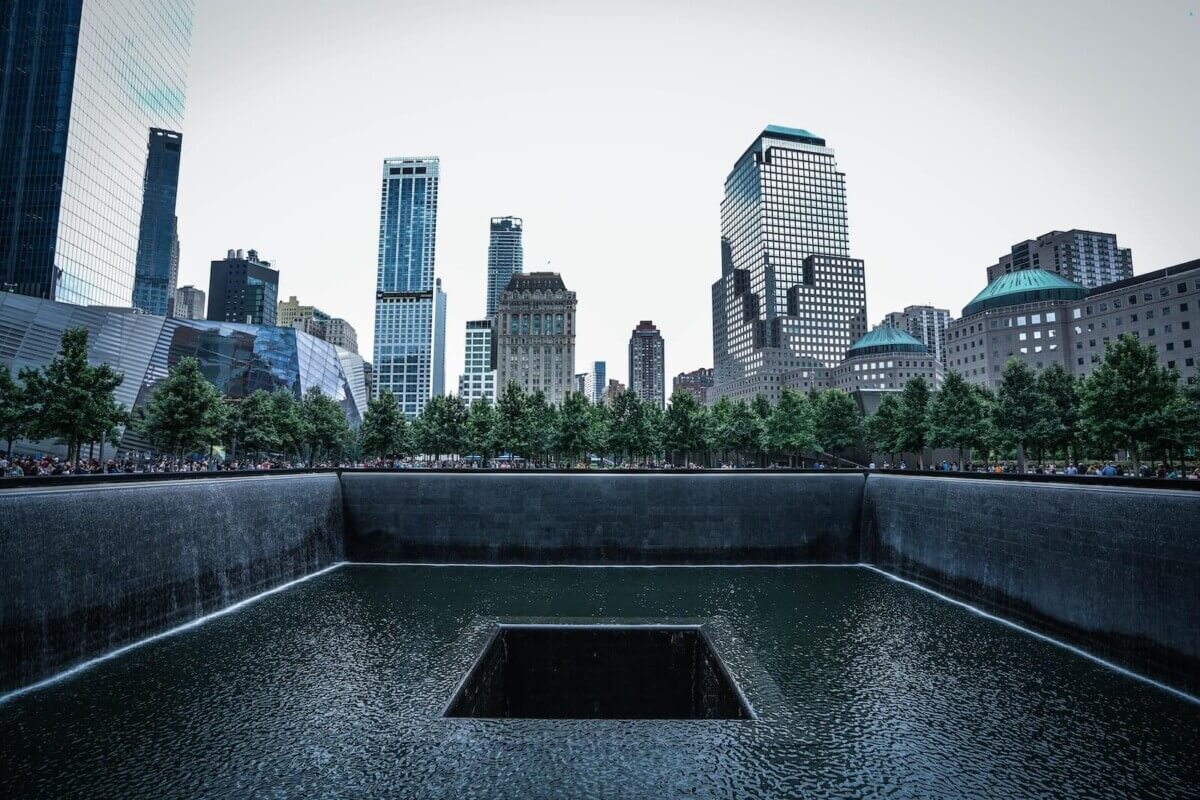
9/11 memorial in New York City (Photo by Axel Houmadi from Unsplash)
Study Finds 9/11 Responders’ Mental Health Struggles Are Linked to Their Children’s Wellbeing
In A Nutshell
- A new study links the trauma experienced by 9/11 World Trade Center responders to measurable mental health struggles in their now-adult children, more than two decades later.
- Adult children of responders with greater disaster exposure were more likely to screen positive for PTSD, anxiety, and panic symptoms; those whose parents currently struggle with PTSD or depression showed similar patterns.
- Strained parent-child relationships were tied to higher rates of depression, PTSD, and alcohol use disorder in the children, while the quality of a parent’s friendships showed no significant effect.
- Researchers raise the possibility that the psychological effects of September 11 could extend to a third generation, as many of these adult children are now starting families of their own.
A new study suggests the psychological toll of September 11 extended well beyond the World Trade Center responders who lived through it. More than two decades later, their now-adult children are showing measurably higher rates of PTSD, anxiety, depression, and alcohol use disorder, with stronger effects tied to how severely a parent was exposed.
Researchers at New York State Psychiatric Institute and Columbia University studied 176 World Trade Center responders who had been diagnosed with PTSD after the attacks, along with 270 of their now-adult children. Published in PLOS Mental Health, results show that the more severe a parent’s exposure to the disaster, the more likely their adult children were to screen positive for PTSD, anxiety, or panic symptoms.
This goes beyond shared grief or growing up in a difficult household. Researchers call the phenomenon intergenerational transmission of trauma, the idea that a parent’s extreme stress can ripple outward, affecting how children develop emotionally and how likely the next generation is to struggle with mental health conditions. Holocaust survivors’ descendants and children of war veterans have been studied for this effect before, but the World Trade Center population offered a rare window: these were parents already raising children when the trauma happened, meaning their kids grew up in homes actively being reshaped by a parent’s traumatic experience.
How 9/11 Responder Families Were Studied
Email invitations went to 2,783 World Trade Center responders with a documented PTSD diagnosis who had been raising children at the time of the attacks. Of those, 176 parents enrolled along with at least one now-adult child, for a total of 270 adult children across 176 families, completing an online survey between April 2021 and October 2022.
Participants included two types of workers: traditional first responders such as law enforcement officers, and civilian recovery workers, including utility employees, sanitation workers, and construction crews. Civilian workers spent weeks or months at Ground Zero with minimal institutional support and lower average incomes than their law enforcement counterparts, and in the years immediately after the attacks, their PTSD rates were reported to be four times higher.
Parents and children completed the same screening tools covering depression, anxiety, PTSD, panic disorder, alcohol and substance use, and overall quality of life. Detailed parental exposure data came from an existing federal health database tracking site time, dust cloud exposure, and contact with human remains.
What the Screening Data Showed About Generational Trauma
Among the adult children, more than 20% met screening criteria for depression and more than a quarter showed signs of an anxiety disorder, based on screening tools rather than formal clinical diagnoses. Alcohol use disorder was notably more common in the adult children than in their parents.
Parental exposure stood out as a key factor. Responders who arrived at the site earlier, spent more hours there in the first three weeks after the attacks, or had contact with human remains were significantly more likely to have adult children who screened positive for PTSD and anxiety. Extended time at the site in those early weeks was also tied to elevated panic symptoms in the children.
A parent currently struggling with PTSD was significantly more likely to have an adult child who also screened positive for PTSD, panic symptoms, and depression, connections that held up after researchers accounted for the child’s age, sex, and racial or ethnic background. Parental depression was directly associated with depression in the children.
Family relationship quality added another layer. When parent-child bonds were marked by more negativity and less warmth, adult children were more likely to screen positive for depression, PTSD, and problematic drinking. Strained spousal relationships were also tied to higher depression and PTSD rates in the children.
How Occupation Shaped Mental Health Outcomes in Responders’ Kids
For children of civilian recovery workers, having a parent who worked at the debris pile was associated with a higher risk of anxiety disorders. In one subgroup analysis, children of law enforcement responders whose parents worked on the pile or pit were less likely to screen positive for PTSD, a pattern the authors attribute in part to occupational culture, though it should be read cautiously as a subgroup association, not a sweeping conclusion.
That divide also appeared in the alcohol data. Among children of law enforcement responders, a worse relationship with their parent was strongly tied to a higher likelihood of alcohol use disorder. Police culture has been linked in other studies to elevated rates of alcohol misuse, and children raised in those households may be more vulnerable when the parent-child bond is already strained.
Could September 11 Reach a Third Generation?
Many of these adult children are now at the age when they may be starting families of their own. That raises a question the researchers themselves pose: could the effects of September 11 extend to a third generation, the grandchildren of the responders who answered the call that morning? If the patterns documented here persist, the mental health ripple from a single catastrophic day in 2001 may not be finished yet.
Disclaimer: This article is based on observational research using self-reported screening tools. Findings reflect associations, not proven causes, and screening results are not equivalent to clinical diagnoses. Anyone struggling with trauma, PTSD, or mental health concerns is encouraged to reach out to a qualified mental health professional.
Paper Notes
Limitations
All mental health data in this study came from self-reported screening instruments rather than structured clinical interviews conducted by mental health professionals. This means the reported rates of depression, anxiety, PTSD, and other conditions are indicators of probable disorders rather than confirmed diagnoses. Participation bias is also possible: families who enrolled may be systematically different from those who declined, potentially showing stronger family bonds or greater openness to mental health topics, while more severely affected families may have been less likely to take part. Researchers applied statistical weighting to partially address this, but those adjustments relied primarily on demographic variables and only partially accounted for mental health history. Sample size, though adequate for detecting moderate associations, limits the ability to draw strong conclusions from subgroup analyses. Authors call for future longitudinal research using clinical interviews and multiple assessment methods.
Funding and Disclosures
This research was supported by the National Institute for Occupational Safety and Health (NIOSH) and the Centers for Disease Control and Prevention (CDC) under Grant No. U01OH012065. All authors received salary support from this grant. Funders had no role in study design, data collection and analysis, the decision to publish, or preparation of the manuscript. Authors declared no competing interests.
Publication Details
Authors: Yael M. Cycowicz, Diana V. Rodriguez-Moreno, Daniel Craft, and Keely Cheslack-Postava, all affiliated with the New York State Psychiatric Institute; Cycowicz, Rodriguez-Moreno, and Cheslack-Postava are also affiliated with the Department of Psychiatry at Columbia University, New York. | Paper Title: “The long shadow of 9/11: Mental health outcomes in adult children of World Trade Center Responders with PTSD” | Journal: PLOS Mental Health, Volume 3, Issue 5, Article e0000574 | Published: May 27, 2026 | DOI: https://doi.org/10.1371/journal.pmen.0000574


