
Galápagos Islands, Ecuador (Photo by Heidi Bruce on Unsplash)
In A Nutshell
- A single octopus collected nearly a mile deep near the Galápagos Islands has been identified as a new species, Microeledone galapagensis, overturning a recent definition that placed its entire family exclusively in the cold Southern Ocean.
- Small enough to fit in the palm of a hand and vivid blue on top with a deep purple-to-maroon underside, the animal displays an unusual reversed color pattern that extends inside its body, a feature researchers think may help hide the glow of bioluminescent prey.
- Because the DNA samples were lost and no second specimen has been collected, the entire species description rests on a single female with no male for comparison and no genetic data.
- Scientists revised the formal definition of the octopus family based on this one animal, and say the deep tropical Pacific likely holds many more undiscovered species.
A single small octopus, pulled from nearly a mile below the ocean surface near the Galápagos Islands, is pushing scientists to reconsider what they thought they knew about an entire group of deep-sea creatures. Scientists had recently described the family as large-bodied animals confined to the cold, deep Southern Ocean, though a blue, grape-sized animal collected almost directly on the equator didn’t fit that picture at all.
Now officially named Microeledone galapagensis in the journal Zootaxa, the specimen was collected in 2015 near Darwin Island, the northernmost island in the Galápagos archipelago. Small, squat, and short-armed, with smooth blue skin on top and a deep maroon-to-purple underside, it displays what researchers describe as strong reverse countershading: vivid blue above, dark below. That unusual color pattern turned out to be one of the least surprising things about it.
A Galápagos Deep-Sea Discovery Built on One Specimen
On July 1, 2015, a remotely operated vehicle called Hercules descended roughly 1,773 meters, about 1.1 miles, below the surface near an underwater mountain about 25 kilometers northwest of Darwin Island. Part of a ten-day expedition aboard the research vessel E/V Nautilus within the Galápagos Marine Reserve, the dive used a suction sampler to collect the octopus from a sandy, sediment-covered area dotted with basalt rock outcrops.
Once brought to the surface, the specimen was transferred to chilled seawater and photographed while still fresh. Tissue samples taken for genetic analysis were later lost, removing any chance of molecular confirmation. No second specimen was collected. During the same dive, cameras spotted two additional octopuses that appeared to be the same species, and a fourth was observed on a nearby underwater mountain about 60 kilometers away, but none were collected.
That single female, with no male and no usable DNA, is the entire basis for the formal species description. Her body, not counting the arms, measured 31.5 millimeters long, roughly grape-sized. Her short arms carried no more than 33 suckers each, a striking contrast to common shallow-water octopuses, which can have well over 200 suckers per arm.
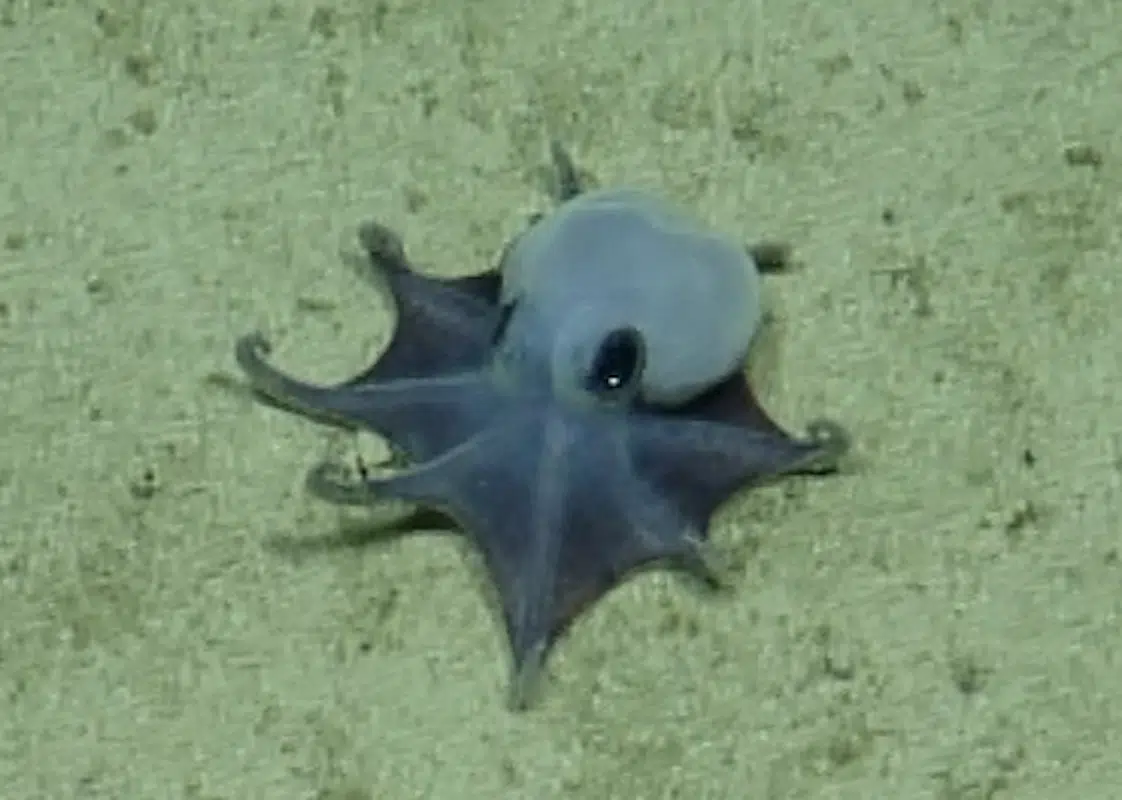
Courtesy of the Charles Darwin Foundation)
Scanning the Only Known Specimen Without Cutting It Open
Because securing a second specimen of such a rare deep-sea animal is, as the authors put it, “near impossible,” researchers turned to a high-powered imaging technique more often associated with medical diagnostics. Using a micro-CT scanner at the Field Museum in Chicago, essentially an extremely detailed X-ray system that builds three-dimensional pictures of an object’s interior, the team mapped the octopus’s internal organs, reproductive system, and mouthparts without destroying the only known specimen.
Scans revealed a reproductive system consistent with a mature female, with a highly stretched egg-containing organ holding thirteen eggs measuring up to 11 millimeters long. Despite that reproductive readiness, there were no clear signs she was nearing the end of her life. Tiny shell-like fragments from single-celled marine organisms turned up inside her stomach, likely swallowed alongside prey. She also lacked an ink sac, the organ octopuses use to release ink, a trait shared with several other deep-sea species.
Upside-Down Colors May Hide Glowing Prey
While the outside of the animal is already unusual, bright blue on top and deep purple to maroon below, that reversed color pattern doesn’t stop at the skin. Dense pigment also covers the muscular inner lining of the upper body cavity, while the internal organs themselves are largely colorless. In the only other known species in the same genus, Microeledone mangoldi, found near New Caledonia, the arrangement is flipped: pigment appears on the sheaths around the organs rather than on the body cavity wall.
Researchers speculate both patterns may be convergent adaptations to concealing ingested bioluminescent prey, creatures that produce their own light in the pitch-black depths. If so, the two species appear to have arrived at slightly different solutions to the same problem, suggesting they took separate paths into the deep sea rather than sharing a single deep-water ancestor.
One Octopus Exposes a Flaw in How Its Family Was Defined
A 2024 scientific publication had defined this family as “large-bodied” animals “endemic to the cold and deep waters of the Southern Ocean.” Microeledone galapagensis is small, tropical, and equatorial, sitting about as far from Antarctica as an ocean creature can reasonably get, and it exposed a problem both in that recent definition and in a longer Antarctic-centered way of thinking about the family.
In response, the research team revised the official family definition to focus on physical traits rather than geography or body size, emphasizing features like a single row of arm suckers, short arms, and broad heads and body cavities. One small blue octopus, hauled up from nearly a mile underwater near the equator, managed to change how an entire animal family is formally defined, and pointed toward just how much of the deep tropical Pacific remains unknown.
Paper Notes
Limitations
This study is based on a single female specimen, which significantly limits the conclusions that can be drawn. No male has been collected, meaning key characteristics used in octopus taxonomy, specifically the structure of the reproductive arm, cannot yet be described for this species. Tissue preserved for genetic analysis was lost, removing the possibility of molecular confirmation of the species’ placement in the family tree. Additional specimens, especially males and usable DNA, could refine or change how this species fits within the family. Several physical features used to classify the specimen, such as gland size and sucker count, show considerable natural variation even within known species. During the same dive, two additional octopuses appeared consistent with the species but were not collected, and a fourth individual observed nearby was described as morphologically consistent but also not collected. The full geographic range of the family remains poorly understood due to extremely limited deep-sea sampling.
Funding and Disclosures
According to the paper, the research cruise aboard the E/V Nautilus was a collaboration between the Ocean Exploration Trust, the Charles Darwin Foundation, and the Galápagos National Park Directorate. Funding for the E/V Nautilus Exploration Program was provided by the NOAA Office of Exploration and Research (grant NA15OAR0110220). Research was conducted under permits PC-26-15 and PC-45-15 from the Galápagos National Park Directorate, with sample export carried out under permit 102-2022-DPNG. No conflicts of interest are disclosed in the paper.
Publication Details
Authors: Janet R. Voight and Stephanie M. Smith (Field Museum of Natural History, Chicago, Illinois, USA); Salome Buglass (Charles Darwin Foundation, Galápagos Islands, Ecuador; University of British Columbia, Vancouver, Canada); Alexander Ziegler (Rheinische Friedrich-Wilhelms-Universität Bonn, Germany) | Paper Title: ‘A new species of Microeledone from Galápagos Islands and an amended diagnosis of the Megaleledonidae (Octopoda: Incirrata)’ | Journal: Zootaxa, Volume 5814, Issue 4, pages 533–549 | DOI: https://doi.org/10.11646/zootaxa.5814.4.5 | Published: May 25, 2026 | Accepted: April 8, 2026


