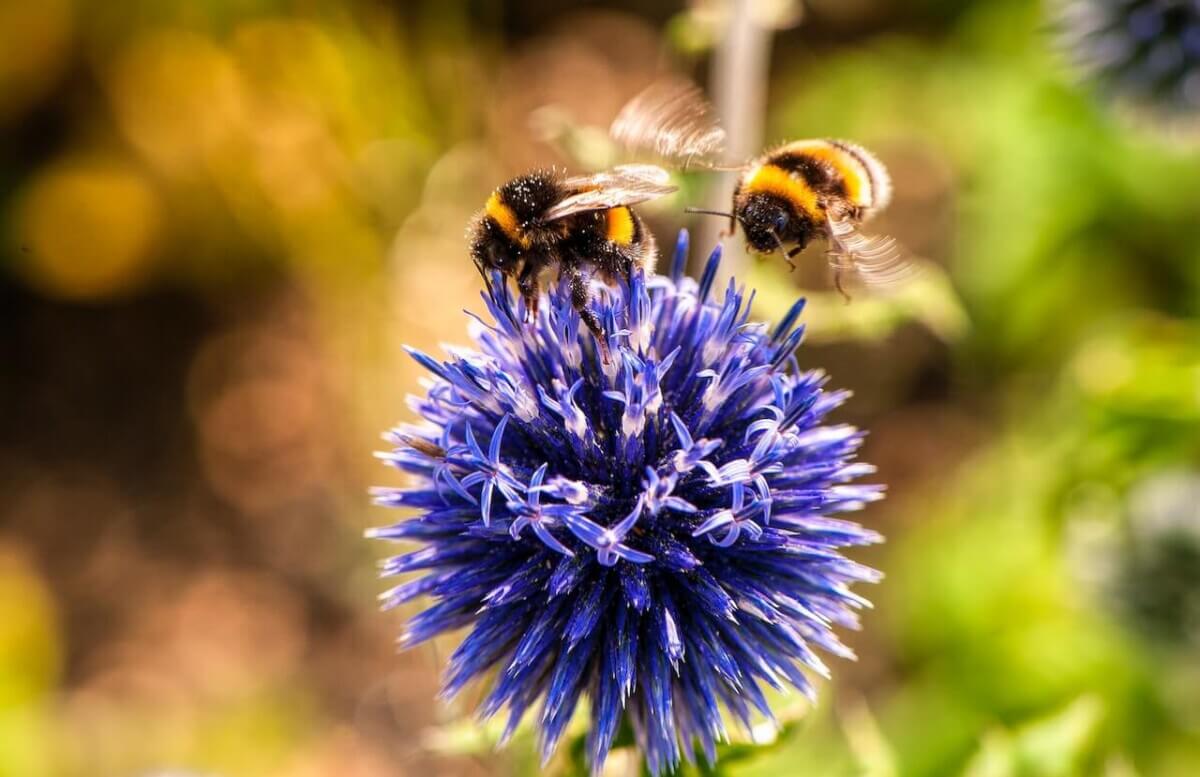
(Photo by Michael Hodgins from Pexels)
Bumble Bees Share a Rare Learning Skill With Chimpanzees
In A Nutshell
- A bumble bee brain with fewer than a million neurons can solve new problems.
- Some untrained bees learned a multistep puzzle by watching a skilled nestmate.
- An optimism-like mood spread between bees by sight alone.
- Extra memory and navigation circuits may explain it, but remain unproven.
Scientists have long tied intelligence to big brains, and a bumble bee’s brain is tiny. Fewer than a million neurons are enough for the insect to solve problems it has never faced, learn a skill by watching a nestmate, and pick up that nestmate’s apparent optimism. That is what a new perspective article in the journal Science lays out, written by Lars Chittka of Queen Mary University of London and Stanley Heinze of Lund University in Sweden.
Humans and chimpanzees are the usual examples of sophisticated thinking. Bumble bees were never expected to join them. Chittka and Heinze review recent experiments that put that expectation to the test. As a perspective piece, the article summarizes earlier studies instead of reporting a new experiment, so there is no single group of bees to count.
That raises the authors’ central question: what is the smallest amount of brain that can produce real intelligence? Bees make a useful test case, because they pull off feats once linked to much larger brains.
Bumble Bee Intelligence Shows Up in Ball-Rolling Problem-Solving
One experiment placed bees in a container with a ceiling too low for controlled flight. Artificial flowers filled with nectar sat on the ceiling’s underside, out of reach. The only route to a drink was to move a ball into position and climb on top of it. Bees could even direct the ball toward a goal location that had stopped being visible.
A classic chimpanzee experiment follows the same logic, with a banana hung out of reach and boxes the animals moved to climb up to it. Chittka and Heinze read the results as goal-directed problem-solving, evidence that insects can flexibly use what they have learned on a brand-new problem.

Some Bumble Bees Learn Multistep Skills by Watching Nestmates
Other experiments used puzzle boxes with latches that had to be moved in the correct order to reach nectar, a bit like a combination lock. No bee solved the puzzle without the chance to watch another bee first. But some untrained bees that observed a skilled demonstrator eventually opened the box themselves.
Picking up a skill too difficult to discover alone, purely by watching, has been documented only in humans and chimpanzees besides bumble bees, according to the authors. Copying a peer’s know-how does not appear to require a big primate brain.
Optimism-Like Moods Spread Between Bumble Bees by Sight Alone
A third experiment tested something closer to mood. After an unexpected reward, bees appeared to settle into an upbeat state. They then treated a vague signal, one that might or might not promise food, as more likely to be good news, much like a person who sees a glass as half full.
Other bees that simply watched an upbeat nestmate through a clear partition began making the same hopeful call. No food passed between the bees, and no chemical cues were involved, so sight alone carried the effect, much as a coworker’s good mood can rub off.
Chittka and Heinze stay cautious about what that means. Spreading moods is “only a basic component of empathy,” they write, and alternative explanations for these results are still debated. Even so, finding it in an insect hints that some ways of passing along internal states may be “evolutionarily widespread.”
Bumble Bee Intelligence May Trace to Memory and Navigation Circuits
Two regions of the bee brain stand out. One is a memory center called the mushroom body, which links a smell, sight, or sound to something good or bad. A bumble bee has roughly 50 times more of this region’s key cell type than a fruit fly does, leaving room for many separate memories to coexist without interfering. The authors compare its layout to the hippocampus, a memory region in mammals.
A second region handles steering. It compares the direction a bee is heading with where it wants to go and corrects course when the two do not match. Fruit flies have a similar setup, but bumble bees carry extra circuits that could let them keep track of many routes at once, which may help when picking the best path among several flowers. Bees may not have needed entirely new brain machinery, either. Evolution may have simply expanded ancient insect circuits, and higher thinking may have evolved many times.
Those circuit ideas remain unproven, and testing them depends on a connectome, a complete map of how a brain’s cells connect. One already exists for the fruit fly, whose brain holds about 140,000 neurons. Only a few regions of the bumble bee brain have been mapped, though current technology could put a whole-brain map within a decade’s reach. Comparing species could show which wiring differences explain more flexible behavior.
Bees have not been tested on every hallmark of intelligence, and an animal that lacks an ability may lack the brain hardware or may simply never have needed the skill. Still, a brain this small is solving problems, learning from peers, and passing along emotion-like states, which makes brain size look like a weak predictor of sophisticated thinking.
Disclaimer: This article summarizes published scientific research for general informational purposes only. It is not medical, legal, or professional advice, and it should not replace consultation with a qualified expert. Readers should consult the original paper for full details.
Paper Notes
Limitations
This article covers a perspective piece that summarizes and interprets several earlier studies of bumble bee and fruit fly brains and behavior, so it reports no new experiment, sample size, or participant data. The authors say bumble bee research does not address every domain of intelligence, and that alternative explanations for some results remain debated. Links between extra bee brain circuits and advanced thinking are presented as possibilities, not demonstrated mechanisms. Judging whether a species truly lacks an ability is difficult, because ecological differences may favor a skill in one species while the underlying mental capacity stays the same. The authors also call it plausible that bumble bees have larger brains only to support sharper senses and greater motor dexterity, without greater cognitive capacity. A complete bumble bee brain map within a decade is a technology projection, not a guaranteed milestone.
Funding and Disclosures
Funding sources and author disclosures are not listed in the paper.
Publication Details
Title: Bumble bee cognition. Authors: Lars Chittka, School of Biological and Behavioural Sciences, Queen Mary University of London, London, UK; Stanley Heinze, Lund Vision Group, Department of Biology, Lund University, Lund, Sweden. Journal: Science, Volume 394, Issue 6826, published November 19, 2026, pages 835 to 837. Article type: Perspective (Neuroscience). DOI: 10.1126/science.aek1724.


