(Credit: © Aryazu - stock.adobe.com)
In a Nutshell
- Memory accuracy for pairing faces with objects and scenes dropped sharply after young adulthood, with middle-aged and older adults scoring similarly to each other rather than declining in a steady line.
- Brain activity patterns that helped younger adults remember accurately were linked, in older adults, to more mix-up errors that crossed between entirely different categories of items, such as mistaking a scene for an object.
- Neither brain shrinkage nor attention differences fully explained why older adults’ brains showed this shift toward blended, less precise memories.
An older relative insists they left their keys with a particular grandchild, in a particular room, on a particular day, and gets every detail wrong except that keys were involved. That kind of confident mix-up may not be simple forgetfulness. New brain-imaging research suggests something odder is happening inside aging brains: the very system meant to lock memories into place may be blending them together instead.
A study published in Cerebral Cortex scanned the brains of adults aged 18 to 74 as they learned pairs of faces with objects and faces with scenes, rested, and then tried to recall the correct pairings. Researchers tracked activity patterns in the hippocampus, the brain’s memory hub, at three points: while learning, during a quiet rest afterward, and during the memory test itself. The results turn a common assumption about memory loss on its head. Older brains may not simply hold onto memories more weakly. In some cases, they hold onto too much of the wrong thing, replaying scattered pieces of unrelated experiences and stitching them into false connections.
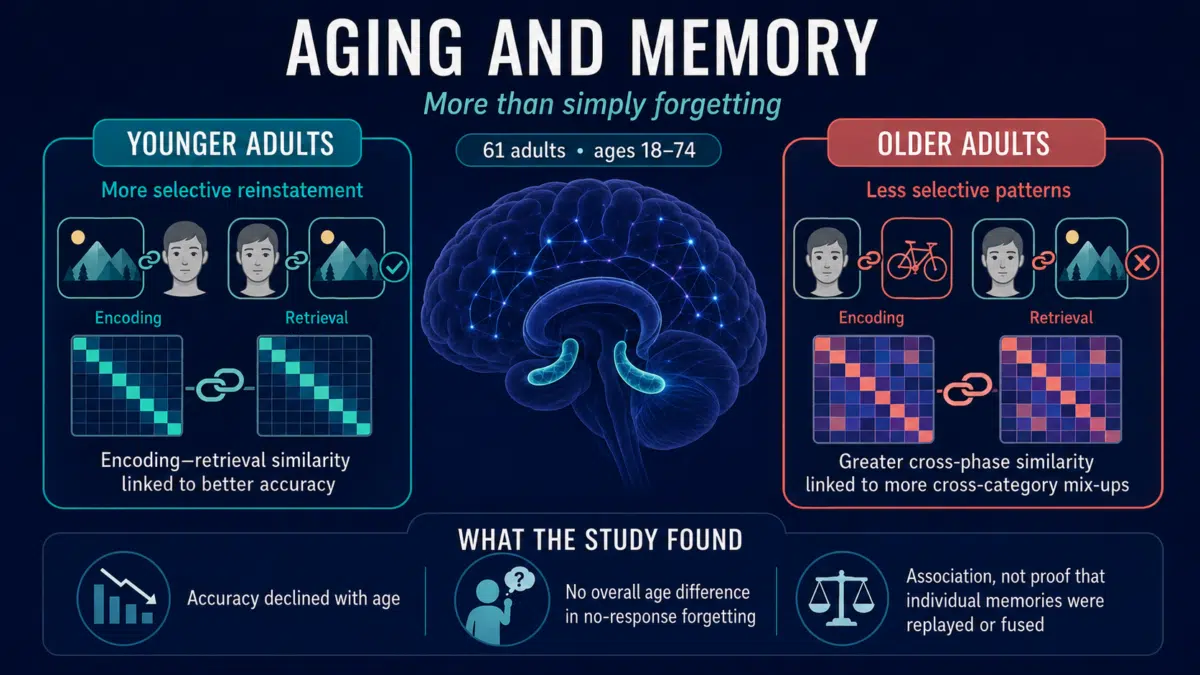
Younger adults in the study showed a clean pattern: the more closely their brain activity during recall matched their brain activity during learning, the better they performed on the memory test. That’s the brain doing what it’s supposed to do, replaying one specific memory faithfully. But among older adults, that same overlap in brain activity stopped predicting accuracy and instead predicted a very specific kind of mistake: confusing items across entirely different categories, like linking a face to a scene when it had actually been paired with an object. Their brains were retrieving too broadly rather than not at all.
How Scientists Tested Aging Brains and Memory
Researchers recruited adults between 18 and 74 years old and eventually analyzed data from 61 participants after excluding some for excessive head movement during scanning or other issues. The final group included 17 younger adults (ages 18 to 30), 21 middle-aged adults (ages 50 to 60), and 23 older adults (ages 61 to 74).
Each participant lay in an MRI scanner and completed a multi-step memory task. First, they completed a resting scan, lying still with their eyes closed. Then came the learning phase, where participants saw a face paired with either an object or a scene and were asked to imagine that person interacting with the item, a trick meant to help the pairing stick. After rating how likely they were to remember each pair, participants rested again inside the scanner. Finally, they took a memory test in which a face appeared alongside four possible answers, two objects and two scenes, and had to pick the one that had actually been paired with that face during learning. Some wrong answers were close misses, like choosing the wrong object when the answer was an object, while others were far off, like choosing a scene when the answer was an object.
To study what was happening in the brain, researchers created an activity fingerprint for the hippocampus during each of the three phases, then measured how closely those fingerprints matched one another. A close match between the learning fingerprint and the recall fingerprint may mean the brain is reactivating the original memory, though similar activity can also reflect similar thinking rather than the exact same memory playing back. A weak or scrambled match suggests the memory trace has shifted or broken down somehow.
What Brain Scans Revealed About Aging and Memory
Age predicted memory performance strongly. Younger participants correctly identified the right pairing far more often than middle-aged or older participants, while middle-aged and older adults performed similarly. Age didn’t reliably predict how often people forgot entirely or what kind of error they made when the data was viewed as one overall pattern. The real differences only showed up once researchers looked at how brain similarity connected to those errors.
That connection sits at the center of the paper. Similarity between learning-phase and recall-phase brain patterns was strongest overall compared with the other phase pairings, and higher learning-to-recall similarity predicted better memory across participants. But once researchers accounted for age, a split appeared. Younger adults with strong learning-to-recall similarity remembered more and forgot less. Middle-aged adults showed a weaker version of that same benefit. Older adults showed almost no benefit. Instead, stronger similarity in their brain patterns was linked to more cross-category confusion errors, the kind where a person mixes up an object with a scene entirely rather than confusing two similar items within the same category. That link showed up across the different brain-pattern comparisons, not just the learning-to-recall one.
Researchers then tried to figure out why. Could it be brain shrinkage? Hippocampal volume did decline with age and was loosely tied to one phase of brain-pattern similarity, but accounting for volume didn’t erase the odd pattern in older adults. Could it be baseline differences in how organized the hippocampus was before learning even started? That baseline organization explained some of the age-related decline in overall accuracy, but not the category-confusion errors. Could it be attention problems, since older adults are known to have more trouble filtering out irrelevant information? The attention measures collected in the study weren’t linked to age or to the brain patterns at all. None of the usual explanations accounted for the mix-up effect.
Combined, the brain and attention measures explained a fair amount of the age-related differences in overall accuracy and in the category-error pattern, according to the study’s estimates. But a clear biological reason why older brains start blending memories together remains an open question.
Why Blended Memories Matter as Brains Age
This distinction is more than academic. The study’s authors describe it as a shift from cleanly replaying one specific memory to what they call category-level misbinding, where the brain grabs the general gist of an experience but loses the details that separate it from similar experiences. The task itself used simple learned pairings in a lab, not real-life recollections, but anyone who has watched a parent or grandparent confidently describe an event that didn’t quite happen the way they remember it will recognize the shape of the problem. The errors aren’t random noise. They may be a predictable result of a brain that is still actively replaying memories, just replaying them too broadly and without the precision it once had.
Aging brains do not simply run out of storage space. Instead, the replay process itself changes character over time, working less like a scalpel and more like a wide brush. Recognizing that difference could eventually help researchers design tools aimed not at boosting memory in general, but specifically at sharpening the brain’s ability to keep similar memories separate, the ability this study points to as most affected.
Paper Notes
Limitations
The authors note several caveats. The research focused specifically on the hippocampus and did not fully explore how similar brain-pattern changes might unfold in other brain regions. Pattern similarity measures used in the study don’t uniquely prove memory reactivation is occurring, since similar brain activity could also reflect similar general thinking processes rather than the same specific memory. The study also excluded brain scan data from moments with heavy head movement, a common but imperfect practice, and newer methods might handle this differently. Because the sample had a gap in ages between roughly 30 and 50, the authors caution against interpreting the age-related trends as a smooth, straight-line decline across the entire lifespan. Finally, the authors note substantial overlap in memory performance across age groups, meaning individual differences likely also play a role beyond age alone.
Funding and Disclosures
Funding was provided by the University of Alabama through startup funds and a College Academy of Research, Scholarship, and Creative Activity award to author Ian M. McDonough, along with support from the University of Alabama at Birmingham and the National Institutes of Health (Grant/Award Number: P30AG031054). The authors reported no conflicts of interest.
Publication Details
Paper Title: “Aging shifts hippocampal reactivation from selective reinstatement to category-level misbinding during episodic memory”
Authors: Destaw B. Mekbib and Ian M. McDonough, Department of Psychology and Center for Cognitive Applications, Binghamton University
Journal: Cerebral Cortex, 2026, Volume 36, Issue 7, bhag114.


