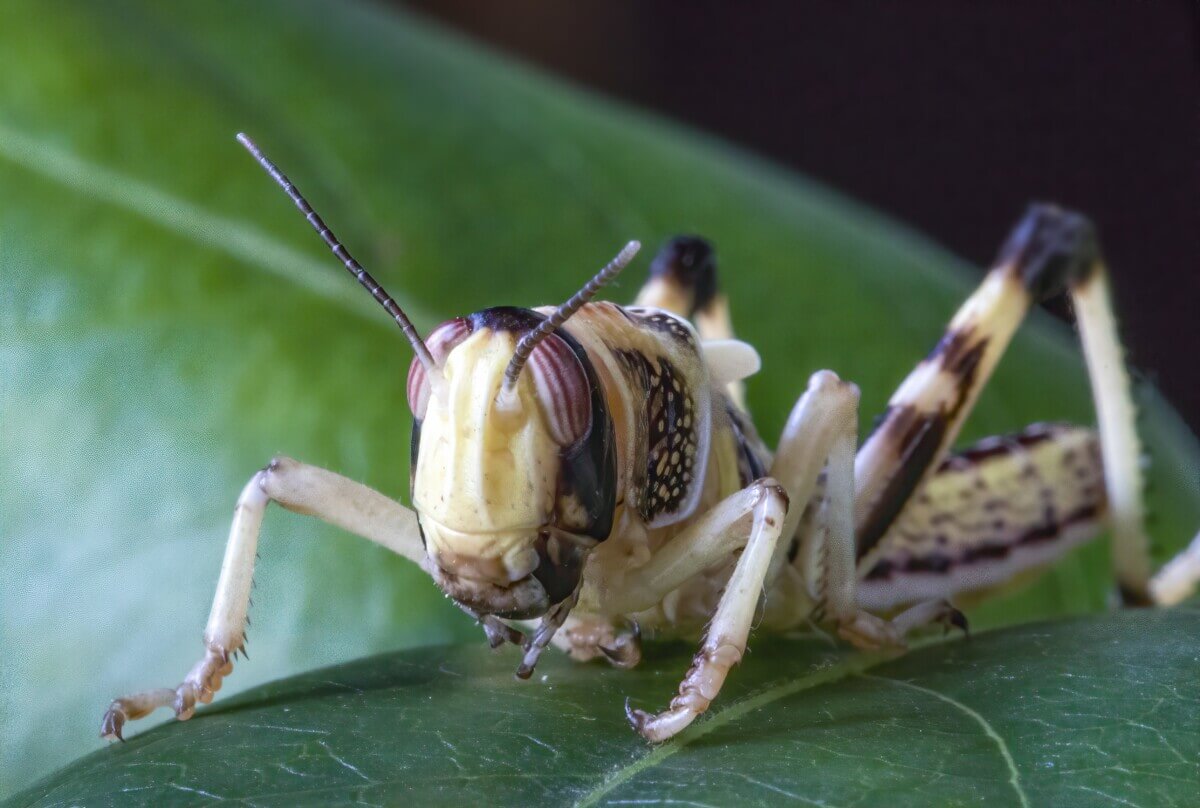
Photo by Illuvis on Pixabay
A Locust’s Sense of Smell May Help Spot Stubborn Infections
In A Nutshell
- A locust’s brain cells told biofilm bacteria apart from free-floating bacteria by smell, with up to 96% accuracy.
- Biofilms resist antibiotics and account for about 80% of bacterial infections in humans, yet standard tests can take days.
- Useful brain signals arrived in under a second, but only lab-grown bacterial cultures were tested.
- Human breath studies are planned before any hospital use could be considered.
Bacteria sheltered inside slimy biofilms can resist antibiotics far better than free-floating ones, yet a living locust brain can tell the two apart by smell, with up to 96% accuracy, in less time than it takes to tie a shoe. Michigan State University researchers connected an electrode to the smell-processing region of a locust’s brain and let the insect’s own neurons do the sniffing.
Biofilms are colonies that bacteria build on surfaces, and dental plaque is a familiar example. They make infections far harder to clear. Bacteria in a biofilm can be 1,000 times more resistant to antibiotics than free-floating ones, and biofilms account for about 80% of bacterial infections in humans, including wound, implant, and lung infections. Some nearly dormant bacteria buried inside can survive treatment and rebuild the colony afterward. Biofilms are also hard to spot, since faster tests cannot tell them apart from free-floating bacteria and standard ones take days.
Dogs have been trained to sniff out disease, and the paper describes insect noses as extremely sensitive, on par with dogs. Bacteria give off gases that add up to a recognizable smell. The study, published in the journal Communications Biology, tested whether a locust’s brain could register the odor difference between the two bacterial lifestyles.
Locust Brain Cells Distinguished Biofilm Odors From Free-Floating Bacteria
Researchers grew two bacteria known for forming biofilms, Pseudomonas aeruginosa and Staphylococcus aureus, in sealed flasks. Pseudomonas often causes lasting infections in people with cystic fibrosis, partly because of biofilms, the paper notes. Each species was grown both as a biofilm and as free-floating (planktonic) cells in separate flasks. A flask of plain nutrient broth served as a control, showing how the brain reacts to the liquid alone, making five odor samples in all.
Air from each flask was puffed at the antennae of six locusts of either sex, raised in a crowded colony. Locust antennae work much like noses, with tiny hairs that let odor molecules in. Surgery had exposed the antennal lobe, a smell-processing region of the brain, while leaving the nerves from the antennae intact. Each odor lasted four seconds and was repeated five times, with a one-minute break between puffs. A random order of puffs kept any one odor from getting an unfair advantage, since a locust’s response to the first odor is sometimes the strongest.
An electrode recorded 32 neurons, pooled across the six locusts. Their combined firing pattern formed a “fingerprint” for each odor, and a computer matched each test pattern to the closest known fingerprint. Electronic noses are built to spot a few chemicals chosen in advance, but the locust itself needed no training on which compounds matter.

Biofilm Detection Reached 88% Accuracy Across All Five Samples
Biofilm odors triggered different brain activity than free-floating bacteria of the same species, for both species. In the Pseudomonas experiment, every repeat was labeled correctly. With Staphylococcus, one of five free-floating repeats was mislabeled as biofilm, and the broth control was sometimes confused with Staphylococcus samples.
Scoring all five samples at once, the system reached 88% accuracy, with biofilm samples from both species identified correctly every time. The abstract reports a best-case figure of up to 96% for biofilm versus free-floating odors. Telling the two species apart proved easier than telling biofilm from free-floating bacteria, though the locust neurons still managed the harder job. More neurons in the analysis improved accuracy.
Biofilm Detection Reached Over 80% Accuracy With Under a Second of Data
Brain responses were most revealing right after the odor arrived, while the steadier firing that followed carried less useful information. A quarter-second slice taken around the one-second mark reached 82% accuracy in the five-sample test, and a half-second slice reached 91%.
Traditional bacterial testing can take days, so seconds would be a big improvement, but the samples were already-prepared cultures. According to the paper, a single locust sensor can analyze a sample every 60 seconds, while recordings stayed reliable for about four hours after surgery.
Locust Brain Sensors Remain Untested on Patient Samples
A sensor that can pick up biofilm-specific smells in seconds could eventually help doctors detect infections faster, potentially without invasive sampling such as blood draws. The team plans human breath studies, which will bring in more variation between samples and conditions such as cystic fibrosis, which this work did not examine.
Practical problems also remain. The 32 neurons amounted to roughly 4% of the neurons that carry smell signals out of the antennal lobe, and the team is developing custom electrodes to get enough data from a single locust. A hospital device built around a living insect brain would need to keep that tissue working outside a lab. The authors argue that a rapid, noninvasive detection device could help doctors avoid overprescribing or wrongly prescribing antibiotics, a goal that depends on solving those problems.
Until human breath studies are done, the locust sensor is a solid lab result, not a diagnostic tool. Still, a locust brain has shown that the odor gap between biofilm and free-floating bacteria is real and readable.
Disclaimer: This article is for general information only and is not medical advice. The research involved lab-grown bacteria and locusts, not patients. Anyone with questions about an infection or its treatment should talk with a qualified health professional.
Paper Notes
Limitations
Recordings came from 32 neurons across six locusts, with five trials per odor, and only two bacterial species grown in laboratory flasks were tested. No patient samples were used, so accuracy in clinical settings is unknown. The main accuracy test, called leave-one-trial-out, does not keep the data used to train the computer fully separate from the data used to test it, although the authors report that a separate analysis with non-overlapping trials gave similar results. Biofilm and free-floating samples could not be matched for bacterial numbers because the two grow at different rates, which could affect odor and brain responses. The authors also did not examine other health conditions such as cystic fibrosis, and the locust sensor’s usable recording time varies, with recordings staying reliable for about four hours after surgery. The version reviewed is an early “Article in Press” release that will be replaced by a final edited version.
Funding and Disclosures
Funding came from a National Science Foundation CAREER grant (2238686) to D. Saha, along with NSF Graduate Research Fellowships to A.M.S. and S.M.S. The authors declare no competing interests.
Publication Details
Title: “Noninvasive detection of bacterial biofilms using an insect olfactory brain-based gas sensor” | Authors: Michael Parnas, Autumn K. McLane-Svoboda, Mariam Shahab, Camron Stout, Summer B. McLane-Svoboda, Elyssa Cox, Mitchell Vaske, Jonathan Hardy, and Debajit Saha. Affiliations: Department of Biomedical Engineering; The Institute for Quantitative Health Science and Engineering (IQ); and Department of Microbiology, Genetics, Immunology, all at Michigan State University, East Lansing, MI, USA. Correspondence: Jonathan Hardy and Debajit Saha. | Journal: Communications Biology (Nature Portfolio), 2026 | DOI: https://doi.org/10.1038/s42003-026-10943-0 | Dates: Received 19 September 2025; accepted 2 September 2026; published 22 September 2026. Open access under a Creative Commons Attribution-NonCommercial-NoDerivatives 4.0 International License. Data and code: https://doi.org/10.6084/m9.figshare.32999924


