
Credit: New Africa on Shutterstock
In A Nutshell
- Common lab gloves can leave behind residues that look like microplastics under standard tests.
- A single touch can create thousands of false positives, potentially skewing pollution data.
- Most research guidelines still recommend gloves, despite growing evidence of contamination risk.
- New analysis methods can help scientists separate real microplastics from glove residues.
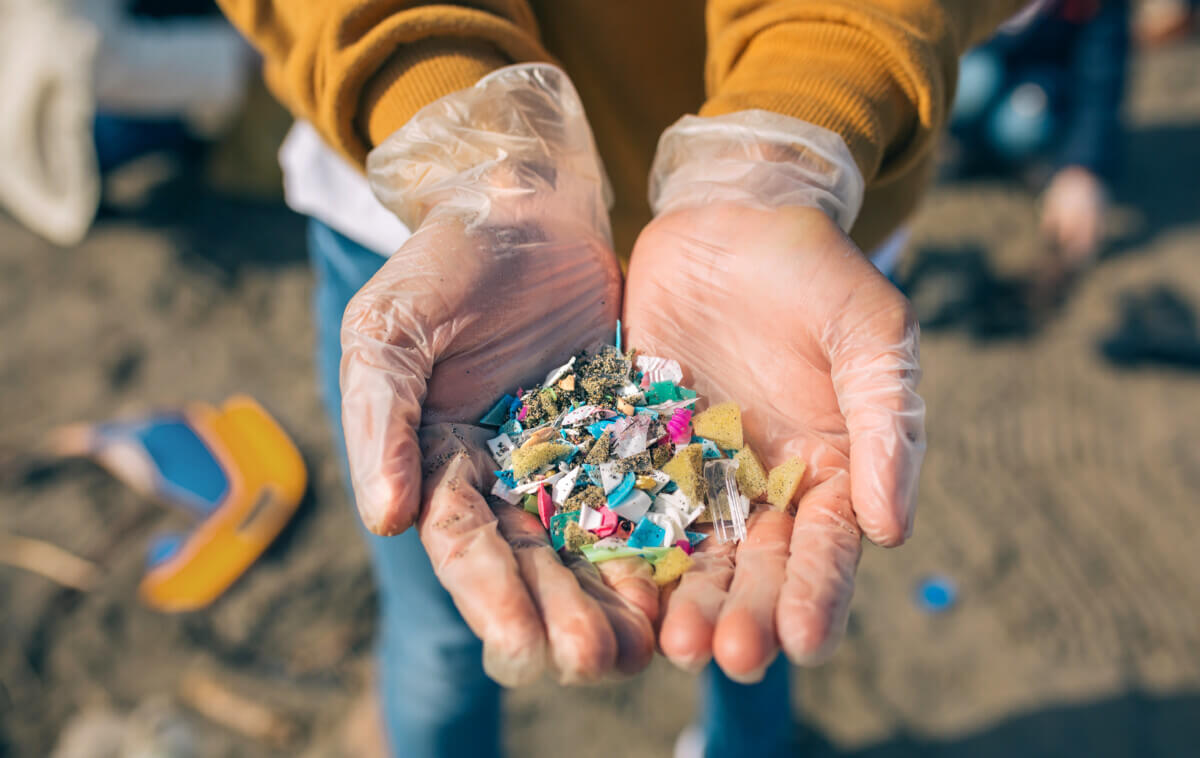
Every time a researcher snaps on a pair of disposable gloves to handle an environmental sample, they might be unknowingly skewing their own results without realizing it. A new study has found that simply touching a lab surface while wearing common nitrile or latex gloves can deposit thousands of tiny residue particles that get mistakenly counted as microplastic pollution, potentially inflating estimates of just how much plastic is floating around in the natural world.
The irony is hard to miss. Wearing gloves is one of the most widely recommended practices in microplastic research, intended to keep stray plastic fibers from a researcher’s hands out of delicate samples. Yet the gloves themselves shed chemical residues, specifically stearate salts used during manufacturing to help peel gloves off their molds, that can be mistaken for microplastics by standard detection methods. On average, a single dry touch from a standard lab glove left behind roughly 2,000 particles per square millimeter that were falsely identified as microplastics using traditional analysis methods.
Researchers at the University of Michigan uncovered this problem while working on an atmospheric microplastic study in four Michigan locations. When their data came back showing microplastic quantities that were unexpectedly high, they dug deeper and traced the inflated numbers back to their own gloves. Rather than simply discard the compromised data, the team set out to understand the scope of the problem and develop practical fixes, both to prevent this contamination and to rescue datasets already tainted by it.
How Common Lab Gloves Fool Microplastic Detection Instruments
To measure microplastic pollution, scientists use instruments that shine infrared or laser light onto tiny particles. Different materials absorb and scatter light in characteristic patterns, creating a kind of chemical fingerprint. Researchers then compare these fingerprints against libraries of known materials to figure out what each particle is made of. The trouble is that stearate salts, the residues left behind by gloves, have a chemical structure built from carbon and hydrogen chains that closely resemble polyethylene, one of the most common plastics on Earth.
The study, published in Analytical Methods, tested seven types of disposable laboratory gloves: three latex varieties, three nitrile varieties, and one nitrile cleanroom glove. Using a texture-analysis instrument, they pressed each glove against a reflective surface with about the force needed to lift a six-and-a-half-pound weight, well within the range of a normal pinch or grip. They then examined what was left behind using an advanced microscopy system that collects two types of chemical fingerprints from the same particle simultaneously.
Nearly all tested gloves deposited stearate residues that were incorrectly identified as microplastics when researchers used the standard approach of accepting whichever reference material scored the highest match. The worst offender, a latex glove labeled L1 in the study, released more than 7,000 false-positive particles per square millimeter. Across all glove types, the average was about 2,000 false positives per square millimeter. Only the nitrile cleanroom glove performed significantly better, averaging around 100 false positives per square millimeter.

Why Microplastic Research Safeguards Are Falling Short
The average stearate residue measured just 1.6 micrometers across, far smaller than the width of a human hair and squarely within the size range that matters most for health and environmental concerns. Microplastics smaller than 10 micrometers are considered particularly worrisome because they can travel between ecosystems and may interact more easily with living systems. By disproportionately inflating counts in this size range, glove contamination could distort the scientific picture of where the smallest, most dangerous microplastics actually exist.
Making matters worse, these stearate particles look virtually identical to real microplastics under a microscope. The team collected electron microscope images showing that both glove residues and genuine polyethylene fragments appear as thin, ridged, film-like particles. No amount of squinting through a lens could tell them apart.
The research team surveyed 26 review articles published between 2018 and 2024 that offered guidance on quality control in microplastic research. A full 81 percent recommended wearing gloves to protect samples. Only two reviews mentioned that contact between gloves and samples should be limited. Even after a 2020 study by other researchers showed that gloves soaking in water could release residues mistaken for polyethylene, glove recommendations barely changed. The proportion of articles suggesting glove use decreased by only 7 percent. Latex gloves actually became more commonly recommended after that earlier warning, accounting for 38 percent of material suggestions, despite evidence that latex and nitrile gloves posed similar contamination risks.
That 2020 research had shown that stearate contamination from wet contact, such as gloves submerged in water, could be caught because stearate salts contain a distinctive chemical group that polyethylene lacks. But the Michigan team discovered that dry contact produces much smaller particles, and at that tiny scale, the instruments struggle to pick up the distinguishing signal from background noise. The average difference in match scores between stearate and microplastic identities was a mere 0.01, essentially a coin flip for the software.
How Scientists Can Catch the Fakes in Microplastic Data
Rather than simply sounding an alarm, the team developed two concrete approaches to identify and correct glove contamination in existing datasets.
For infrared data, they found that narrowing the comparison window to a specific range of light wavelengths where the distinguishing signal is most prominent allowed the automated system to help distinguish stearates from real microplastics. When matching across the full spectrum, the carbon-hydrogen stretch region common to both materials overwhelmed the subtle differences. But by zeroing in on the region where those distinguishing features live, the software could more effectively separate contaminants from genuine plastic particles.
For a second type of spectral data where that distinguishing signal is invisible to the instrument, the team turned to a statistical method called conformal prediction. This approach does not just accept the single best match. Instead, it generates a set of possible identities for each particle along with a statistical confidence level. When applied with a 95 percent confidence threshold, the method assigned nearly half of the glove residue particles to stearate-only predictions rather than lumping them in with microplastics. For particles where the method could not confidently distinguish between identities, it flagged them for manual review, a far more cautious approach than blindly accepting the top match.
The team then applied both techniques to their compromised Michigan atmospheric dataset. The infrared workflow correctly identified all 14 stearate contaminants that a trained analyst had flagged. The second workflow agreed with the analyst’s assessment for five confirmed polyethylene particles and flagged 16 others as needing additional review.
What Scientists Should Do Now
The team provided open-access spectral libraries of stearate standards, reference fingerprints that have been largely absent from the research community’s shared resources, along with code and a user guide so other researchers can apply the same correction methods to their own data.
Their top recommendation is straightforward: avoid wearing gloves when handling microplastic samples, if safety permits. When harsh chemicals make gloves necessary, the team suggests cleanroom-grade nitrile gloves, which released roughly 95 percent fewer contaminant particles than conventional lab gloves. For datasets already collected with standard gloves, the modified analysis workflows and statistical tools can help researchers sort real microplastics from imposters.
At a moment when microplastic research is informing environmental regulations and public health policy, the accuracy of every data point matters. If the gloves meant to keep samples clean have instead been quietly padding the numbers, the true scale of microplastic pollution, while almost certainly still alarming, may look different than scientists currently believe.
Paper Notes
Limitations
The study tested seven glove varieties from a limited number of manufacturers, and glove-to-glove variability and differences in applied pressure were acknowledged as factors that unevenly affect contamination levels. The controlled contact experiments used a fixed force representative of a normal grip, which does not capture the full range of forces researchers might apply in different laboratory tasks. The average particle size of 1.6 micrometers was below the resolution of conventional infrared microscopes (approximately 10 micrometers), meaning the findings are most directly applicable to newer, higher-resolution instruments. The environmental case study dataset was collected from only four Michigan locations during one season, and the team acknowledged that environmental aging of particles can reduce spectral quality and complicate identification. The conformal prediction method’s performance was shown to depend significantly on spectral data quality, with higher-quality lab-generated data yielding better results than environmentally aged samples. The authors noted that their proposed automated workflows are not perfect: for infrared data, the method better identified contaminants (false positives) than confirmed true microplastics, and manual assessment of spectral similarity remains necessary to correctly predict chemical identity.
Funding and Disclosures
The authors reported no conflicts of interest. Funding was acknowledged from the College of Literature, Science, and Arts at the University of Michigan. R. L. Parham was supported by an NSF Graduate Research Fellowship (NSF-GRFP) DGE-2241144. M. E. Clough was partially supported by the University of Michigan Rackham Graduate School through a merit and predoctoral fellowship.
Publication Details
Title: Avoiding and reducing microplastic false positives from dry glove contact | Authors: Madeline E. Clough, Eduardo Ochoa Rivera, Abbygail M. Ayala, Rebecca L. Parham, Joseph Pennacchio, Henry E. Thurber, Andrew P. Ault, Ambuj Tewari, and Anne J. McNeil | Affiliations: Department of Chemistry, Department of Statistics, Macromolecular Science and Engineering Program, Department of Electrical Engineering and Computer Science, and Program in the Environment, University of Michigan, Ann Arbor, MI | Journal: Analytical Methods (Royal Society of Chemistry) | DOI: 10.1039/d5ay01801c | Received: October 29, 2025 | Accepted: March 11, 2026


