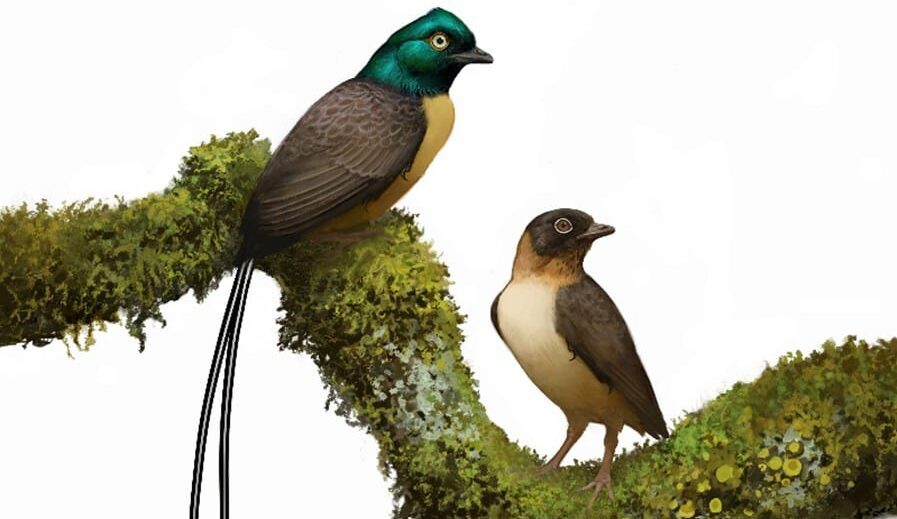
A potential male and female of the newly named taxa Plumadraco bankoorum. (Artwork by Ville Sinkkonen, CC-BY 4.0)
In A Nutshell
- Researchers have identified a new extinct bird species, Plumadraco bankoorum, whose tail feathers measured nearly twice its body length, the longest ever recorded in its group.
- The feathers created drag rather than lift, leading scientists to believe they served a social or courtship display function rather than an aerodynamic one.
- Chemical analysis of the fossil revealed possible color differences between the tail feathers and the rest of the body, potentially making the display even more visually striking.
- Researchers tentatively suggest the specimen was male and that the feathers evolved through sexual selection, though direct evidence remains limited.
A newly identified ancient bird species that lived about 121 million years ago sported a pair of tail feathers so absurdly long they stretched to nearly twice the length of its entire body. Scientists believe those feathers probably weren’t for flying. They may have helped the bird stand out during displays, perhaps in courtship.
Researchers have formally described Plumadraco bankoorum, a crow-to-thrush-sized bird that lived during the Early Cretaceous period in what is now northeastern China. The fossil, recovered from a rock formation in Liaoning Province, is remarkably intact, with bones, body feathers, wing feathers, and most strikingly, a pair of ornamental tail feathers preserved in exceptional detail. Those tail feathers, measuring nearly twice the creature’s body length, are the proportionally longest ever recorded in its group, and their fine preservation offers strong clues about what the bird may have been doing with them.
Plumadraco belongs to a group of extinct birds called enantiornithines, the most diverse and widespread birds of the Cretaceous period, with over 100 known species found on every continent except Antarctica. These birds ruled the skies alongside dinosaurs for tens of millions of years before vanishing at the end of the Cretaceous.
What Is Plumadraco bankoorum, the Ancient ‘Feather Dragon’ Bird?
Named for its most dramatic feature, Plumadraco comes from the Latin words for “feather” and “dragon.” Its species name, bankoorum, honors Winston E. and Paul C. Banko, two researchers whose work contributed significantly to the understanding of bird biology and conservation in Hawaii.
Preserved as a complete, connected skeleton on a single slab of rock, the fossil is a rarity in paleontology. Its tail feathers alone measure 293 millimeters, while the body length comes in at 149 millimeters. Previous record-holders in this group had tail feathers reaching only about 1.6 times body length. Plumadraco surpasses that at nearly 1.97 times.
These tail feathers belong to a type of ornamental feather unique to enantiornithines and a handful of their relatives. Unlike modern flight feathers, which have a solid, tube-like central shaft, these ancient feathers had a different, open internal structure that created drag rather than lift, making them a liability in the air and likely an asset on the ground.

Built to Show Off: How Plumadraco Used Its Spectacular Tail Feathers
What makes this fossil especially exciting is not just the feathers’ length but how well-preserved they are. For the first time, researchers can examine the complete structure of one of these tail feathers from base to tip, something no previously discovered specimen in this group made possible.
Near the tips of each tail feather, the central shaft gradually tapers and stops partway into the feather’s decorative, paddle-shaped end. That weakening makes the tip more flexible. When the bird raised its tail during a display, the stiffer base would move first, while the looser paddle at the tip would lag behind and snap forward, creating a flickering, eye-catching motion. Scientists see the same design at work in the ornamental rump feathers of peacocks today.
A chemical scan of the fossil found that body and wing feathers carried higher levels of pigment-linked elements than the tail feathers did, pointing to possible color differences across the bird’s plumage.
Why Scientists Think These Tail Feathers Were About Sexual Selection
Researchers make a careful but tentative argument that these extraordinary tail feathers were likely linked to sexual selection, though they acknowledge the evolutionary drivers are difficult to pin down.
Their case draws on several lines of evidence. Among early Cretaceous birds for which multiple feather-preserving fossils exist, ornamental tail feathers appear in roughly 40 to 60 percent of individuals, consistent with a trait present in only one sex. Enantiornithines also grew their ornamental feathers before reaching full adult size, suggesting these feathers carried real biological costs early in life. Studies on living birds have shown that artificially lengthening male tail feathers increases breeding success, pointing to females actively favoring longer tails when selecting mates.
Based on limited nest fossils, some enantiornithines appear to have nested on open ground. If Plumadraco or its relatives did the same, that would fit the pattern seen in modern open-ground nesters, where males carry the flashy plumage and females stay inconspicuous to avoid drawing predators to the nest.
Publishing in PLOS ONE, the researchers suggest the specimen may have been male and that its spectacular tail was shaped by sexual selection and used in courtship displays, while noting that more evidence is still needed to confirm it.

A Glimpse at an Ancient Arms Race
Plumadraco is not an isolated case. Ornamental tail feathers appear again and again in the enantiornithine fossil record, spanning at least 30 million years across nearly every continent, with each species apparently sporting its own variation in shape, length, and flexibility.
Growing something extravagant and moving it in exactly the right way to attract a mate may not be a modern invention at all. It was possibly playing out in the ancient forests of China more than 120 million years ago, long before any bird alive today ever existed.
Paper Notes
Limitations
Authors acknowledge several important constraints on their conclusions. Evidence for enantiornithine nesting behavior is geographically and geologically limited, with nest and egg data coming only from Late Cretaceous sites in Romania, Mongolia, and Argentina, meaning direct evidence of nesting strategies for Early Cretaceous enantiornithines like Plumadraco is largely indirect. The specimen itself shows signs of being skeletally immature at the time of death, based on the lack of fusion of certain bone joints. Determining whether ornamental feathers in enantiornithines were driven by sexual selection, non-sexual social signaling, or some combination of both remains difficult due to limited soft tissue data across the group. Enantiornithines have no living direct relatives, making behavioral inferences inherently uncertain.
Funding and Disclosures
This research was funded in part by the Taishan Scholar Foundation of Shandong Province (grant Ts20190954) and the National Natural Science Foundation of China, under grant numbers 42288201 and 42572027. The authors declared no competing interests.
Publication Details
Authors: Clark AD, O’Connor JK, Wang X, Wang Y, Pruett-Jones S, Zhang X, et al. Paper Title: Hyperelongate ornamental tail feathers in a new early Cretaceous enantiornithine bird Journal: PLOS ONE, Volume 21, Issue 5 Article ID: e0347641 Published: May 27, 2026 DOI: https://doi.org/10.1371/journal.pone.0347641 Editor: Jun Liu, Chinese Academy of Sciences, China Open Access: This is an open access article distributed under the Creative Commons Attribution License.


