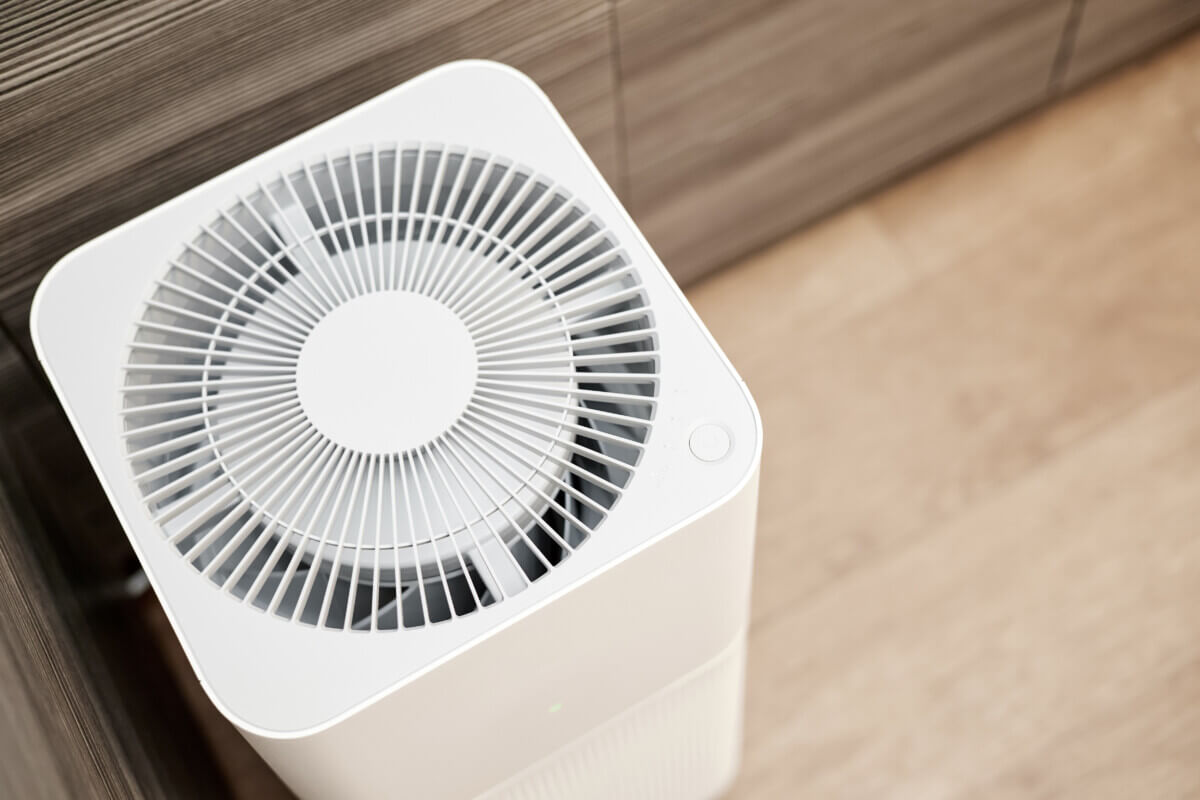
(© marketlan - stock.adobe.com)
Could Cleaner Air Be Key To Protecting The Middle-Aged Brain?
In A Nutshell
- Adults over 40 living near highways completed a cognitive task-switching test 12% faster after one month with a HEPA air purifier versus a fake one.
- Real HEPA filters cut indoor fine particle pollution by about 52% compared to sham units in monitored homes.
- No cognitive benefit was detected in adults under 40, and the age-based finding was not planned in advance, so it warrants further study.
- Researchers say the results are preliminary and call for larger studies, particularly among people who already have some cognitive decline.
Most people think of air purifiers as tools for allergy season or wildfire smoke, something to help with breathing, not thinking. But a new study has found that tiny pollution particles drifting indoors from nearby highways may be affecting certain aspects of thinking, and that running a HEPA air purifier in the bedroom and living room was associated with measurably faster performance on a cognitive test in adults over 40.
Researchers at the University of Connecticut and Tufts University found that adults aged 40 and older living near major highways completed a standard brain test 12% faster after one month of using a real HEPA air purifier compared to a month with a fake one. That improvement showed up on the portion measuring mental flexibility and task-switching, skills that matter for everything from managing a workday to driving in traffic. For younger adults, no meaningful difference was detected.
These results, published in Scientific Reports, come from a secondary analysis of a larger trial designed to study blood pressure, and they add to a growing body of evidence that breathing in pollution from car and truck exhaust may also affect how well the brain handles certain higher-level thinking tasks, particularly as people age.
HEPA Air Purifiers Cut Indoor Pollution by More Than Half
The study, called HAFTRAP, recruited people who lived full-time within about 650 feet of highways in Somerville, Massachusetts, close enough that traffic pollution regularly seeped indoors. Participants had to be at least 30, couldn’t smoke or vape, and couldn’t be taking blood pressure medication or have a history of major heart problems. Enrollment ran from September through April, 2020 to 2024, timed to cooler months when near-highway pollution concentrations tend to be higher.
Each household received two air purifiers, one for the living room and one for the bedroom. Every participant went through both conditions: one month with a real HEPA filter and one month with a fake unit that looked and sounded identical but didn’t filter anything, with a one-month break in between. Participants didn’t know which unit was real. Air monitoring in 19 homes confirmed real HEPA filters cut indoor fine particle levels by about 52% and ultrafine particles by about 32% versus the fake units. One caveat: fake units still circulated air, which may have modestly reduced ultrafine particles on its own, meaning the true HEPA benefit could be larger than measured.
At the start and end of each month-long period, a researcher visited participants’ homes early in the morning to administer a pen-and-paper test called the Trail Making Test. Part A asks participants to connect numbered dots in order as fast as possible, testing basic visual memory and hand speed. Part B is harder, requiring alternating between numbers and letters in sequence, the kind of task-switching people rely on throughout the day. One methodological note: the trial manager who gave the test was not blinded to which filtration type was in use, which introduces the possibility of subtle influence on testing conditions, even though participants themselves were blinded and the test is an objective, standardized measure.
Of 156 people originally enrolled, 119 completed all four required test visits. Because each person went through both conditions, every participant served as their own comparison, removing many of the individual differences that can muddy results in other study types.

Adults Over 40 Saw Faster Task-Switching After HEPA Filtration
When researchers looked at all participants together, the overall difference between real and fake filtration didn’t reach statistical significance. Age turned out to be the deciding factor, though the age-based split was decided after the data were collected rather than planned in advance, meaning the finding could be due to chance and warrants replication.
Among participants 40 and older, average Part B completion time was 54.0 seconds after HEPA filtration versus 61.4 seconds after fake filtration. Among participants under 40, no significant benefit appeared on either part of the test.
Part A, the simpler number-connecting task, showed no significant differences for any age group. Other research has similarly found that air pollution exposure tends to affect more demanding cognitive skills while leaving basic hand speed untouched. There is also biological evidence that tiny pollution particles may damage white matter in brain regions responsible for flexible thinking and task management, which aligns with where the benefit appeared here.
Why Millions Living Near Highways Should Pay Attention
Millions of Americans live near busy roads. Prior research cited in the paper has linked that proximity not just to respiratory and heart disease but to neurological conditions including Alzheimer’s and Parkinson’s. HEPA purifiers are widely available, and if running one for a month is associated with faster performance on a task-switching test, the potential public health impact could be meaningful if confirmed in larger studies.
This was a small trial of healthy, well-educated, predominantly White participants with higher household incomes in one Northeastern city, none of whom had pre-existing cognitive problems. Whether air purifiers could help people already experiencing cognitive decline is an open question the researchers called for future studies to address.
At minimum, the air near a highway may be affecting how the brain manages demanding tasks. Cleaner indoor air, at least in this study, was associated with a measurable difference in that performance, and for people past 40, that’s worth knowing.
Disclaimer: This article is based on a single preliminary study with a small, demographically limited sample. Findings have not been replicated and should not be taken as medical advice. Consult a qualified health professional before making decisions based on this research.
Paper Notes
Limitations
The decision to split the analysis by age (40 and older versus under 40) was made after the fact rather than planned from the start, a distinction that matters because such post hoc analyses can find patterns by chance. The Trail Making Test has a known practice effect, meaning participants improve simply from repeated testing, though the study’s crossover design should have balanced this across conditions. The trial manager who administered the tests was not blinded to the type of filtration, which introduces the possibility of subtle influence on participants, although the test itself is a standardized, objective measure completed by participants who were blinded. Fake filtration units may have provided some small benefit by moving air and slightly reducing ultrafine particles, potentially making the difference between conditions smaller than it truly is. The sample was predominantly White, generally well-educated, and had higher household incomes, limiting how broadly the results can be applied. None of the participants had pre-existing cognitive problems, so the findings do not speak to whether air filtration could help individuals already experiencing cognitive decline.
Funding and Disclosures
The study was funded by the National Institute of Environmental Health Sciences (Grant ID: R01 ES030289) and the School of Medicine at the University of Connecticut. None of the authors reported relationships with industry. Air purifiers used in the study were custom-adapted by the manufacturer, Austin Air, and sold at a discount based on bulk purchase. The manufacturer was not involved in any way in the design, conduct, or analysis of the study. The trial was registered on ClinicalTrials.gov (NCT04279249) on February 19, 2020, and received approval from the UConn Health Institutional Review Board Human Subjects Protection Program.
Publication Details
The paper, titled “Effect of HEPA filtration air purifiers on cognitive function from a secondary outcome analysis of a pragmatic randomized crossover trial,” was authored by Nicholas Pellegrino and Misha Eliasziw (co-first authors), along with Richard Fortinsky, Hunter Gates, and Doug Brugge (corresponding author). Pellegrino, Gates, and Brugge are affiliated with the Department of Public Health Sciences at the University of Connecticut Health Center in Farmington, Connecticut. Eliasziw is affiliated with the Department of Public Health and Community Medicine at Tufts University in Boston, Massachusetts. Fortinsky is affiliated with the UConn Center of Aging at the University of Connecticut School of Medicine. Published in Scientific Reports (Article in Press). DOI: 10.1038/s41598-026-48063-8.


