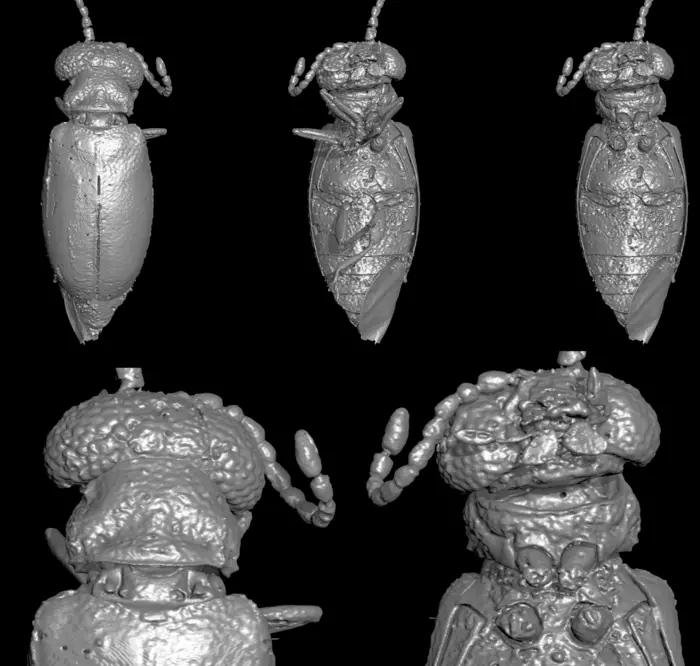
†Cnopus twentyonepilotorum sp. nov., holotype C05038. 3D renderings (Credit: Ferreira et al. 2026, ZooKeys)
In a Nutshell
- A newly identified fossil beetle preserved in 53-million-year-old amber from France was named Cnopus twentyonepilotorum after the band Twenty One Pilots, honoring their mental health advocacy.
- Its genus, Cnopus, still has living members, and the specimen pushes back confirmed evidence of that genus by roughly 15 million years.
- It helps fill a stretch of about 60 million years in which the puppet beetle (Aderidae) fossil record was nearly blank.
Twenty One Pilots now share their name with a beetle that was already 53 million years gone before the band ever wrote a song. About a millimeter long, the insect spent all that time sealed in a bead of hardened tree resin in what is now northern France, and the researchers who studied it chose the band as a tribute to its openness about anxiety and depression. That tribute, though, is only part of why the fossil matters.
What the beetle does to scientists’ timeline for its entire genus is the bigger story. Cnopus twentyonepilotorum, as the species is formally called, belongs to a living group of beetles whose fossil record had been both thin and surprisingly young. This specimen, described in the journal ZooKeys, pushes the genus’s confirmed history back well beyond anything found before.
That thin record matters because the beetle belongs to a family called Aderidae, nicknamed puppet beetles or ant-like leaf beetles, which includes nearly 1,000 living species but has an almost empty fossil record stretching back to the age of dinosaurs. Scientists know these beetles live in trees and shrubs today, with larvae that burrow into rotting wood or sometimes live as parasites inside ant and termite nests, but the family’s deep history has remained mostly guesswork. A fossil this old and well preserved gives researchers a rare, solid data point.
How Scientists Studied This Ancient Amber Beetle
Calling this a team effort is accurate, but it started small: with a single piece of amber collected from Le Quesnoy, a site in the Oise region near Creil in northern France. That amber dates back roughly 53 million years, making it one of the oldest deposits of its kind ever found in Europe. Geological and plant evidence from the site points to a warm, swampy forest crossed by streams and filled with resin-producing trees, exactly the kind of place that would have swarmed with insect life.
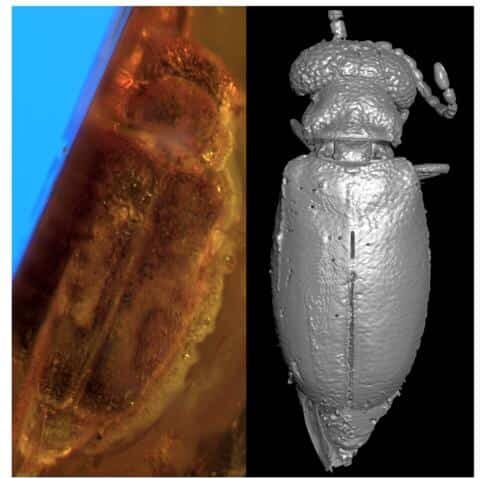
Researchers first examined the amber under a high-powered microscope, photographing it at different focus levels and digitally combining those images into one sharp picture. But studying a bug trapped in amber is tricky: the specimen is sealed inside solid resin, and cutting it open risks destroying it forever. To get a full three-dimensional look at the beetle without damaging it, the team turned to a synchrotron, a powerful particle accelerator that produces X-rays far sharper than anything a hospital scanner could manage. At the ALBA Synchrotron near Barcelona, researchers captured 2,500 individual X-ray images of the amber from different angles and stitched them into a detailed 3D digital model of the beetle’s body, inside and out.
That imaging let the team study fine details: the shape of the antennae, the structure of the legs, and the pattern of tiny hairs on the wing covers, all without ever touching a blade to the amber. Based on these features, including a short first segment on the hind foot that is unique to one group of puppet beetles and a distinct pattern of tiny dimples across its midsection, researchers confidently placed the fossil in an existing genus called Cnopus, which includes a species found in parts of Europe.
Why This Amber Beetle Fossil Matters
Before this discovery, scientists had formally described only 11 fossil species of puppet beetles. The oldest known example comes from amber found in Myanmar, dated to around 99 million years ago, during the age of dinosaurs. After that, the fossil trail goes mostly quiet until amber deposits from about 38 to 34 million years ago in the Baltic region and Germany, which produced most of the family’s known fossil species, including other members of the genus Cnopus.
That left a roughly 60-million-year stretch with almost nothing to show for it. This new fossil falls within that gap, dated to about 53 million years ago, closer to the younger end than the older. Because it belongs to the genus Cnopus, and the previously oldest confirmed Cnopus fossils came from amber dated to around 37.7 million years ago, the new specimen pushes back confirmed evidence of the genus by roughly 15 million years. A group of beetles still alive today was already crawling around, with recognizable body features, tens of millions of years earlier than anyone had proof of.
Researchers compared the fossil to its closest living relative, a species called Cnopus minor that lives in western Europe. Both share bulging eyes, a wide head, and distinctive dimples along the back edge of the midsection, but the fossil’s body is longer and slightly smaller overall. Because the features scientists typically use to distinguish species, located in the beetle’s reproductive anatomy, were not preserved, researchers could not say with certainty that the fossil represents a new species rather than a known one. Still, given its age, they consider it highly unlikely to belong to any species alive today.
This fossil also feeds into an ongoing debate about when puppet beetles first evolved, though scientists are still working out exactly where Cnopus sits in the beetle family tree. Different research teams using DNA-based dating methods have produced wildly different estimates for the family’s age, ranging from roughly 191 million years ago to under 50 million years ago, depending on the method and assumptions used. This new fossil does not settle that debate, but it does cast doubt on some of those estimates. A genus like Cnopus existing 53 million years ago is hard to reconcile with calculations suggesting the whole family only began around 48 million years ago.
Beyond the dating puzzle, the fossil backs up what scientists already suspected about the ancient French forest preserved in this amber. Puppet beetles tend to live in trees, shrubs, and warm climates, and finding one here lines up with other clues pointing to a lush, humid woodland at the site 53 million years ago.
A Tiny Amber Beetle With a Big Scientific Story
Naming a fossil beetle after a rock band might look like a lighthearted footnote, but it reflects something researchers increasingly do: use scientific names to connect small discoveries to bigger cultural conversations, in this case around mental health. The beetle itself offers something longer-lasting than a clever name, though. It’s physical proof that a beetle genus still crawling around on leaves in Europe today was already alive in a prehistoric swamp forest tens of millions of years before anyone expected to find it there. For a family of insects this poorly studied, one well-preserved specimen sealed in amber can rewrite assumptions built over decades.
Paper Notes
Limitations
This study’s description and conclusions rest on a single fossil specimen, the holotype preserved in one piece of amber. Internal reproductive structures, typically used to distinguish closely related living species of Cnopus, were not preserved, which prevented researchers from ruling out a match with an already-known species with full certainty. Some body regions, including parts of the underside of the legs, could not be clearly examined because of the preservation condition of that part of the specimen. Antenna proportions, while described, vary enough within this genus that the authors caution against treating them as a defining feature. Broader conclusions about the timing of puppet beetle evolution remain limited by the family’s sparse fossil record, with large gaps in geographic and geologic coverage still unfilled.
Funding and Disclosures
Funding came from Spain’s Ministry of Science, Innovation and Universities through projects known as “FLOW” and “HIPI,” along with support from the Spanish National Research Council (CSIC) for one author and a separate research fellowship program for another. The work is also described as part of one author’s doctoral thesis on beetle evolution. The authors stated that they have no competing interests and reported that they did not use artificial intelligence tools to prepare the manuscript.
Publication Details
Paper Title: “First fossil species of puppet beetles (Coleoptera, Tenebrionoidea, Aderidae) from the lowermost Eocene Oise amber (France), with a review of the fossil record of Aderidae,”
Authors: Jules Ferreira, Erich L. Spiessberger, André Nel, Alessandra Patera, and David Peris
Journal: ZooKeys, volume 1297, pages 153 to 180 (2026).


