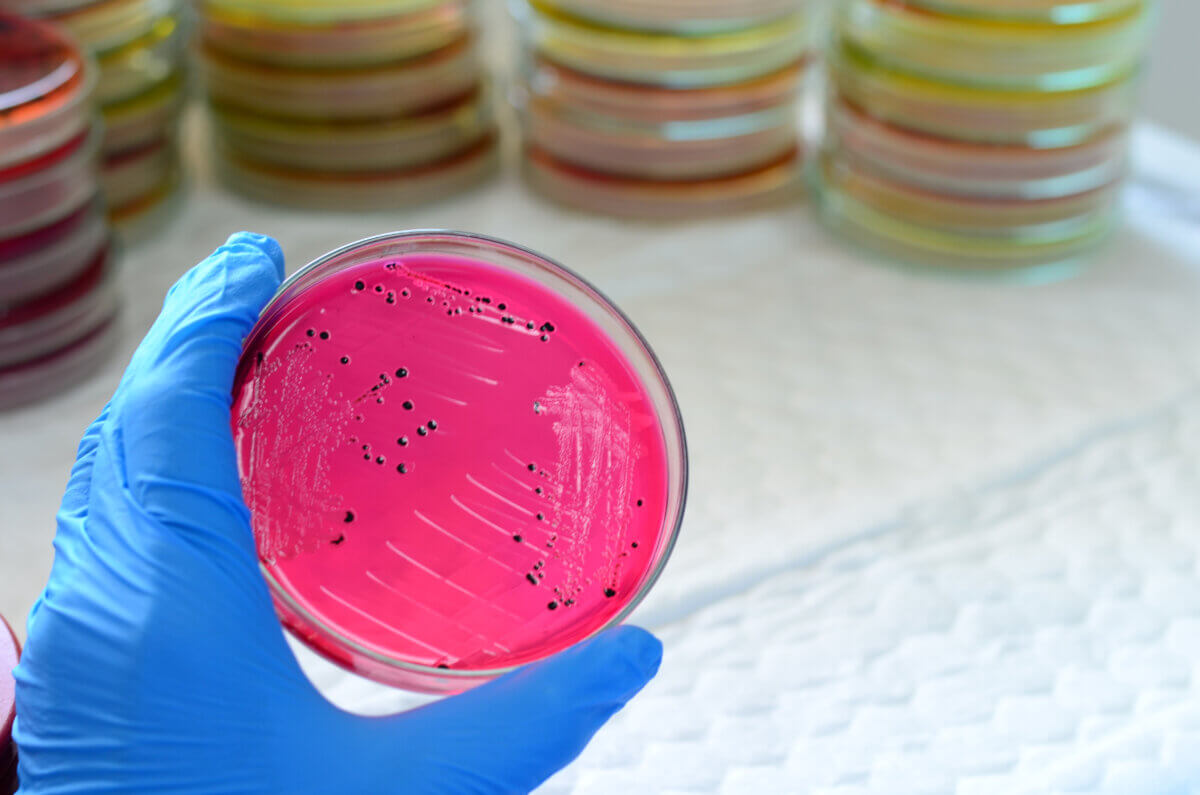
Close-up of Salmonella bacteria that produce hydrogen sulfide growth on XLD agar. (Credit: Yayah_AI on Shutterstock)
Warmer temperatures in the near future are increasing the risk for widespread Salmonella, according to a new study published in the Journal of Infection. The new research calculated that climates above 50°F, relative humidity, dewpoint temperature between 44.6°F—50°F, and longer days over 12 to 15 hours were found to be the drivers of the coming rise in Salmonella cases.
The Salmonella bacteria is one of the main culprits behind food poisoning. It’s usually found in the intestines of animals and humans, and it can contaminate food when meals are not cooked or handled correctly.
“The study highlights how weather plays a significant role in Salmonella outbreaks and provides a valuable tool for predicting future risks and tailoring interventions, particularly in the context of climate change,” says Dr. Laura Gonzalez Villeta, a researcher at the University of Surrey in England and lead author of the new study, in a press release.
The researchers analyzed data from the UK Health Security Agency, which included 144,703 cases of Salmonella in England and Wales from 2000 to 2016. They also extracted data on the timing of these outbreaks, focusing on 14 weather-related factors. According to the researchers, the multiple data points provide a more well-rounded look at the causes of a potential surge in Salmonella outbreaks.
“The model we used to analyze the data shows promise, as the findings were replicated across England, Wales and, independently, in the Netherlands, suggesting a potential for wider application in other European and high-income countries to help gain new insights on the incidence of Salmonella,” Villeta explains. “It would be interesting to investigate this in regions with very different environmental and socio-economic characteristics, like tropical countries.”
Weather factors with the strongest link to salmonella cases include rising temperatures, increased humidity, reduced rainfall, and longer days. Changes in air pressure, wind speed, temperature amplitude, and sunshine duration had less impact on future Salmonella cases than temperature and day length. Additionally, the researchers noted that the potential uptick in Salmonella was irrespective of geographical location.


