
A killer whale chases after salmon. (© Allison - stock.adobe.com)
In A Nutshell
- A Short-Lived Fad: A 2004 review in Biological Conservation reported that in 1987 a K-Pod female’s habit of carrying a dead salmon spread to the Southern Residents’ other two pods within five to six weeks, then faded after a few repeats the next summer.
- One Photo, Not A Comeback: A 2024 photo of J27 Blackberry and an unphotographed sighting about 10 days later fall far short of that spread, and orca specialists say the evidence does not show the fad has returned.
- Motive Still Unknown: Play, food storage and food sharing remain untested ideas, and the bigger question for these 76 endangered whales is whether they have enough salmon to eat.
Why would a killer whale balance a dead salmon on its head? Orca watchers have wondered since 1987, when the habit swept briefly through the Southern Resident orcas of Washington’s Puget Sound and then faded.
A 2024 photo of a male orca named J27 Blackberry revived the question and gave birth to a tidier story: the fad is back. The evidence supports something smaller. One clear photograph, one unphotographed sighting and a handful of one-offs over the years don’t make a trend. They’re a reason to look again at the 1987 account that started it all.
How Solid Is The 1987 Account?
Solid on the sequence, thin on the meaning. The main published account comes from a 2004 review in Biological Conservation by whale researchers Hal Whitehead, Luke Rendell, Richard Osborne and Bernd Würsig. It reported that a female in K-Pod began carrying a dead salmon in 1987. K-Pod is one of the three family groups, or pods, that make up the Southern Resident killer whales.
Over five to six weeks, the review said, the habit spread to the other two pods, J and L, then stopped. A few repeats followed the next summer, and the review, published in 2004, recorded none after that. The authors offered it as an example of horizontal culture, meaning a behavior that passes mostly between animals of the same generation through social learning, rather than down from older generations.
The evidence has limits. The review cites the 1987 episode as a personal observation by Osborne, of The Whale Museum in Friday Harbor, Washington. It does not name the whale that started it, count how many whales copied it or test why they did it. The authors also noted that some scientists won’t call a behavior cultural without experimental proof of social learning, a standard they said can’t be met for large whales.
“Hat” is a human label. It is not evidence that the whales meant to decorate themselves or show off.
Why Are Specialists Cautious About A Comeback?
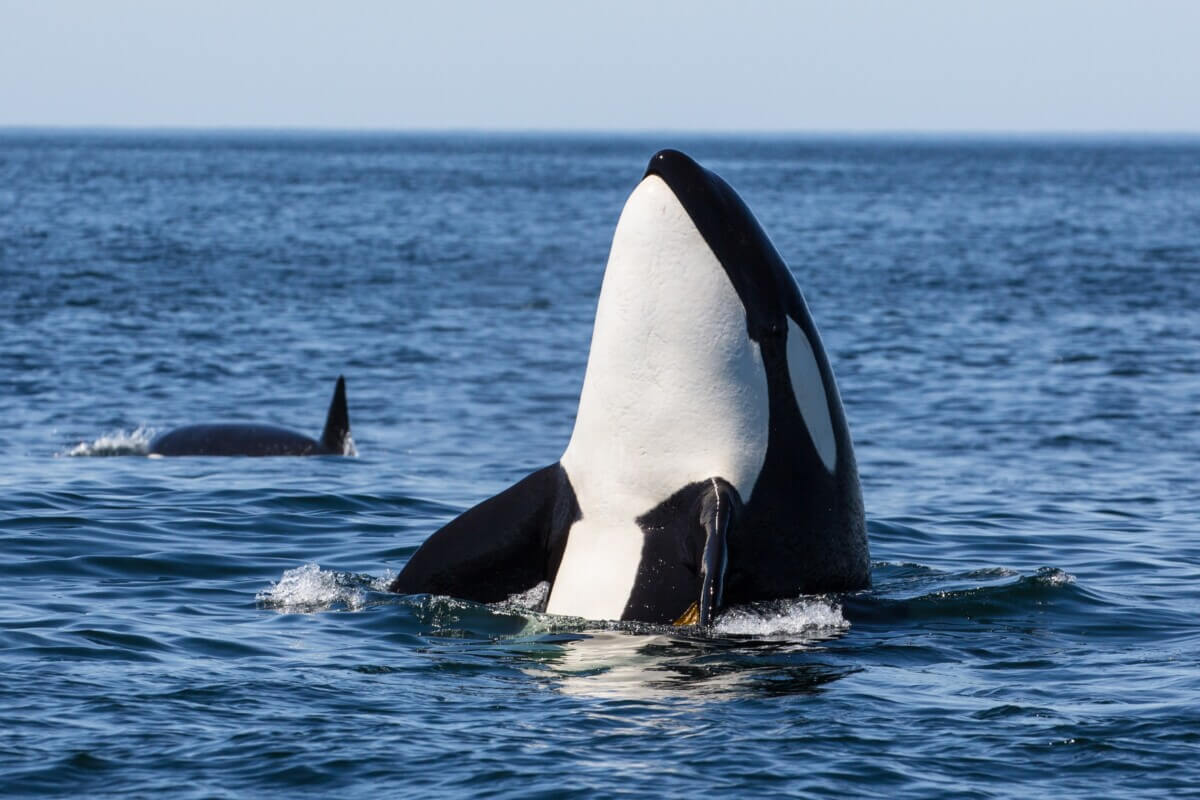
Too few whales have been seen doing it. On Oct. 25, 2024, photographer Jim Pasola photographed J27 Blackberry, an adult male in J-Pod, in Puget Sound with a salmon draped across his head. Orca Network shared the image in its Oct. 29 sighting report. Orca Network program manager Stephanie Raymond said the photographer described it as a single frame: in the next one, the salmon was gone.
The photo also wasn’t the first salmon-on-head sighting since 1987. In a report from the Center for Whale Research, director Michael Weiss said a drone operated by the center recorded a Southern Resident with a salmon on its head in 2018. The report added that a few more cases followed in later years, each a one-off. Deborah Giles, science and research director at the nonprofit Wild Orca, told Smithsonian she had seen the behavior maybe a handful of times in 19 years of fieldwork. About 10 days after Pasola’s photo, Giles told CNN, she spotted another orca with a salmon on its head while her team was collecting data in Puget Sound. The whale slipped below the surface before her colleagues could see it, and it was never identified or photographed.
That adds up to a few scattered sightings, far short of the spread across three pods described in 1987. Monika Wieland Shields, director of the Orca Behavior Institute, told National Geographic she doubted the photo even showed a salmon hat, adding that it was “an even greater stretch to say the fad is back off a single photo.” Raymond told Smithsonian that with so many observers and cameras watching these whales, a real revival would have produced “ample documentation.”
What Could A Salmon On The Head Mean?
Several things, but none has been tested. National Geographic raised communication, courtship and play as possibilities. Giles told the magazine that every explanation is guesswork and that researchers don’t know. She suggested play was plausible this time because Puget Sound had an unusually large run of chum salmon in fall 2024, and orcas with enough to eat have more time to rest and socialize.
Food is the other leading idea. In an NPR interview, Giles said a well-fed whale might be holding on to its next meal, or waiting for another whale to come share it. She made the same point to CNN, noting that these orcas hunt cooperatively and share food.
Wieland Shields told National Geographic that salmon hats are one of several passing fads in this population. Others have included spy-hopping (poking the head straight up out of the water) with dead salmon draped over a pectoral fin, and pulling kelp underwater so it shoots back above the surface. Each caught on for a season, then faded.
None of the accounts reviewed for this story say whether J27 ate, shared or dropped his fish after Pasola’s single frame. A fish resting on an orca’s head may look like a hat, but the resemblance can’t reveal its purpose.
What Does The Evidence Actually Support?
Something narrow, but still worth watching. A photo can show that a fish rested on a whale’s head. On its own, it can’t show decoration, a revived fad moving through J, K and L pods or a recovering population.
The whales’ larger situation is less playful. NOAA Fisheries listed the Southern Residents as endangered under the Endangered Species Act in 2005, and in March 2026 the agency said they remain at risk from too little prey, environmental contaminants, disturbance and inbreeding. The Center for Whale Research’s July 2026 census counted 76 whales, up two from the year before.
Giles told NPR she hoped the attention would show how badly these whales need enough food all year, and that more salmon hats could be a sign they’re getting it. For now, the salmon was real. The comeback is still an interpretation.


