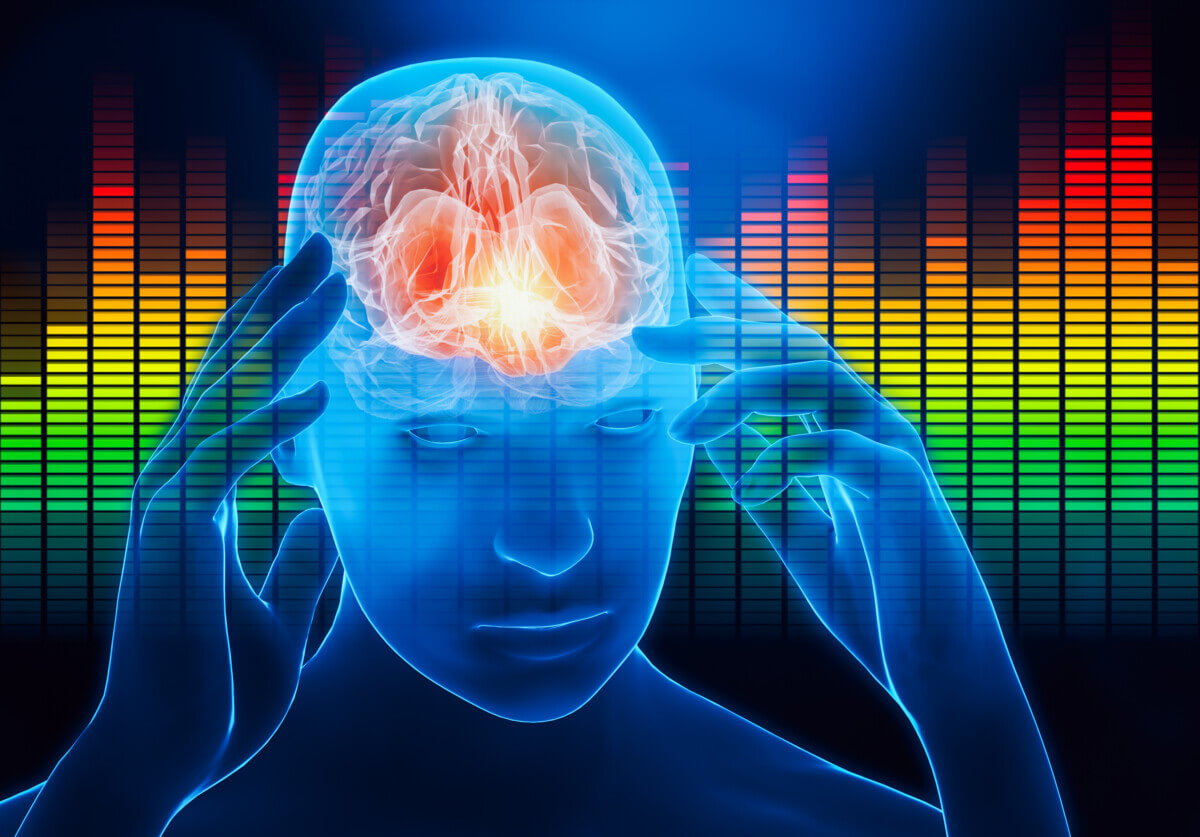
(© Matthieu - stock.adobe.com)
Some of the most complex cognitive functions are possible because different sides of your brain control them. Chief among them is speech perception, the ability to interpret language. In people, the speech perception process is typically dominated by the left hemisphere.
Your brain breaks apart fleeting streams of acoustic information into parallel channels – linguistic, emotional and musical – and acts as a biological multicore processor. Although scientists have recognized this division of cognitive labor for over 160 years, the mechanisms underpinning it remain poorly understood.
Researchers know that distinct subgroups of neurons must be tuned to different frequencies and timing of sound. In recent decades, studies on animal models, especially in rodents, have confirmed that splitting sound processing across the brain is not uniquely human, opening the door to more closely dissecting how this occurs.
Yet a central puzzle persists: What makes near-identical regions in opposite hemispheres of the brain process different types of information?
Answering that question promises broader insight into how experience sculpts neural circuits during critical periods of early development, and why that process is disrupted in neurodevelopmental disorders.
Timing Is Everything
Sensory processing of sounds begins in the cochlea, a part of the inner ear where sound frequencies are converted into electricity and forwarded to the auditory cortex of the brain. Researchers believe that the division of labor across brain hemispheres required to recognize sound patterns begins in this region.
For more than a decade, my work as a neuroscientist has focused on the auditory cortex. My lab has shown that mice process sound differently in the left and right hemispheres of their brains, and we have worked to tease apart the underlying circuitry.
For example, we’ve found the left side of the brain has more focused, specialized connections that may help detect key features of speech, such as distinguishing one word from another. Meanwhile, the right side is more broadly connected, suited for processing melodies and the intonation of speech.

We tackled the question of how these left-right differences in hearing develop in our latest work, and our results underscore the adage that timing is everything.
We tracked how neural circuits in the left and right auditory cortex develop from early life to adulthood. To do this, we recorded electrical signals in mouse brains to observe how the auditory cortex matures and to see how sound experiences shape its structure.
Surprisingly, we found that the right hemisphere consistently outpaced the left in development, showing more rapid growth and refinement. This suggests there are critical windows of development – brief periods when the brain is especially adaptive and sensitive to environmental sound – specific to each hemisphere that occur at different times.
To test the consequences of this asynchrony, we exposed young mice to specific tones during these sensitive periods. In adulthood, we found that where sound is processed in their brains was permanently skewed. Animals that heard tones during the right hemisphere’s earlier critical window had an overrepresentation of those frequencies mapped in the right auditory cortex.
Adding yet another layer of complexity, we found that these critical windows vary by sex. The right hemisphere critical window opens earlier in female mice, and the left hemisphere window opens just days later. In contrast, male mice had a very sensitive right hemisphere critical window, but no detectable window on the left. This points to the elusive role sex may play in brain plasticity.
Our findings provide a new way to understand how different hemispheres of the brain process sound and why this might vary for different people. They also provide evidence that parallel areas of the brain are not interchangeable: the brain can encode the same sound in radically different ways, depending on when it occurs and which hemisphere is primed to receive it.
Speech And Neurodevelopment
The division of labor between brain hemispheres is a hallmark of many human cognitive functions, especially language. This is often disrupted in neuropsychiatric conditions such as autism and schizophrenia.
Reduced language information encoding in the left hemisphere is a strong indication of auditory hallucinations in schizophrenia. And a shift from left- to right-hemisphere language processing is characteristic of autism, where language development is often impaired.
Strikingly, the right hemisphere of people with autism seems to respond earlier to sound than the left hemisphere, echoing the accelerated right-side maturation we saw in our study on mice. Our findings suggest that this early dominance of the right hemisphere in encoding sound information might amplify its control of auditory processing, deepening the imbalance between hemispheres.
These insights deepen our understanding of how language-related areas in the brain typically develop and can help scientists design earlier and more targeted treatments to support early speech, especially for children with neurodevelopmental language disorders.
Hysell V. Oviedo, Assistant Professor of Biomedical Research, Washington University in St. Louis. She receives funding from NIH.
This article is republished from The Conversation under a Creative Commons license. Read the original article.


