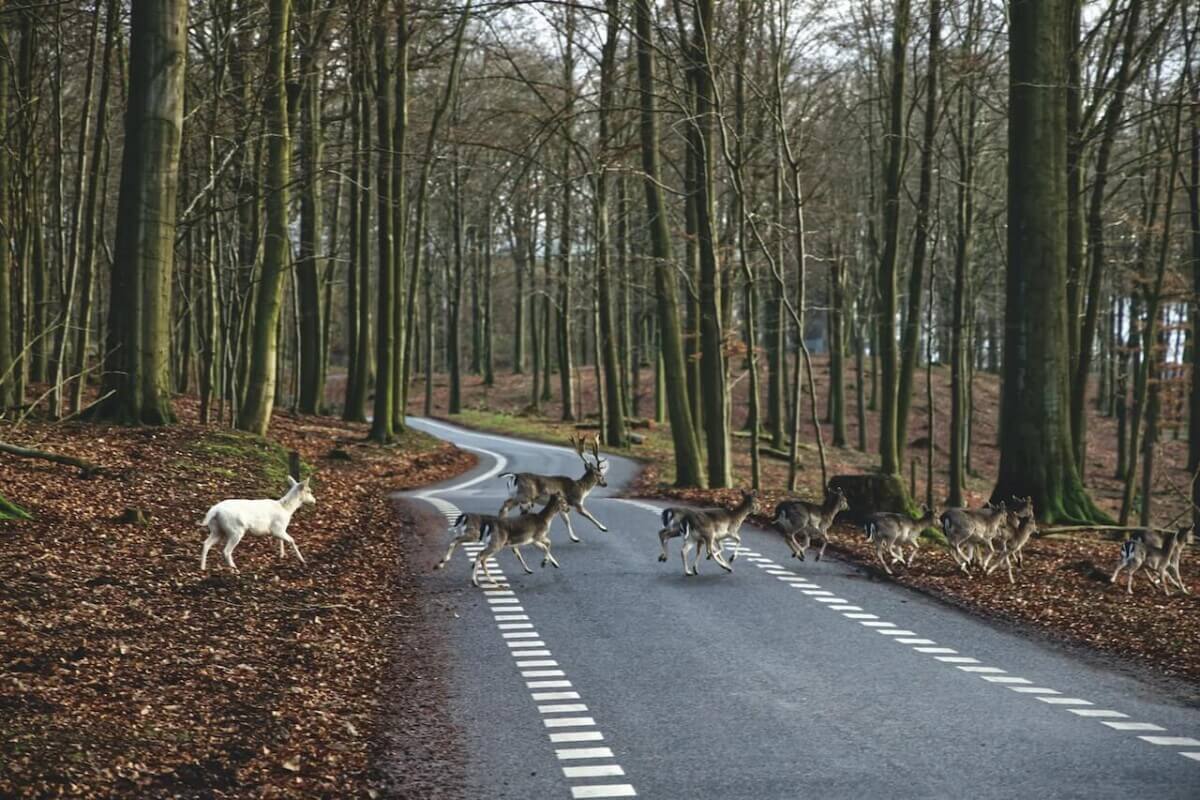
(Photo by gryffyn m from Pexels)
Animals May React to People, Not Just Roads and Cities
In A Nutshell
- A study of nearly 12 million GPS location points from 4,581 animals found that human presence alone, separate from roads or development, meaningfully changed how two-thirds of species used space.
- Many animals reacted more strongly to people in wilder, less developed areas, suggesting some urban and farm-country animals have simply adapted or have nowhere left to retreat.
- Coyotes shrank their territories around human activity while ravens expanded theirs, possibly because both exploit human food sources but coyotes face far more direct persecution.
- Researchers say managing when and where people move through wild areas, not just what gets built, could be a practical new tool for conservation.
Hikers moving through a national forest or wandering a nature trail may have no idea the animals nearby are already adjusting their behavior in response. Not because of the road at the trailhead. Because of the person walking through.
For decades, scientists studying how humans affect wildlife have focused mostly on what humans build: highways, suburbs, agricultural fields. Physical development has long been the go-to measuring stick for understanding wildlife disruption. A large-scale study published in the journal Science now shows that the movement of people through landscapes is a major and largely independent force shaping where animals go, how much ground they cover, and what habitats they use. It is not only what people have done to the land. It is where people are at any given moment.
That distinction points wildlife managers toward a different strategy centered on managing when and where people go, not just what they build.
A Pandemic Twist Gave Scientists a Rare Window Into Animal Behavior
To pull this off, researchers needed reliable data on where people actually are on a daily basis, combined with records of animal movement in the same places and times. That combination arrived courtesy of COVID-19.
During 2019 and 2020, researchers accessed mobile phone location data, made temporarily available during the pandemic, to estimate daily human presence across the continental United States. Lockdowns in 2020 created a natural experiment: when human movement dropped in many areas, the land itself stayed the same. That separation let researchers distinguish the effects of people moving through places from the effects of permanent landscape change, two things that normally go hand in hand.
On the animal side, the team compiled GPS tracking data from 4,581 individual animals across 37 species, 22 bird species and 15 mammal species, yielding roughly 11.8 million location records from January through August of both years.
More Than Two-Thirds of Species Shifted Their Behavior Around Human Activity
Human presence was linked to meaningful changes in how animals used space for 67% of mammal species and 68% of bird species. More than half of all species, 57%, were affected by both human presence and landscape modification.
For about 60% of species that responded, the two forces did not work independently. Many animals reacted more strongly to human presence in wilder areas. In heavily modified landscapes like cities or farm country, some animals appear to have adapted, or simply have nowhere left to go.
Most mammal species that showed a response, about 67%, reduced the area they used when human presence or landscape modification increased. Gray wolves were a notable exception, expanding their range in response to both. Researchers attribute this to the wolves’ long history of persecution by humans. Covering more ground may be how they stay out of trouble.
For birds, 41% pulled back when more people were present. Wild turkeys retreated in response to human presence, though less so in heavily developed areas. Great egrets showed a more layered response, with the direction of their reaction flipping depending on how modified the surrounding landscape was.
Coyotes Shrink Their Territory While Ravens Roam Farther for the Same Reason
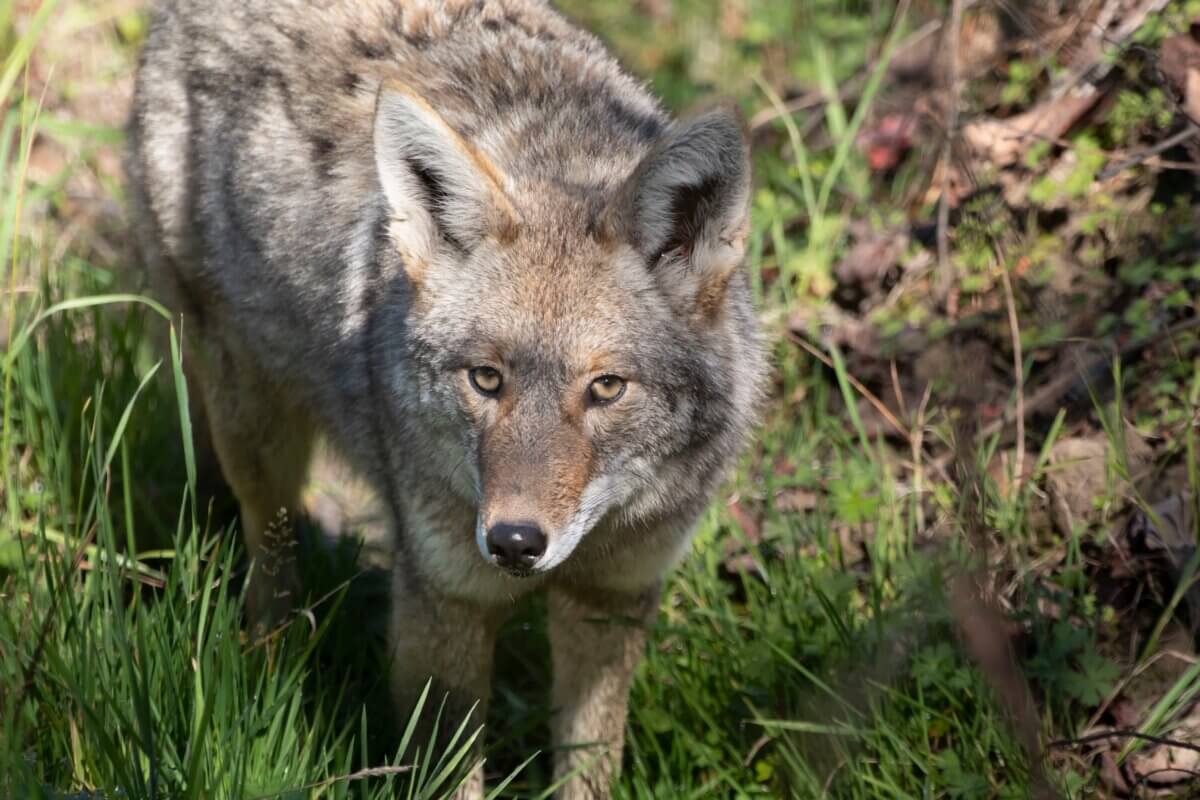
Two species appear to move in opposite directions, possibly for the same underlying reason. Coyotes used about 4.4 square miles less area per week under high human activity. Common ravens used about 10 square miles more. Both exploit food humans leave behind. Coyotes, which face active persecution in many areas, may forage close to home and under the radar. Ravens, less threatened by direct conflict with people, may roam more boldly to take advantage of those same opportunities.
Across all species with meaningful responses, mammals reduced their weekly area use by a median of 11% per animal under high human activity versus low. Birds showed a smaller median decrease of 1.8%, and the variety of environments animals used narrowed by a median of about 2.8%.
One of the study’s most telling findings comes from individual animals tracked across both years. By comparing how the same animal behaved from 2019 to 2020, researchers confirmed that individual animals adjusted in response to year-to-year shifts in human activity, based on more than 19,000 paired weekly observations from 1,251 animals across 13 species.
Wildlife Managers May Get Better Results by Controlling When People Visit, Not Just Where
Researchers are careful to note they cannot say from this data alone whether the behavioral changes are good or bad for the animals involved. Covering less ground might mean an animal is squeezed out of resources, or it might mean a well-fed animal is staying near an easy food source. Without knowing the specific nature of human activity in each location, that question stays open.
Managing when people use certain areas, rather than simply drawing lines on a map and locking places down, could offer real conservation benefits. If a critical wildlife corridor sees heavy foot traffic during the hours when animals most need to move through it, shifting that traffic pattern might help, even without any change to the physical landscape.
Wildlife has always had to share space with people. But the most consequential human presence affecting animals is not always a highway or a subdivision. Sometimes, it is just a person walking by.
Paper Notes
Limitations
The study was necessarily restricted to species large enough to carry GPS tracking devices, which excludes most smaller-bodied birds and mammals, groups that may respond quite differently to human activity. Researchers were also unable to determine from this data alone whether the behavioral changes observed represent a cost or a benefit to the animals, as that would require more detailed information about the nature of human activities in each area and data on the fitness consequences for individual animals. The spatial resolution of available human mobility data may also limit the ability to capture fine-scale behavioral responses. The authors note that the current access model for human mobility data largely prevents its full use in conservation research.
Funding and Disclosures
The study originated at the Max Planck-Yale Center for Biodiversity Movement and Global Change. It is a contribution of the COVID-19 Bio-Logging Initiative, funded in part by the Gordon and Betty Moore Foundation (grant GBMF9881) and the National Geographic Society (grant NGS-82515R-20), both to author C. Rutz. Additional funding came from NASA, the National Science Foundation, the US Geological Survey, the US Fish and Wildlife Service, the US Department of Agriculture, and numerous state wildlife agencies, private foundations, and international institutions. A full list of funding sources appears in the paper’s acknowledgments. Author C. Rutz holds advisory roles with the National Geographic Society, the International Bio-Logging Society, UNEP’s Convention on the Conservation of Migratory Species of Wild Animals, WILDLABS, MoveBON, and Save the Elephants’ Continental Tracking Initiative. Authors R.Y.O., S.W.Y., and C.R. hold advisory roles with or participate in MoveBON. No other competing interests were declared.
Publication Details
Title: Interacting effects of human presence and landscape modification on birds and mammals | Authors: Ruth Y. Oliver and Scott W. Yanco (co-first authors), Diego Ellis-Soto, Brett R. Jesmer, and a large multi-institutional team of collaborators. | Journal: Science, published May 21, 2026, Vol. 392, Issue 6800, pp. 879-884 | DOI: 10.1126/science.adq3396 | Lead author contact: [email protected] (R.Y.O.); [email protected] (S.W.Y.) | Data and code are available on the Open Science Framework at https://doi.org/10.17605/OSF.IO/3UA2C.


