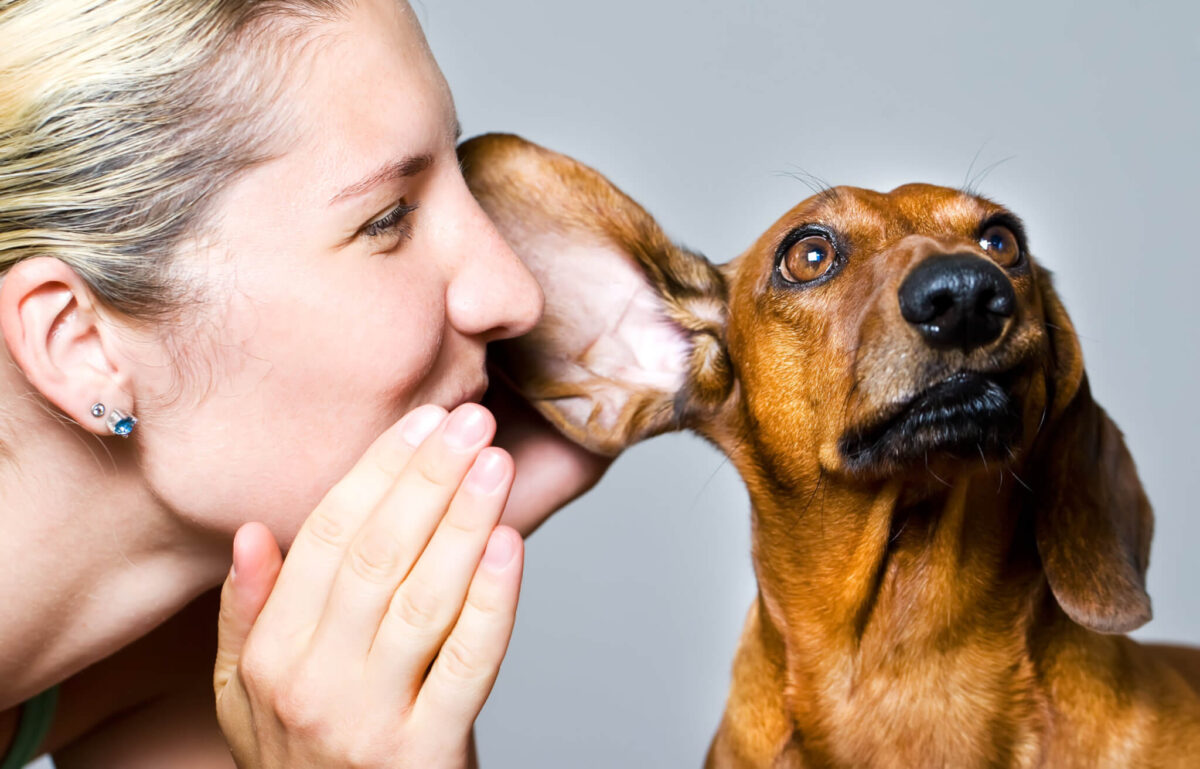
(Credit: © mariiya - stock.adobe.com)
In a Nutshell
- Researchers created a scoring system with 30 measurable categories to analyze how people talk to and interact with their pets in everyday life.
- People spoke to their pets in about 9.2 percent of all the moments researchers caught them talking, showing that pet conversations are a small but real slice of daily speech.
- The way individuals interacted with their pets varied enormously from person to person, some using baby talk and pet nicknames constantly, others rarely at all, which may help explain why pet ownership affects people’s wellbeing so differently.
A microphone tucked in a pocket, switching on at random moments no one can predict. Just the ordinary sounds of daily life, including the moment someone leans down to a dog on the couch and asks, in a voice a few octaves higher than usual, “who’s a good boy?”
That’s roughly what happened in a new study, published in Frontiers in Psychiatry, that captured 240 people going about their normal routines, gathering thousands of tiny audio snapshots of how humans actually talk to their cats and dogs during unguarded, everyday moments. The results paint a detailed picture of a habit most people never think twice about, and researchers say it could hold clues to why some people’s bonds with animals seem to boost their wellbeing while others show almost no effect.
Researchers at the University of Arizona built a new tool called AURAL-Pet (short for Audio-based Understanding of Relational Animal-directed Language) specifically to measure this behavior. The reasoning was simple: scientists have long known that owning a pet doesn’t automatically make someone happier or healthier. Some studies find pet ownership eases loneliness and depression, while others find little to no effect. One likely explanation is that not all human-pet relationships look the same day to day, and until now, there hasn’t been a good way to capture those everyday differences without people changing their behavior because they knew they were being watched.
How Scientists Captured People Talking Naturally to Their Pets
Behind this study’s honesty sits a device called the Electronically Activated Recorder, or EAR. It’s a smartphone app that randomly turns on for short bursts, roughly five times an hour, and records whatever sound is happening nearby. Participants know they’re wearing it, but they don’t know exactly when it’s recording, so over time they tend to forget about it and act naturally. Earlier research found people’s self-consciousness about the device fades within the first two hours of wearing it. That made it a good match for a project that needed real, unscripted moments rather than posed interactions in a lab or a vet’s office.
Researchers didn’t collect any brand-new recordings. Instead, they mined four existing collections of EAR data from older studies that originally had nothing to do with pets. These included groups of older adults, healthy adults practicing meditation, couples coping with breast cancer, and recently divorced or separated adults, all based in the United States. Because none of these people were recorded with pets in mind, no one was putting on a show about how they treat their animals.
Building the scoring system took a long process of trial and error. The team reviewed existing research on how people talk to animals, listened to real audio clips to find patterns worth measuring, brought in outside experts to sharpen the categories, and tested draft versions repeatedly until the system produced consistent results. They started with 55 possible categories, decided that was too many, and trimmed the list down to 30 final measures. These track things like whether someone is playing with a pet, going for a walk, giving a command, asking the pet a question, using a nickname, or slipping into what researchers call “human substitute” speech, meaning talking to the animal as if it understood full human thoughts rather than just its basic needs.
To check that the system actually worked, trained listeners independently scored the same audio clips and researchers compared how often they agreed. Out of 23 original core measures, 22 held up when two listeners’ scores were averaged together, and 14 held up even when relying on just one listener. Only one measure, which tracked whether speech was about a pet’s basic needs versus more complicated ideas, fell short and needs extra caution in future use.

What the Recordings Revealed About Talking to Pets
Once the system passed its checks, researchers applied it to every clip across the four archives that showed signs a pet was nearby, whether that meant a bark, a meow, or someone mentioning the animal directly. That amounted to 5,072 audio clips from 240 participants recorded around cats or dogs often enough to analyze. The group skewed female, with about two-thirds being women, and ages ranged from 24 to 87.
One of the clearest findings: talking to a pet is a real but modest slice of daily conversation. Averaged across everyone, people spoke to their dogs or cats in about 9.2 percent of all the moments they were caught talking to anyone or anything, whether that was another person, themselves, or a pet. That might sound small, but researchers pointed out it shows a “non-trivial role” pets play in daily verbal life, especially since these were unplanned snippets from real days.
Pets showed up in both quiet solo moments and social settings. On average, people were alone in 44 percent of their pet-related clips, with one other person present in about 36 percent, and multiple people around in about 14 percent. Pets also appeared alongside other people about as often as in solitary moments.
Perhaps the clearest pattern was just how differently individual people behaved. Across eleven speech-related categories the team measured, some participants never showed a particular behavior in any of their clips, while others showed that same behavior in every single clip researchers analyzed. Some people leaned heavily into what’s called pet-directed speech, that singsong, high-pitched voice similar to how adults talk to infants, complete with a slower pace and stretched-out vowels. Others rarely, if ever, shifted into that register. Some frequently gave their pets human nicknames like “baby” or referred to themselves as the animal’s “mom” or “dad,” a pattern researchers labeled “parental role” language, while others stuck to plainer, more practical talk focused on food, walks, or basic commands.
When researchers looked more closely at what people actually said to their pets, familiar themes emerged. People often narrated their own actions or the pet’s behavior out loud, talked about the weather, mentioned errands like going to the store, or discussed future plans, sometimes speaking to their pet almost like a sounding board for the day ahead.
Why the Way People Talk to Pets Matters for Health
It would be easy to read all this as a charming curiosity, more proof that people are a little silly about their pets. But the researchers behind AURAL-Pet see something more useful buried in these numbers. If some people consistently use more affectionate, more “human substitute” style speech with their pets while others stick to basic commands, that variation might help explain why studies on pets and human wellbeing keep landing on mixed results. A tool that can reliably measure those differences, without relying on people’s own possibly rosy accounts of how great their relationship with their pet is, gives researchers a new way to test whether different patterns of daily interaction are associated with mental health and wellbeing.
People talking to their pets surprises no one. What stands out is that scientists have finally built a reliable, bias-resistant way to measure exactly how they do it. That variety in how people speak to animals may offer one clue to understanding when, and why, living with pets is linked to better wellbeing.
Paper Notes
Limitations
The researchers noted several limits to their work. One coding category, “animal content,” did not reach the reliability threshold when based on two listeners’ averaged scores and should be interpreted cautiously or double-checked with a third coder in future work. The pet-directed speech register categories (pitch change, slower tempo, and vowel modulation) were also difficult to define with a hard, objective cutoff. Because the audio clips were short, sometimes just 30 or 50 seconds, some interactions may have been cut off before finishing, though the researchers note this concern is partly offset by using many clips per participant over time. The recordings had no visual component, which introduced ambiguity, and researchers ultimately found they could not reliably tell dog sounds from cat sounds except when clear vocalizations like barking or meowing occurred, so they dropped species-specific coding. Because the data came from archives not originally collected to study pets, researchers could not always confirm whether a nearby animal was actually the participant’s own pet, so they use the term “pet-adjacent” rather than “pet owner” throughout. The system was also built and tested only on English-language interactions with dogs and cats, so its reliability with other languages or other animal species remains unknown. Finally, because the study was exploratory and made no specific predictions in advance, the authors say the differences observed across age groups and genders should be seen as groundwork for future research rather than firm conclusions.
Funding and Disclosures
The authors reported that financial support for the original archival data collection came from the Mind and Life Institute, the National Institutes of Health, the National Cancer Institute, and the National Institute of Child Health and Human Development. The Waltham Petcare Science Institute and Mars Petcare funded the creation of the AURAL-Pet manuscript; the authors state they reviewed the manuscript for accuracy but had no role in the study’s design, data collection, analysis, or decision to publish. The authors declared no commercial or financial conflicts of interest and stated that they did not use generative AI to create the manuscript.
Publication Details
Paper Title: “Cross-species conversations: the development of the AURAL-Pet coding system to capture how people talk to pets in daily life”
Authors: Dara S. Jonkoski, Nicole M. Lorig, Molly C. Delzio, Alyssa Klensin, Abigail Marsters, Huashi Li, Amanda M. Bernal, Matthias R. Mehl, Kerri E. Rodriguez, and Emily E. Bray, affiliated with the University of Arizona.
Journal: Frontiers in Psychiatry, August 4, 2026 (Front. Psychiatry 17:1881870)


