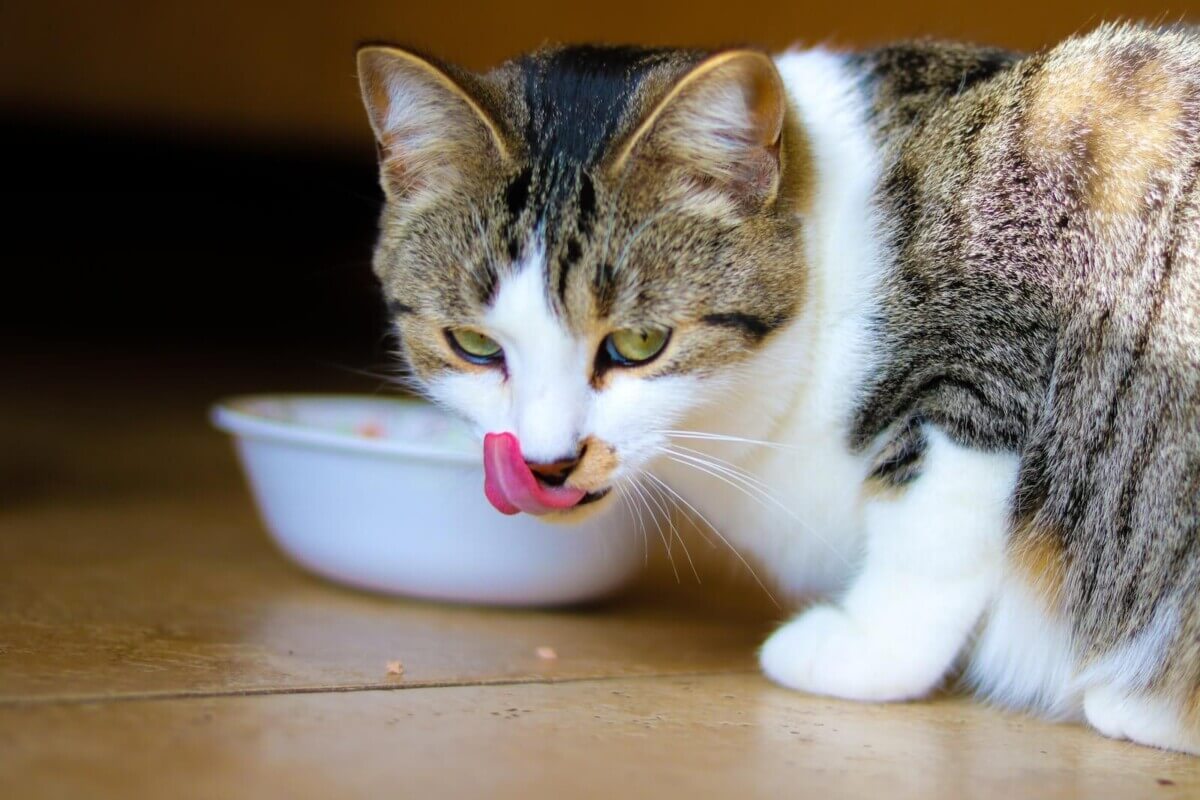
(Photo by Abeer Zaki on Unsplash)
In A Nutshell
- Vegan-fed cats had 34% lower odds of being labeled overweight, per owner reports in a 1,305-cat survey.
- That result was not statistically reliable, with only four vegan-fed cats overweight.
- No vegan-fed cat had arthritis or other mobility problems, but only 127 ate vegan food.
- Survey data cannot prove diet caused the gap or that vegan diets met nutritional needs.
Cats eating vegan food had 34% lower odds of being labeled overweight by their vets than cats eating traditional meat-based diets, according to what owners reported in a survey of 1,305 cats. Not a single vegan-fed cat was reported to have arthritis, disc disease, or other mobility problems that researchers tracked. The catch is that the scientists behind the work aren’t ready to call it proof of anything.
Published in Frontiers in Animal Science, the study compared reports from owners of 1,178 cats on conventional meat-based diets and 127 cats on vegan diets, all fed that way for at least a year. Researchers adjusted for age, sex, neuter status, activity level, and feeding habits before landing on the 34% figure. Lower odds roughly means a lower chance.
Statistically, that number is shaky. Only four vegan-fed cats were reported overweight, and the range of plausible results ran from 82% lower to 142% higher, so chance alone could explain the gap. Because owners simply reported what had already happened, the survey also cannot show that diet caused any difference. Still, every version of the analysis leaned the same direction, and extra weight ranks among the most commonly diagnosed problems in pet cats.
Vegan Cat Diets Survey Relied on Owners Recruited Online in 2020
Data came from an online survey open from May to December 2020, shared through social media pet groups and paid Facebook ads. Some outreach targeted unconventional-diet groups to recruit enough vegan-feeding owners. Owners described one cat that had lived with them at least a year, including its diet, weight, activity level, and any health problems a vet flagged in the past year.
Cats qualified only if owners reported a conventional meat-based diet or a vegan one, meaning no animal products at all. Cats on raw meat, vegetarian, insect-based, or unclear diets were left out of the main analysis, and the researchers never independently verified what owners said their cats ate.
Owners were 90% women, and 91% lived in the United Kingdom or elsewhere in Europe. Cats averaged 8 years old, though vegan-fed cats skewed younger (6.2 years versus 8.2), a gap the researchers adjusted for.

Owners Said Vets Flagged Fewer Overweight Cats Among Vegan-Fed Pets
Before any adjusting, owners said vets had labeled 4.1% of meat-fed cats overweight versus 3.1% of vegan-fed cats. Underweight showed a similar pattern, at 2.3% versus 0.8%, which was a single vegan-fed cat. Comparisons put the drop in odds of being underweight between 50% and 66%, depending on the method, but those numbers were not statistically reliable either.
Mobility and muscle problems looked even better on paper. Arthritis turned up in 15 meat-fed cats, with disc disease and other movement problems in more, while vegan-fed cats had none. With only 127 cats in that group, though, rare conditions had little chance to appear, and the authors warned against reading that zero as protection.
Feeding habits made the weight result more surprising. Vegan-fed cats were far more likely to eat mostly dry food (79%) and to have food available around the clock (53% versus 36%), both habits tied to weight gain in earlier research. Odds of being overweight stayed lower after the researchers accounted for those habits. With so few overweight cases to work from, however, the authors said they could not tell whether diet itself changed that link.
Possible reasons, floated by the authors for future testing, include vegan formulas carrying more fiber, fewer calories, or more L-carnitine, a nutrient that helps cats keep lean muscle. Without food data, that remains guesswork.
Owners Saw Far More Weight Problems Than Vets Did in Both Diet Groups
Vets and owners disagreed on how many cats were at an ideal weight. Vets rated 94% of meat-fed cats and 96% of vegan-fed cats as ideal, while owners said 70% and 76%. Owners flagged far more cats as overweight or underweight, the reverse of the usual pattern, in which owners tend to miss extra weight.
Two explanations came from the authors. Owners who answer pet health surveys may be more health-conscious or anxious, and vets don’t always raise weight during visits, so a concern only counted if the owner remembered hearing it. True vet concern, the authors wrote, was probably higher than reported.
Authors Call Vegan Cat Diets Results a Starting Point, Not Proof
Everything rested on owners recalling what their vets said, rather than on medical records or standardized weight checks. Owners who choose vegan food for a cat may also watch its health more closely in ways the survey could not capture. Cats that got sick on a vegan diet may have been switched back before the survey, leaving a healthier group behind. The foods’ nutritional content was never assessed either, so the survey cannot say whether the vegan diets met cats’ nutritional needs.
In the authors’ words, the findings “should be interpreted cautiously and considered exploratory.” Their suggested next step is a study that follows cats over time and pulls weights straight from vet records.
Vegan-fed cats had fewer reported weight and mobility problems, but 127 cats cannot carry a verdict. The 34% figure is a lead worth testing, nothing more.
Disclaimer: This article summarizes one published study and is not veterinary advice. Pet owners should consult a veterinarian before changing a cat’s diet.
Paper Notes
Limitations
Because the research was observational and relied on owners reporting information, including what they remembered their vets saying, differences in weight between diet groups may reflect unmeasured factors such as how owners manage their cats’ lifestyles. The brand of food was not collected, and homemade food was not analyzed separately, though the authors report that homemade diets have been linked to lower odds of overweight in other research. Diet categories were self-reported and not independently verified, and nutritional composition was not assessed. Owner-reported weight assessments are not the same as a standardized veterinary body condition score and, according to other research, tend to underestimate overweight. The small number of vegan-fed cats, and the very low number with the tracked conditions, limited statistical power and made some comparisons impossible. Only the overweight outcome had enough cases for a fully adjusted model, and even that fell short of a common rule of thumb for how many cases such models need. The study covered only weight-related muscle, movement, and nerve conditions, leaving out diabetes, urinary, heart, and skin problems. The authors also named possible bias from owners committed to a particular diet reporting more favorable outcomes, and from cats that developed problems on a vegan diet being switched before the survey.
Funding and Disclosures
The authors declared that no financial support was received for the work or its publication, and that the research was conducted without commercial or financial relationships that could be seen as a conflict of interest. Andrew Knight, Alexander Bauer, and Jenny L. Mace each list an affiliation with the Sustainable Pet Food Foundation in London, and Mace also lists Mace Animal Welfare in Edinburgh. The survey received ethics approval from the University of Winchester, and participants gave written informed consent. The authors stated that generative AI was not used in creating the manuscript.
Publication Details
The study, “Impacts of a vegan diet on body weight and related health disorders in 1,305 cats: an exploratory cross-sectional survey,” was written by Andrew Knight (Murdoch University, Griffith University, University of Winchester, and the Sustainable Pet Food Foundation), Alexander Bauer (Sustainable Pet Food Foundation), and Jenny L. Mace (Sustainable Pet Food Foundation, University of St Andrews, and Mace Animal Welfare), who is the corresponding author. It appeared in the open-access journal Frontiers in Animal Science, volume 7, article 1939965, on October 8, 2026, after being received July 16 and accepted September 11. DOI: 10.3389/fanim.2026.1939965.


