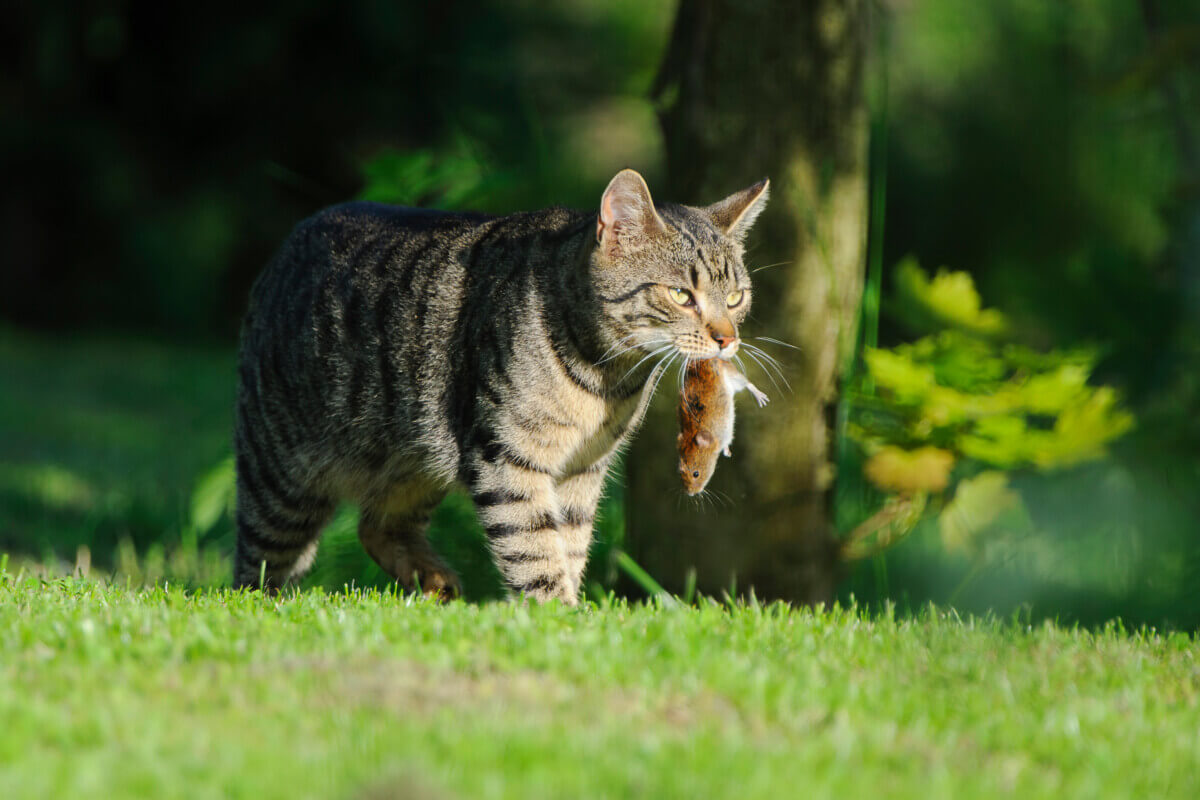
(© Romuald - stock.adobe.com)
In A Nutshell
- The gift theory remains unproven: Studies track where prey ends up, not what cats intend when they carry a catch home.
- Most prey never comes home: Cats wearing small video cameras brought home 23% of the animals they caught. They left the rest where they caught it or ate it.
- Food and play may cut returns: In a household trial in the United Kingdom, cats brought home fewer animals after owners added daily play or switched to a high-meat food.
- Limiting hunting is more reliable: Ohio State University guidance recommends enriching indoor spaces and allowing only controlled outdoor time.
A mouse on the kitchen floor is often described as a grisly present. You may have heard that cats bring prey home as gifts, or because they think people can’t hunt. The evidence points to a less flattering explanation.
Home is a cat’s familiar territory, and the owner may simply be the one who finds what arrives there.
Why Does Prey Sometimes End Up Indoors?
Mostly, the evidence points to cats carrying a catch somewhere safe, and home is often that place.
The clearest look at what happens after a catch comes from a 2013 study in Biological Conservation. University of Georgia researchers put small video cameras, called KittyCams, on 55 pet cats that roamed freely around suburban Athens, Georgia. The study ran for one year. Each cat wore a camera for 7 to 10 days, and the camera recorded everything it did outdoors. Of the animals the cats caught, they brought home 23%, left 49% where they caught them and ate 28%.
Since most prey never reached the house, it’s hard to argue that the cats were hunting for their owners. Still, the cameras recorded what happened to the prey, not what the cats intended. They can’t tell us why any one cat carried a mouse across the threshold.
The British cat charity Cats Protection offers a simpler reason. Home is a cat’s core territory, the place where it feels safe. A cat may carry a catch there so it can eat in peace, store it for later or keep other animals from stealing it.
Sharing also fits poorly with how cats live. A 2004 paper in the Journal of Feline Medicine and Surgery, led by Sharon Crowell-Davis of the University of Georgia, explains that cats hunt alone because of what they hunt. A free-living cat needs several small rodents a day just to feed itself. Sharing a kill the way animals that hunt large game do is impractical for cats.
Individual cats also differ. A 2023 study in Ecology and Evolution surveyed 2,508 cat owners in France through cat-focused Facebook groups. For the questions about prey, the researchers analyzed 719 adult cats that went outdoors every day. Owners reported more birds and small mammals brought home by cats they rated high in “extraversion” (smart, alert and persistent) and low in “neuroticism” (shy and fearful of other cats). Cats that spent more time outdoors also brought home more prey, as did cats in rural or suburban areas rather than cities.
The study has limits. It relied on owners’ estimates from a self-selected online sample, so it shows links, not cause and effect. The researchers also note they couldn’t tell whether personality matters because it changes how long cats stay outside, how motivated they are to hunt or how good they are at it.

Can Food Or Play Change The Pattern?
Yes, sometimes, though not every fix worked.
In a 2021 trial published in Current Biology, University of Exeter researchers worked with cat-owning households in the United Kingdom. Each household tried one change, such as a new food, daily play, a puzzle feeder or a collar bell. The researchers compared the animals each household’s cat brought home to a control group that changed nothing and to that household’s own counts from before the trial.
Cats fed a grain-free food with meat as the main protein source brought home 36% fewer animals. Cats whose owners added 5 to 10 minutes of play with toys each day brought home 25% fewer. Puzzle feeders, which make cats work to get their food, went the other way, with a 33% increase. Bells had no clear effect.
The trial counted animals brought home, not every hunt. The researchers suggest food and play reduce a cat’s urge to hunt. But counts at the door can’t fully separate fewer hunts from fewer successful catches or fewer trips home with a catch.
Could Cats Be Trying To Teach People?
Plausible at first glance, but unproven.
The idea comes from mother cats. The 2004 Journal of Feline Medicine and Surgery paper reports that free-living mothers start bringing prey to their kittens when the kittens are about 4 weeks old. At first, the mother brings dead prey. Later, she brings live prey and releases it at the nest so the kittens can practice hunting and killing.
That evidence concerns mothers feeding and training their own young at a nest. It does not show that adult pet cats see people as kittens, judge their hunting skills or try to give them lessons.
What’s The Practical Takeaway?
Preventing unsupervised hunting works better than trying to decode the delivery.
The Ohio State University’s Indoor Pet Initiative, run by its College of Veterinary Medicine, offers guidance for owners moving outdoor cats indoors. It recommends hiding places, perches near windows, scratching posts and a set play time each day with interactive toys. For cats that still want to be outside, it suggests leash walks with a harness, a sun porch or a screened enclosure.
If a carcass does arrive, the University of New Hampshire Cooperative Extension advises wearing heavy protective gloves to move any dead animal. The rabies virus can survive in saliva and nerve tissue for hours after an infected animal dies. An animal that looks dead may also not be, and it could still bite.
Keep the cat away from it, too. The American Veterinary Medical Association lists exposure to infected wild birds as one way cats catch H5N1 bird flu, which often kills cats that get it.
If the animal is still alive, Cornell University’s wildlife hospital advises contacting a licensed wildlife rehabilitator. If you can do so safely, place the animal in a box or pet carrier and keep it somewhere quiet, dark and warm, away from children and pets. Don’t give it food or water unless a wildlife professional says to. American Bird Conservancy says birds caught by cats need a rehabilitator right away to survive. If you can’t reach one, your state wildlife agency can help.
A carcass on the floor is evidence of a hunt, not proof of a present. An old hunting instinct carried the catch through a modern doorway into familiar territory, where the person who fills the food bowl happened to find it.


