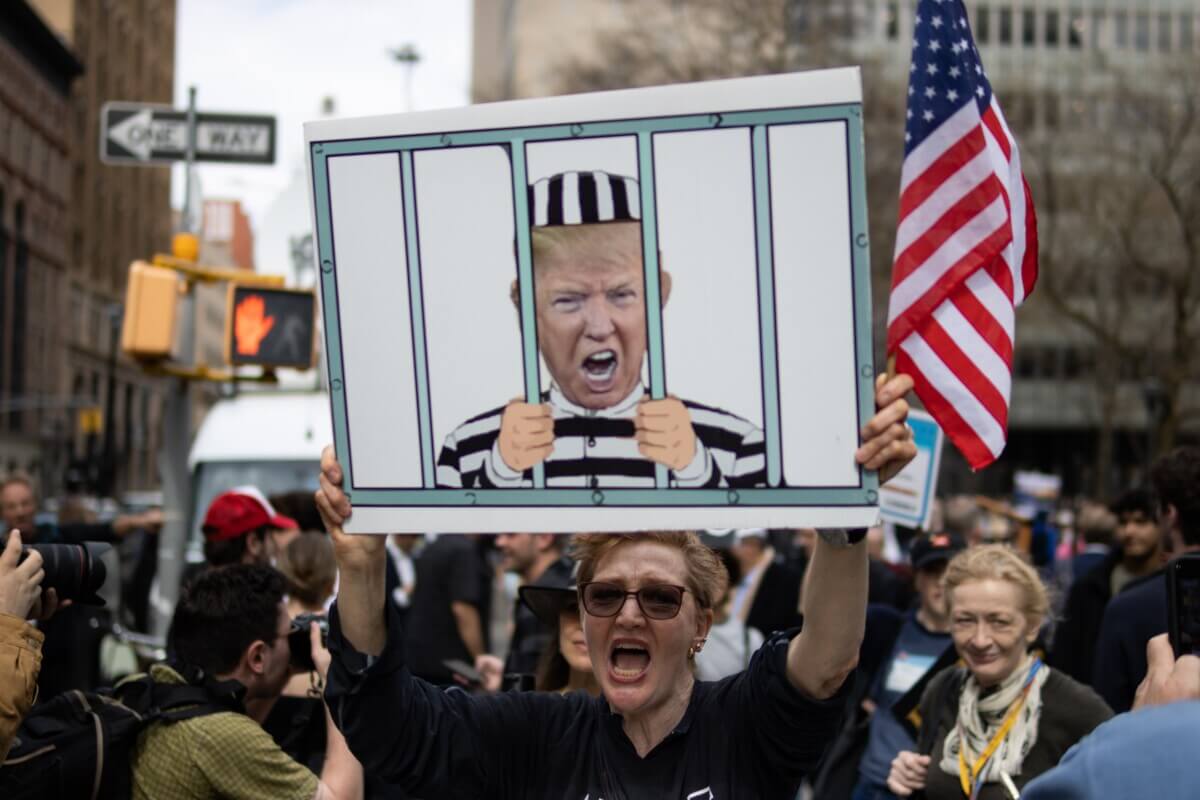
New York, New York USA - April 4 2023: Woman Counter Protester with a Sign of Trump in Jail Outside the Courthouse during the Trump Indictment in New York City (Photo by James Andrews1 on Shutterstock)
Study Shows What’s Driving More Americans Than Ever To March, Chant, and Demonstrate
In A Nutshell
- Protest surge: Since 2017, the number of nonviolent demonstrations in the U.S. has nearly tripled, with millions taking part in movements from Black Lives Matter to the 2025 No Kings protests.
- Polarization as fuel: New research published in Social Forces shows that partisan anger, or dislike of the opposing party, is a stronger motivator for protest than policy concerns alone.
- Real-world effect: Political polarization doesn’t just shape opinions, it drives Americans into the streets, turning anger into visible action.
- Broader significance: With nearly 1 in 10 Americans reporting protest participation in 2020, demonstrations are no longer rare events; they’re becoming routine expressions of political division.
Protests are becoming a routine part of public life in the United States. Since 2017, the number of nonviolent demonstrations has almost tripled, according to researchers with the nonprofit Crowd Counting Consortium.
And more people are joining than ever. The Black Lives Matter marches in 2020, after George Floyd was killed by police in Minneapolis, have been described as the largest nonviolent mobilization in U.S. history. The No Kings protests against Trump administration policies on June 14, 2025, were not far behind, with between 2 million and 4.8 million Americans protesting nationwide
What explains this surge of protest activity?
My research shows that polarization – the extent to which people dislike members of the opposing party – is a key driver. Today political polarization, as reflected by the ratings Americans give to the political parties, continues to be at its highest level since political scientists began using the measure in 1964.
I am an expert on political behavior, and my work analyzes how polarization shapes public life. In a recent article published in the journal Social Forces, I analyzed surveys conducted between 2014 and 2021 that asked Americans whether they had joined protests connected to Black Lives Matter, the climate movement or the tea party, the small-government movement that was active in the early 2010s.
These surveys, which include over 14,000 respondents, make it possible to see what separates people who protest from those who stay home.
The data points to a clear pattern: Anger at the other side motivates protest. People who rated the opposing party more negatively at one point in time were much more likely to take part in demonstrations in the years that followed.

Dislike For The Other Side Spurs Protests
Importantly, I found that partisan animosity was a strong motivator for taking part in protests, even after taking people’s feelings about the issues into account. In the surveys, respondents were asked detailed questions about their views on the movements’ topics: for example, whether white Americans enjoyed advantages that Black Americans did not, or how serious a problem they thought climate change was and whether it was caused by human activity.
This allowed me to calculate how much protest activity was due to partisan anger and how much was simply a result of policy concerns. The results surprised me.
For the two higher-profile movements – Black Lives Matter and the tea party – partisan animosity mattered for protest a little more than half as much as people’s feelings about racial inequality or government spending, respectively. For climate protests, the effect of partisan anger was even greater. How people felt toward the “other side” mattered 2½ times more for their decision to protest than did concern about climate change.
This finding matters because it shows that polarization is not just about what people think. It also changes how they participate in politics.
What’s known as “affective polarization,” or the tendency for partisans to dislike and distrust each other, has already been shown to affect how people view U.S. political parties and their willingness to be friends across party lines. My study showed that this kind of division also increases people’s real-world engagement with politics.
When partisans feel threatened or angry at the opposing side, they don’t just complain about it. They organize, hit the streets and march.
More Division, More Marches
The polarized nature of protest also helps explain why some of today’s protests address multiple issues. The No Kings protests in June 2025, for instance, challenged a number of actions, including funding cuts to social programs, ICE deportations and the deployment of troops in Los Angeles.
But the “King” in question was always clear: President Donald Trump. Protesters may not have shared identical or extreme views on every issue, but they were united by their opposition to Trump.
Protest has long been an infrequent activity, but that’s changing. In the 2020 American National Election Study, nearly 1 in 10 Americans said they had joined a protest in the past year, the highest figure recorded on that survey since the question was first asked in 1976.
That level of participation makes protest one of the most visible ways Americans now engage in politics. As polarization remains high, there is every reason to expect it will continue – starting with another nationwide No Kings protest planned for Oct. 18, 2025.
Seth Warner, Assistant Professor of Political Science, University of Connecticut. The author has attended public events for social movements mentioned in this article. These experiences did not involve any funding, employment, or formal affiliation, and the analysis presented here is guided by academic standards of objectivity and evidence-based research.
This article is republished from The Conversation under a Creative Commons license. Read the original article.


