
(Photo by Jacob Lund on Shutterstock)
Take a look at your bicep and picture it as a sponge filled with water. When you flex, the sponge contracts, squeezing out water. This simple analogy captures an intriguing new understanding of how muscles work, according to a recent study. Scientists from the University of Michigan and Harvard University have discovered that the internal fluid dynamics of muscle fibers play a crucial role in determining how fast and powerfully muscles can contract.
For decades, researchers have focused on the microscopic molecular motors within muscle cells as the primary drivers of muscle contraction. These motors, made of proteins called actin and myosin, slide past each other to generate force. However, this new research suggests that the story is more complex and involves the entire three-dimensional structure of muscle fibers, including the fluid within them.
How water works with muscle fibers
The study’s authors, Suraj Shankar and L. Mahadevan, developed a theoretical model that treats muscle fibers as “active sponges.” This model integrates the behavior of molecular motors with the elastic properties of the muscle’s internal structure and the flow of fluid within it. Their findings, published in the journal Nature Physics, reveal that the speed of muscle contraction is limited not just by how quickly the molecular motors can work, but also by how fast fluid can move through the muscle fiber.

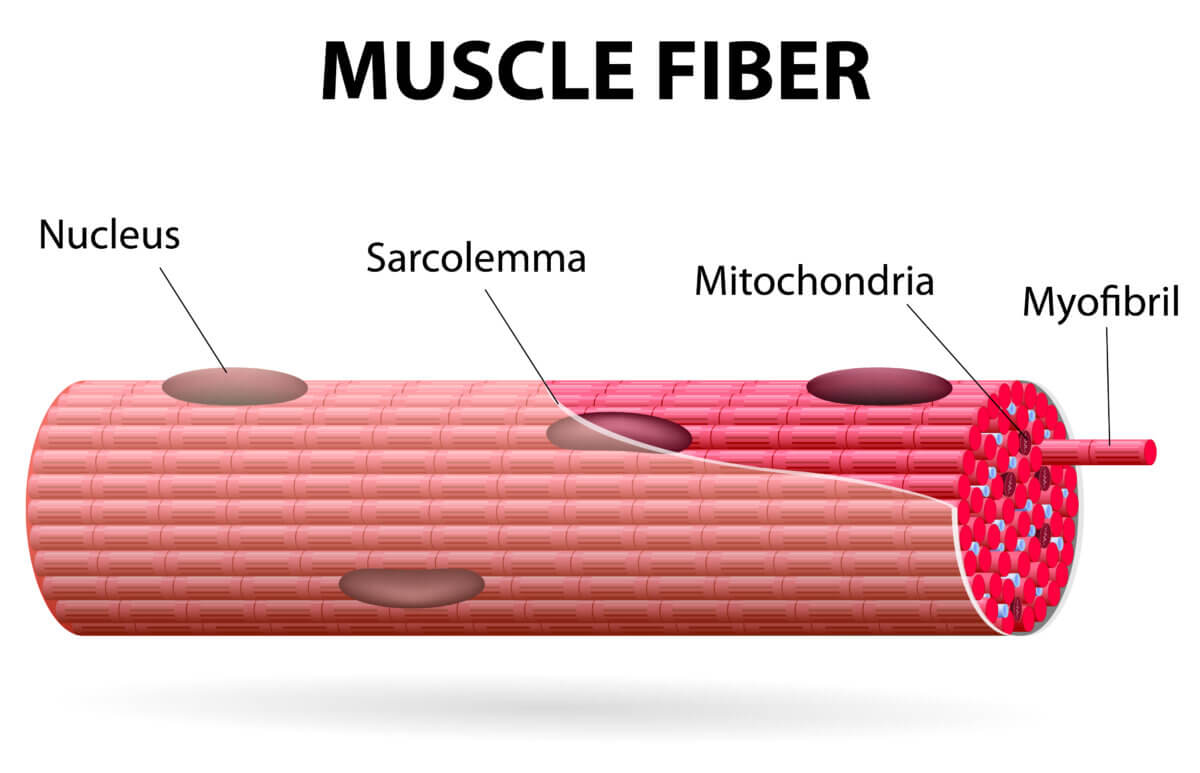
“Muscle fibers are composed of many components, such as various proteins, cell nuclei, organelles such as mitochondria, and molecular motors such as myosin that convert chemical fuel into motion and drive muscle contraction,” explains Shankar, a physicist at Michigan, in a statement. “All of these components form a porous network that is bathed in water. So an appropriate, coarse-grained description for muscle is that of an active sponge.”
This fluid movement, which the researchers call “active hydraulics,” sets an upper limit on how rapidly muscles can contract. For some extremely fast muscles, such as those used by certain insects for flight, this hydraulic limit may be the primary factor determining contraction speed.
“In these cases, we found that fluid flows within the muscle fiber are important and our mechanism of active hydraulics is likely to limit the fastest rates of contraction,” Shankar notes. “Some insects such as mosquitos seem to be close to our theoretically predicted limit, but direct experimental testing is needed to check and challenge our predictions.”
The implications of this discovery extend beyond just understanding how muscles work. It could lead to new approaches in designing artificial muscles or treating muscle disorders. For instance, conditions that affect the internal structure of muscle fibers or alter their fluid content might impact muscle function in ways not previously considered.
‘Odd elasticity’
Another fascinating aspect of the study is the revelation that muscles behave in a “nonreciprocal” manner, which the researchers term “odd elasticity.” In simple terms, this means that the force a muscle generates when stretched in one direction is not necessarily equal and opposite to the force it produces when compressed in the opposite direction. This property allows muscles to function as tiny engines, potentially generating power from cycles of stretching and compressing in different directions.
“Unlike the rubber band, when muscle contracts and relaxes along its length, it also bulges out perpendicularly, and its energy does not stay the same,” says Shankar. “This allows muscle fibers to generate power from repetitive deformations, behaving as a soft engine.”
This nonreciprocal behavior could be particularly important in understanding how muscles work in complex, three-dimensional movements. It suggests that the way we use our muscles in everyday life – with constant changes in direction and force – might be more efficient and powerful than previously thought.

The researchers’ model also helps explain some puzzling observations from previous experiments. For instance, it accounts for why muscle fibers sometimes change volume when they contract, a phenomenon that doesn’t fit with older models of muscle function.
While this research is still theoretical, it opens up new avenues for experimental work. Future studies could directly measure fluid flow within contracting muscles or investigate how altering a muscle’s internal structure affects its performance.
“Our results suggest that even such basic questions as how quickly muscle can contract or how many ways muscle can generate power have new and unexpected answers when one takes a more integrated and holistic view of muscle as a complex and hierarchically organized material rather than just a bag of molecules,” Shankar concludes. “Muscle is more than the sum of its parts.”
Paper Summary
Methodology
The researchers developed a theoretical model that combines several aspects of muscle physiology, treating muscle fibers as “poroelastic” materials – essentially, sponge-like structures that can deform and allow fluid to flow through them. They then used this model to predict muscle behavior under various conditions and compared these predictions to existing data from multiple organisms across mammals, insects, birds, fish, and reptiles, focusing on animals that use muscles for very fast motions.
Results
The model predicted several key findings:
- There is a maximum speed at which muscles can contract, limited by how quickly fluid can move within the muscle fiber.
- Muscles exhibit “odd elasticity,” allowing them to generate power through cycles of stretching and compressing in different directions.
- The model explains previously observed phenomena, such as volume changes in contracting muscle fibers.
- In smaller organisms like flying insects, fluid flows within muscle fibers are crucial for rapid contractions.
Limitations
As this is a theoretical study, its predictions need to be confirmed by direct experimental observations. The researchers acknowledge that “direct experimental testing is needed to check and challenge our predictions.” The model also simplifies some aspects of muscle physiology and may not capture all the complexities of real muscle tissue.
Discussion and Takeaways
This study suggests a new way of thinking about muscle function that integrates molecular, structural, and fluid dynamics. It proposes that the internal fluid movement in muscles is a crucial factor in determining muscle performance, especially for very fast contractions. The concept of “odd elasticity” in muscles opens up new possibilities for understanding how muscles generate and use energy efficiently. These insights could have implications for fields ranging from sports science to the treatment of muscle disorders and the design of artificial muscles. As Shankar notes, “These results are in contrast to prevailing thought, which focuses on molecular details and neglects the fact that muscles are long and filamentous, are hydrated, and have processes on multiple scales.”
Funding and Disclosures
The study was supported by the Harvard Society of Fellows, the NSF-Simons Center for Mathematical and Statistical Analysis of Biology, the Simons Foundation, and the Henri Seydoux Fund. The authors declared no competing interests.


