
Artist's illustration of Venus. (© Igor_Filonenko - stock.adobe.com)
COLOGNE, Germany — A major Venusian mystery has finally been solved. For the first time, German astronomers have detected measurable levels of atomic oxygen in Venus’ atmosphere.
Earth and Venus, two planets in our solar system that share striking similarities in size and age, have long intrigued scientists. While Earth boasts a vibrant blue sky, life-sustaining oceans, and a breathable atmosphere rich in oxygen, Venus presents a starkly different picture. Venus is enveloped by a dense cloud cover, and its atmosphere is composed primarily of carbon dioxide, nitrogen, and various trace gases, making it inhospitable to life as we know it.
In a historic moment, scientists directly measured the concentration of atomic oxygen in the planet’s atmosphere using the “upgraded German Receiver for Astronomy at Terahertz Frequencies” (upGREAT), a far-infrared spectrometer mounted on the Stratospheric Observatory for Infrared Astronomy (SOFIA).

Venus’ atmosphere harbors two distinct, powerful atmospheric currents. Winds below approximately 70 kilometers blow in the opposite direction of the planet’s rotation with hurricane-force strength. In contrast, above 120 kilometers, strong winds flow in the same direction as Venus’ rotation. In between these opposing currents lies a layer of atomic oxygen.
This layer of atomic oxygen is formed through a process initiated by ultraviolet radiation from the Sun. This radiation breaks down carbon dioxide and carbon monoxide in Venus’ atmosphere, resulting in the creation of atomic oxygen and other chemical products.
Until now, measurements of atomic oxygen in Venus’ atmosphere relied on indirect methods and photochemical models. However, in November 2021, a collaborative effort involving researchers from the DLR Institute of Optical Sensor Systems, the Max Planck Institute for Radio Astronomy, and the University of Cologne achieved a breakthrough by directly detecting highly reactive oxygen atoms in Venus’s atmosphere. This milestone was made possible through the use of the upGREAT spectrometer on SOFIA.
“The measurements were particularly challenging because Venus could only be observed with SOFIA for approximately 20 minutes on three days and was only slightly above the horizon,” explains study first author Heinz-Wilhelm Hübers, director of the DLR Institute of Optical Sensor Systems, in a media release. “Thanks to upGREAT’s outstanding measurement sensitivity and SOFIA’s unique capabilities, it was possible to create a map of the oxygen distribution on Venus.”
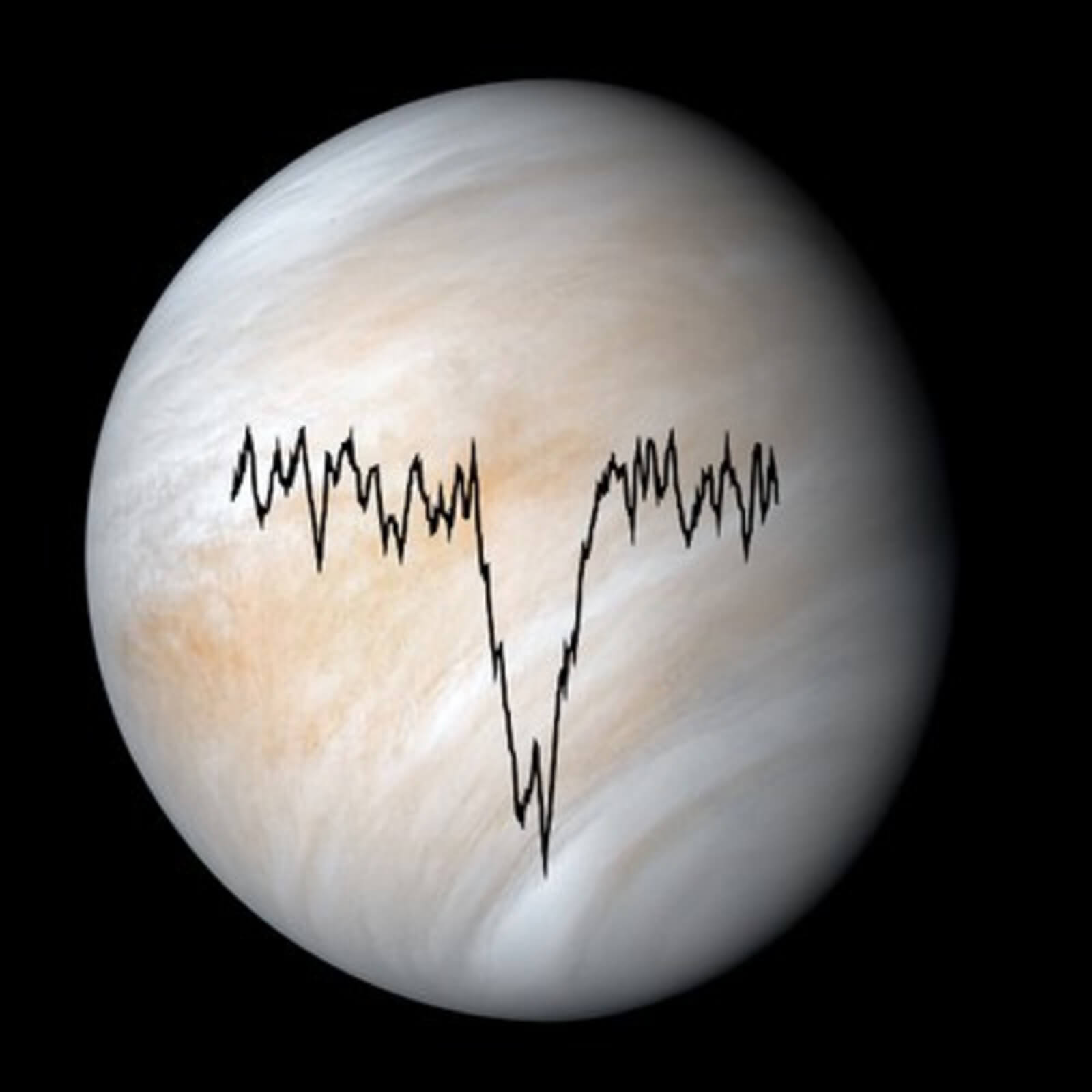
Researchers measured emissions from Venus in a narrow frequency range of around 4.74 terahertz (THz), equivalent to a wavelength of 63.2 micrometers. Atomic oxygen in Venus’ atmosphere absorbs this radiation, similar to the way Fraunhofer lines in the solar spectrum indicate atoms in the sun’s atmosphere. In the terahertz spectrum of Venus, an absorption line appeared, characterizing the presence of atomic oxygen. The strength and shape of this absorption signal provided insights into the quantity and temperature of atomic oxygen.
The research revealed that atomic oxygen is produced on the day side of Venus, and its concentration decreases with diminishing solar radiation. On the night side, local increases in concentration suggest an enrichment of atomic oxygen due to wind currents. This atomic oxygen primarily exists at an altitude layer around 100 kilometers and spans temperatures from approximately minus 120 degrees Celsius on the day side to minus 160 degrees Celsius on the night side. Its concentration is approximately ten times lower than in Earth’s atmosphere.
The study is published in the journal Nature Communications.


