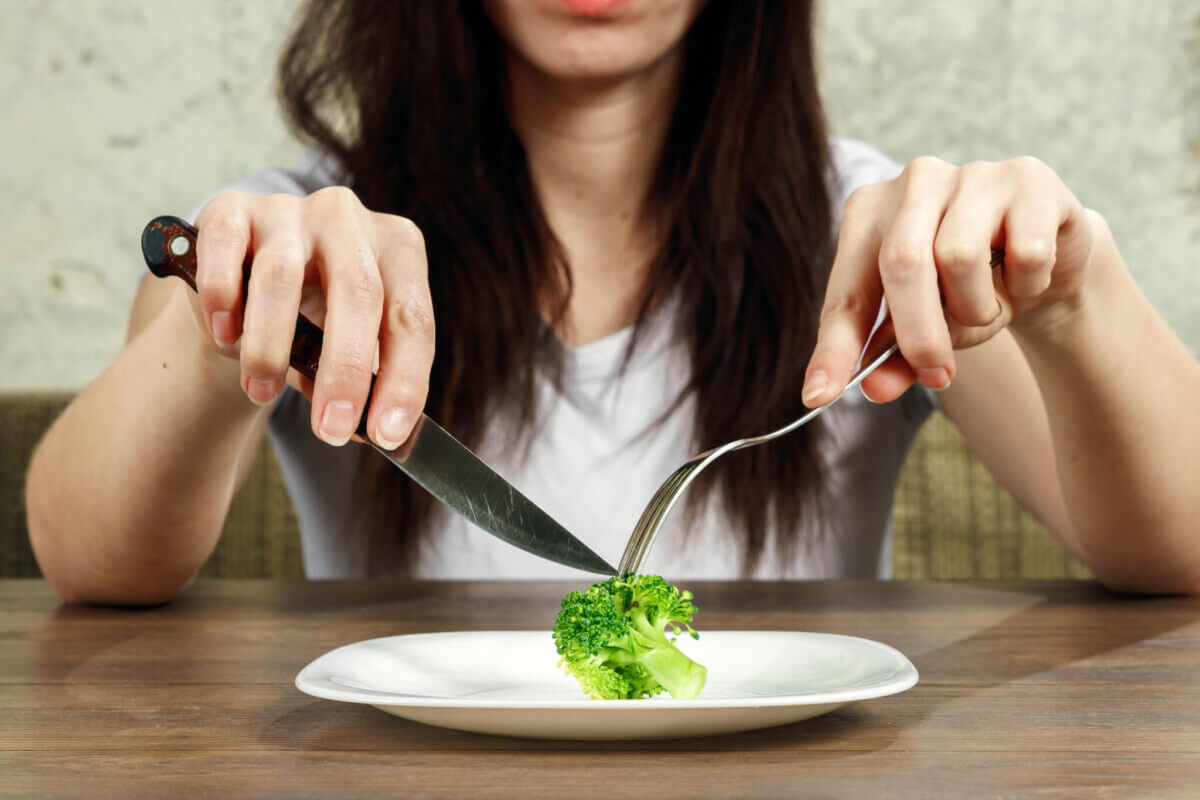
(© markoaliaksandr - stock.adobe.com)
Study Shows How Society ‘Celebrates’ Little-Known Eating Disorder Without Realizing It
In A Nutshell
- Orthorexia is an obsession with “healthy” eating that can damage health and relationships.
- Because it looks like discipline and self-care, it often goes unnoticed or even praised.
- People describe intense anxiety, isolation, and physical harm despite eating “clean.”
- Researchers argue the problem reflects wider cultural pressures around health and morality.
A clean diet hardly sounds like a health problem, but as the old saying goes, too much of a good thing can quickly turn bleak. Enter orthorexia nervosa.
People complimented her diet constantly. Friends admired her discipline. On social media, she received hearts and positive comments for her “clean eating” posts. From the outside, she looked like the picture of wellness: glowing with virtue, dedicated to her body, a model of self-control.
Inside, she was falling apart. Her hair was thinning. She’d stopped menstruating months ago. She ate alone to avoid the anxiety of restaurant meals and had quietly stopped attending family gatherings. Her daughter eventually stopped speaking to her for a year.
Her story echoes accounts described across recent research on orthorexia nervosa. “People often compliment my diet… it looks very healthy… but the behavior itself is not,” one person told researchers.
Unlike anorexia or bulimia, which most people recognize as dangerous, orthorexia nervosa masquerades as something virtuous. It hides behind wellness culture, optimization language, and self-improvement rhetoric. Researchers note that orthorexia often overlaps with anorexia or emerges during recovery from other eating disorders, rather than standing entirely apart. And that’s exactly what makes it so dangerous.
A new study published in Acta Psychologica analyzed the experiences of hundreds of people who struggled with orthorexic behaviors. Led by Panagiota Tragantzopoulou from the University of Westminster, the research indicates orthorexia is an eating disorder that society actively celebrates even as it destroys people’s health, relationships, and lives.
How Social Media Fuels Orthorexia Nervosa
While someone with anorexia might hear “you’re too thin” or “you need to eat,” people with orthorexia hear the opposite. Online wellness communities reward increasingly restrictive behaviors with likes and follows. Coworkers admire rigid meal prep routines. Friends marvel at the ability to decline birthday cake every single time.
“I felt elated, holy almost, because of how virtuously I was eating,” one person shared.
This creates an especially cruel trap. How do you recognize you have a problem when everyone is telling you you’re doing something right?
Participants described social media as reinforcing and intensifying existing tendencies. The internet offers an overwhelming flood of contradictory dietary advice: detox protocols, elimination diets, superfood regimens, all packaged as paths to optimal health.
“Nobody really knows what diet is best… so really social media plays a big part. Like me who was confused really about diet… it plays upon the mental aspect,” one participant explained.
Seeking answers only deepened restriction for many. “The more I learned, the more confusing it got… I got a lot more restrictive,” another noted.
Online communities created hierarchies of “good” and “bad” foods, with members competing to demonstrate ever-purer eating habits. One blogger described “scouring every women’s magazine, cycling through all of the 1,200–1,500 cal-per-day meal plans.”
But the pursuit of “clean eating” became more than dietary choices, it became a moral framework. Participants described judging others for their food choices, feeling morally superior to people eating “impure” foods. “My roommate was eating Doritos on the couch and I couldn’t help but judge,” one person admitted.
When Control Spirals Into Chaos
For many, food became the one thing they could control during chaotic life periods. “Because my life felt so out of control, I decided to try to control food and eat healthier. And it snowballed from there,” one person explained.
But the control was an illusion. Participants developed rigid classifications of “safe” and “unsafe” foods. For many, any deviation triggered intense guilt and fear. “If I have safe foods, that means I have an infinite number of unsafe foods… I would feel like I binged and would want to purge,” one wrote online.
One person described how even small indulgences became catastrophic: “I can’t go get an ice cream… then it starts up mental monkeys… I’m going to feel bad, I’m going to hurt, I’m going to get out of control.”
Dietary rules didn’t stop at food, they consumed daily life. “It will dictate how I should cook my food… or whether or not something has to be organic,” one person explained. Meal prep logistics, ingredient checks, and rigid schedules dictated where people could work, live, or travel.
The Physical and Social Toll of Orthorexia Nervosa
Ironically, behaviors motivated by health end up causing serious harm. Participants across the studies described experiencing malnutrition, hair loss, fatigue, loss of menstruation, gastrointestinal problems, osteoporosis, and irritable bowel syndrome.
One person ate only “lettuce, vegetables, hummus, and occasional avocado,” avoiding even whole grains. Another described how extreme online communities encourage members to “intentionally make food taste bland, so you won’t want to eat it and simultaneously give yourself low sodium and possibly an iodine deficiency.”
The emotional toll matched the physical damage. “I would freak out, likely to be disgusted with myself and feel strong anxiety about the effects,” one person shared about eating “forbidden” foods.
Many described punishing their bodies through excessive exercise and harsh self-talk. “Sweaty, extensive exercise… every day, without fail,” one recalled. Another admitted: “I had abused [my body] … Worked her past her limits. Starved her. Punished her.”
But perhaps the most painful consequence was isolation. “I would hide away a lot of the time […] always wanna eat on my own,” one person shared.
Family gatherings became sources of stress rather than joy. One woman described the ultimate cost: “I had troubled relationships and almost got divorced. And then my daughter stopped talking to me for a year because I was so obsessed.”
When partners couldn’t understand the rigidity, relationships crumbled. “You make a fuss all the time about what you can’t eat […] people start getting annoyed,” one participant admitted. Another summarized simply: “I had little energy to go and do things and meet people, so I was very, very sad.”
The Disorder Nobody Wants to Name
One of the most revealing findings was how difficult it is for people to recognize orthorexia as a problem. Since the behaviors look like health consciousness and discipline (qualities society values) they feel virtuous rather than disordered.
“I would have just kind of adamantly rejected any kind of labels,” one participant admitted.
Recognition often came only in hindsight, triggered by relationship crises or health emergencies. Even then, not everyone accepted it. Some rejected the disorder label entirely: “There are eating disorders, but eating healthy isn’t one of them. This quackery is a disservice to those who lead a healthy lifestyle.”
Others saw orthorexia as a “safer” alternative to anorexia. Eating healthily felt like “a nicer way than having to starve yourself,” offering control without overtly extreme behaviors.
Recovery proved difficult and contradictory. Some people resisted change due to fears around losing control. Others criticized treatment programs for reinforcing orthorexic thinking: “They preach that you have to value the nutritious value of food, and I feel like that pushes the orthorexic ideals.”
A recurring frustration was the invisibility of the disorder. “It hurts when people say my orthorexia is not serious because I don’t have anorexia… when I am ‘so healthy,'” one person wrote.
For those who found their way out, recovery meant rediscovering joy and connection. “Lost in endless rules and regulations that left me neurotic, unhappy and exhausted,” one person reflected. Another noted, “Eating with friends and family and sharing those little indulgences… is more important for our relationships than we sometimes realize.”
When Wellness Culture Becomes Toxic
Tragantzopoulou and her colleagues argue that orthorexia isn’t just an individual problem, it reflects broader cultural anxieties about health, control, and morality. In contemporary Western society, dietary discipline has become a way to demonstrate virtue, self-worth, and social status.
Some scholars suggest that orthorexia may be a cultural evolution of anorexia, a shift from the pursuit of thinness to the pursuit of health as the dominant moral ideal. But what makes orthorexia especially dangerous is that it hides behind socially celebrated language. While anorexia is widely recognized as harmful, orthorexia masquerades as self-care.
The study examined research from the United States, United Kingdom, and Northern Europe published between 2020 and 2024. The researchers acknowledge this geographic focus means the findings may not fully capture how orthorexia appears in other cultural contexts.
As wellness culture continues to grow and spread, the line between health and harm remains dangerously blurred. What looks like self-care from the outside may be harming someone on the inside.
Paper Notes
Study Limitations
This analysis examined 16 qualitative studies, but most were conducted in Western, predominantly white, and relatively affluent contexts such as the United States, United Kingdom, and Northern Europe. The analysis was based on data already interpreted by original study authors rather than raw transcripts, which may limit some contextual details. Studies used different criteria for identifying participants with orthorexic behaviors, creating some variability in what behaviors were examined. The studies were published between 2020 and 2024, a period when social norms around wellness may have shifted.
Funding and Disclosures
This research did not receive any specific grant from funding agencies in the public, commercial, or not-for-profit sectors. The authors declare no conflict of interest.
Publication Details
Authors: Panagiota Tragantzopoulou (School of Social Sciences, University of Westminster, London, UK), Vaitsa Giannouli (School of Psychology, Aristotle University of Thessaloniki, Greece), Sophia Zachariadou (Department of Applied Psychology, University of Derby, UK) | Journal: Acta Psychologica, Volume 264 (2026), Article 106387 | Paper Title: “Eating clean, feeling broken: A qualitative meta-synthesis of the lived experience of orthorexia nervosa” | DOI: https://doi.org/10.1016/j.actpsy.2026.106387 | Publication Dates: Received June 11, 2025; Revised January 7, 2026; Accepted February 2, 2026; Available online February 6, 2026 | License: Open access article under the CC BY-NC-ND license | Corresponding Author: Vaitsa Giannouli ([email protected])


