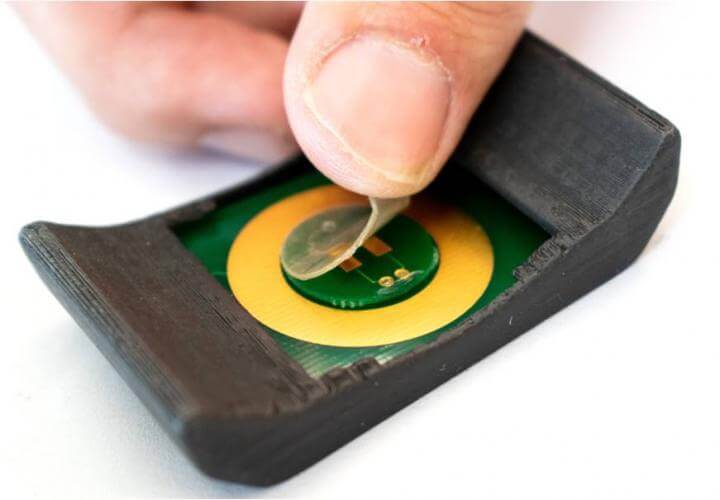
The skin-touching side of the film collects and analyzes the chemical makeup of droplets of sweat. The watch-facing side turns those chemicals signals into electrical ones that can be read, processed and then displayed on the smartwatch. (Photo credit: Yichao Zhao/UCLA)
LOS ANGELES – Smartwatches are powerful devices. They can record our heart rate, track how far we’ve walked, and tell us how well we slept. Some models can even record blood pressure. Now, scientists at UCLA have developed an adhesive film that allows our smartwatches to tell us how well our body’s metabolism is working.
The adhesive film is double-sided and can be placed on the underside of a smartwatch. The side of the film that touches the skin records the amount of metabolism-related chemicals present in sweat droplets. Then, the opposite side of the film transmits this information to the watch. The data is then displayed on the smartwatch or using an app on a smartphone.
Smartwatch detects glucose, lactate levels
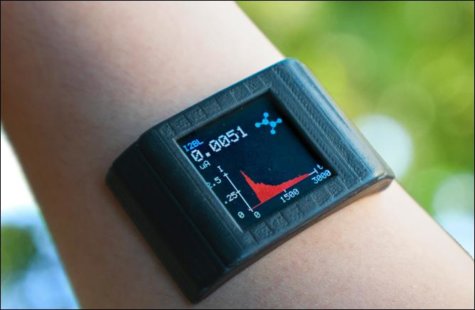
To test the new technology, scientists recorded the levels of two metabolism-related chemicals, glucose and lactate, in different conditions. Glucose levels (more commonly known as blood sugar levels) normally vary throughout the day. They tend to be lowest right before a meal and then increase after eating. Therefore, the researchers recorded glucose levels before and after dinner. As expected, the film recorded low glucose levels before dinner and high glucose levels after dinner.
Lactate, more commonly known as lactic acid, is a chemical produced by muscles and red blood cells. Normally, lactate levels in the body are low, but levels increase under conditions of low oxygen. During strenuous exercise, for example, our muscles require more oxygen than our bodies can typically deliver, resulting in the production of lactic acid.
Accordingly, the researchers tested lactate levels under three different activity conditions: during no activity (sedentary), mild activity (while doing office work), and vigorous activity (strenuous exercise). As expected, the film recorded low lactate levels during inactivity and high lactate levels during strenuous exercise.
Based on their experiments, the researchers conclude that the film can accurately detect levels of both glucose and lactate. Moreover, they found that the film was sticky enough to adhere to the watch and skin for the entire day – even without the need for a watch strap.
Helpful for those with chronic disease
While the new technology could be useful for everyone, it is particularly promising for people with serious health conditions. For people with diabetes, for example, high glucose levels can be life-threatening and monitoring glucose levels is important for staying healthy. Similarly, people with heart disease often have reduced blood and oxygen flow throughout the body. As a result, lactate levels can be a helpful way to monitor heart function.
“We are particularly excited about our technology because by transforming our smartwatches and wearable tech into biomonitoring platforms, we could capture multidimensional, longitudinal and physiologically relevant datasets at an unprecedented scale, basically across hundreds of millions of people,” boasts lead researcher Sam Emaminejad in a release. “This thin sensing film that works with a watch shows such a path forward.”
The study is published in the journal Science Advances.
[fb_follow /]


